

Language :

Language :

Yolatech attended the 16th Epoxy Resin Conference in Shanghai on 20 and 21 October 2026. It ran over two days at the Fuyue Hotel in Songjiang, with eight parallel sessions on electronic resin, phenolic resin and flame retardants, nine venues in total. The epoxy track carried all twenty-one papers.
The full title is the 16th Epoxy Resin High-end Application Technology Exchange Conference. It is organised by Beijing Guohua New Material Technology Research Institute, with the ACMI Epoxy Resin Institute as organising institute and Guangdong Guyan Electronic Materials as co-organiser. The delegate guide lists the small and medium enterprise committee of the China Petroleum and Chemical Industry Federation as supervising body.
The programme opened with a plenary session of seven papers on automotive interiors, bonding and photoresist resins. The epoxy track then ran in three blocks: electronic and electrical parts, pressure vessels, pipes and cylinders, and structural adhesives. Registration took place on 19 October, with the exhibition area on the third floor landing.
| Table 1. The 16th Epoxy Resin Conference at a glance | |
| Item | Detail |
| Meeting | 16th Epoxy Resin High-end Application Technology Exchange Conference |
| Dates | 20 and 21 October 2026, registration on 19 October |
| Venue | Fuyue Hotel, Songjiang, Shanghai |
| Supervising body | SME committee, China Petroleum and Chemical Industry Federation |
| Host | Beijing Guohua New Material Technology Research Institute |
| Organising institute | ACMI Epoxy Resin Institute |
| Co-organiser | Guangdong Guyan Electronic Materials |
| Programme | One plenary session and eight parallel forums in nine venues |
| Epoxy track | Three half-day blocks, twenty-one papers |
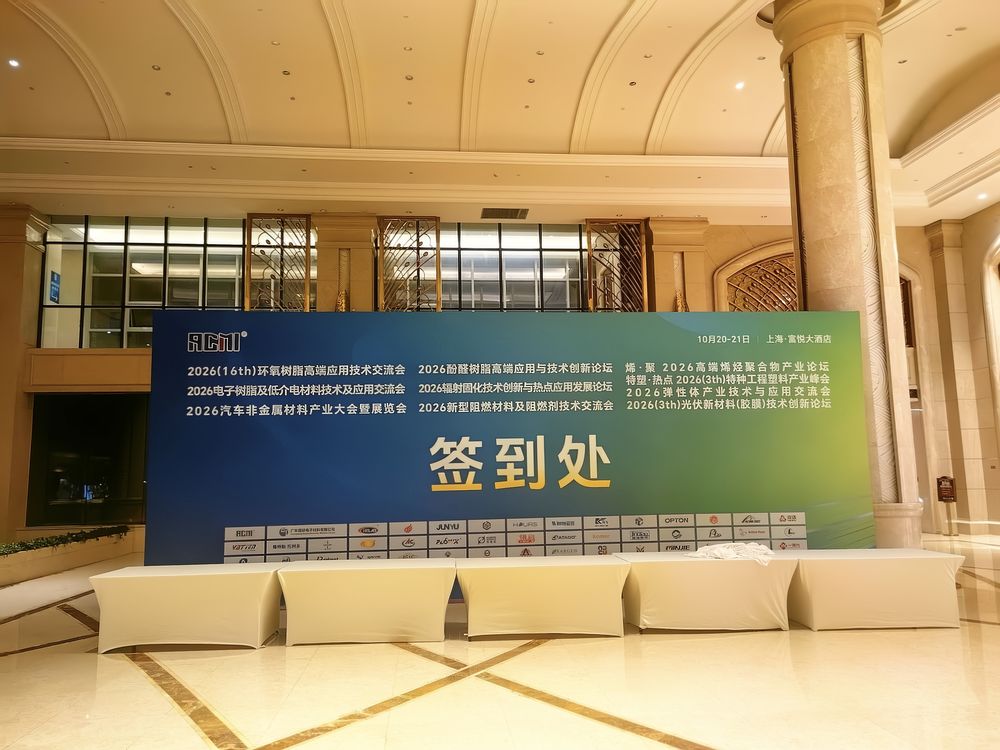
Figure 1. The sign-in backdrop at the Fuyue Hotel on 20 October 2026, carrying the titles of all nine venues.
|
The electronic and electrical block carried the papers closest to packaging work. Wu Guangpeng of Zhejiang University presented halide-free epoxy next to a high-sensitivity EUV photoresist resin; Zhou Fusheng of the China Southern Power Grid research institute weighed degradable epoxy for electrical equipment against its industrial outlook; Liang Liyan of the Guangzhou Institute of Chemistry measured polyphenol active-ester curing against dielectric loss; Fei Xiaoma of Wuxi Chuangda reviewed moulding compounds for semiconductor packages.
Pressure vessels filled the second block. Wu Zhanjun of Dalian University of Technology designed a carbon fibre reinforced epoxy tank for liquid hydrogen, Qiao Kun of Shandong University reported a 1,500 L vehicle-mounted LNG cylinder, and Xu Jiazhong of Harbin University of Science and Technology took type IV vessels through production. Li Houbu of CNPC's engineering materials institute set out where thermosets stand in oil and gas composite equipment and what that market now asks for.
Structural adhesives closed the track on the second afternoon. Ye Fen of Tongji University covered bridge deck paving, Zhu Jun of Beijing Gaomeng the adhesive duty inside power battery packs, Wei Peixin of CRRC Nanjing Puzhen rail vehicle assembly, and Yin Hao of Jiangsu Sobute repair work in bridges and tunnels.
| Table 2. Conference threads mapped to our product lines | ||
| Conference thread | What it decides in a formulation | Where it maps in our range |
| Halide-free resin for packaging and photoresist | Ionic purity, colour and dielectric loss | Liquid BPA epoxy with a published chlorine limit |
| Composite pressure vessels and pipes | Infusion viscosity, glass transition, fatigue life | Resin and hardener pairs for filament winding |
| Structural adhesive for battery and rail | Adhesion through thermal cycling, pot life | Polyetheramine D-230 for room-temperature cure |
| Low dielectric laminate for high-speed PCB | Dk, Df and hydrolyzable chlorine | Solid BPA epoxy for prepreg and laminate |
| Phosphorus flame retardancy | Phosphorus content, char yield, smoke density | Phenolic epoxy with intrinsic char |
A low dielectric forum ran in parallel for the full two days, seventeen papers in three sessions. Yu Xinhai of Donghua University tied high-speed PCB resin to AI server boards, Ran Qichao of Sichuan University presented low dielectric benzoxazine, Wu Zhimin of Zhejiang Sci-Tech University covered dihydroxy polyphenylene oxide, and Gao Jingmin of the Ningbo Institute of Materials Technology took LCP film through its key process steps.
Those papers press on ionic content rather than viscosity. A resin that carries hydrolyzable chlorine into a high-frequency laminate moves dielectric loss and copper adhesion at once, so an electronic grade is bought against a chlorine ceiling. Our liquid bisphenol A epoxy resin is published with that limit per grade and ships with a COA on each batch. Phosphorus flame retardancy, the other thread running through the hall, follows the same logic on the phenolic epoxy resin side.
The two days reduce to a short list of decisions: which epoxide equivalent a casting or laminate needs, which hardener holds a joint through thermal cycling, how much diluent a filled system tolerates before toughness pays for the viscosity drop. Send a target EEW, AHEW or viscosity and a sample follows the nearest production grade. The modified amine curing agents page quotes AHEW per grade; the reactive diluent page quotes EEW and viscosity.
Application notes for the three sectors that dominated the programme sit on our pages for electrical and electronic parts, composites and adhesives, each with grade tables and the test method behind every figure.

 IPv6 network supported