Allyl Glycidyl Ether: Silane Intermediate, Not the C12–14 Diluent
Nov 26, 2026
Allyl glycidyl ether is a 114.1 g/eq monoepoxide, CAS 106-92-3, whose allyl bond drives platinum-catalysed hydrosilylation to 3-glycidoxypropyltrimethoxysilane. It is not the C12–14 alkyl glycidyl ether sold as AGE diluent, CAS 68609-97-2. One tonne of the allyl grade returns 2.07 t of crude silane.
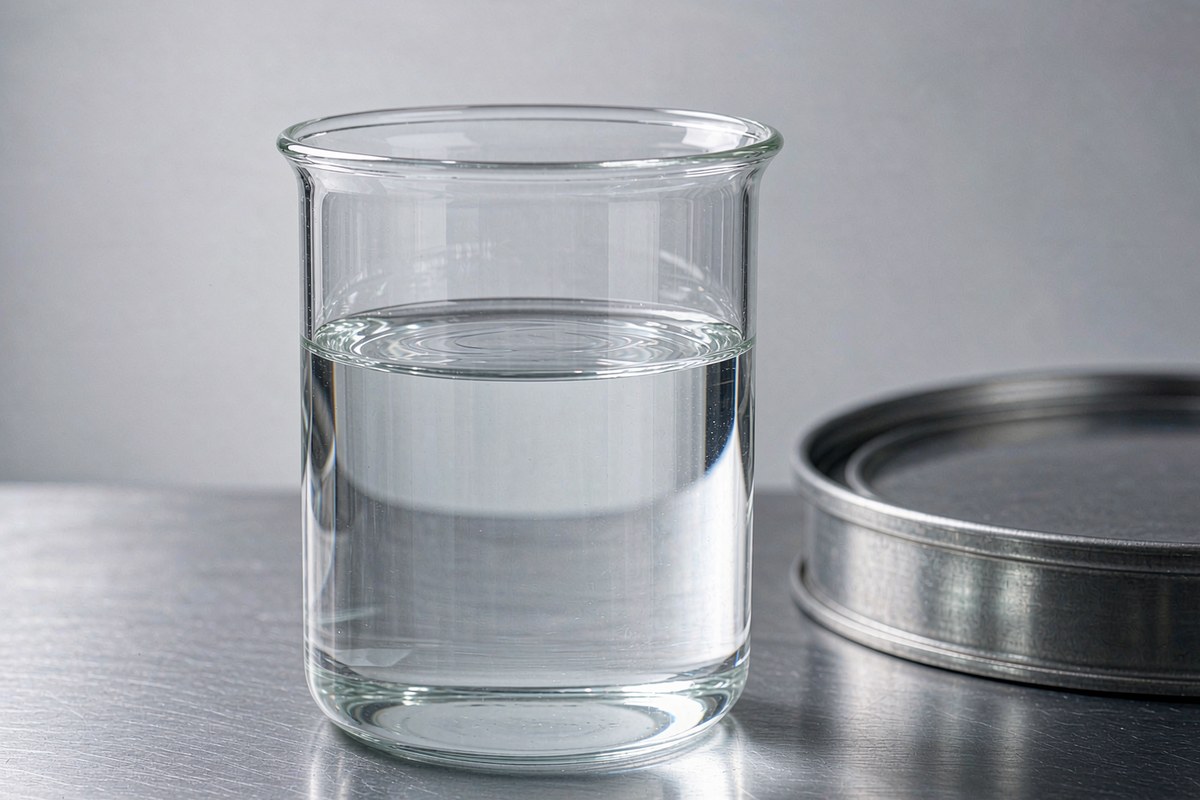
Figure 1. YLD-9005 is water-white and thin at 1-7 mPa·s; the low flash point, not the colour, sets the drum rules.
1. Introduction
Two substances trade under one acronym, and the mix-up surfaces after a failed trial rather than at the quotation.
In Chinese trade, AGE normally means the C12–14 alkyl glycidyl ether: a 4-12 mPa·s diluent for flooring, castings and adhesives. The allyl isomer, CAS 106-92-3, is a different molecule with a different job.
That job is hydrosilylation: most merchant volume leaves the plant as epoxy silane, which ties a resin to glass, silica or hydrated metal.
This note separates the two, works the silane stoichiometry, then keeps the diluent arithmetic at 5-20 phr.
2. Materials and Methods: Identifying Allyl Glycidyl Ether and Its Namesake
2.1 Product identification and specification
YLD-9005 is the allyl grade: C6H10O2 at 114.14 g/mol, one epoxide and one allyl bond per molecule, listed on the YLD-9005 product page at CAS 106-92-3.
Table 1. Identification data for YLD-9005, from the product page.
Item
Information
Grade
YLD-9005
Chemical name
Allyl glycidyl ether, 1-allyloxy-2,3-epoxypropane
CAS No.
106-92-3
Formula, molecular weight
C6H10O2, 114.14 g/mol
Reactive groups
One epoxide, one allyl double bond
One row decides the silane route: hydrolyzable chloride at 0.2%, which is 2,000 ppm on the drum.
Table 2. Specification of YLD-9005 for the allyl grade.
Parameter
Specification
Appearance
Transparent liquid
Colour, APHA
Max. 20
Viscosity at 25 °C, mPa·s
1-7
EEW, g/eq
112-118
Hydrolyzable chloride, %
Max. 0.2
Inorganic chlorine, mg/kg
Max. 20
Water, %
Max. 0.1
2.2 Test methods and data sources
Every figure comes from the product page, the 2026 catalogue or arithmetic; nothing was titrated in house.
Epoxy content is determined according to ASTM D1652, with ISO 3001 as the equivalent route; duplicates within 2 g/eq make a workable rule.
Viscosity is dynamic at 25 °C, so ASTM D445, a kinematic method, does not apply; a rotational spindle is the practical check.
Yields in Table 3 are calculated, not measured, so 92% is a planning figure.
3. Results and Discussion: Stoichiometry of the Silane Route
3.1 Mass balance of the hydrosilylation step
One mole of AGE takes one mole of trimethoxysilane, and the masses close to within 0.02 g/mol, which is the arithmetic check that the route is understood.
The addition is anti-Markovnikov: silicon lands on the terminal carbon, leaving a three-carbon bridge to the silane.
Table 3. Molar and mass balance for 3-glycidoxypropyltrimethoxysilane from YLD-9005, full conversion.
Species
MW, g/mol
kg per t AGE
mol per t
Allyl glycidyl ether
114.14
1,000
8,761
Trimethoxysilane
122.22
1,071
8,761
3-glycidoxypropyltrimethoxysilane
236.34
2,071
8,761
At full conversion a tonne of AGE returns 2,071 kg of crude silane; at 92% yield, 1,905 kg, and the gap is what distillation costs.
Chloride, not yield, sets the grade a plant will accept: 2,000 ppm on a tonne is 2 kg against roughly 20 g of platinum at a 10 ppm charge.
Halide and sulfur species are recognised poisons for hydrosilylation catalysts, so a low-chlorine grade earns its premium wherever the loading is tight.
If a supplier quotes 99% purity with no chloride figure, the number that decides the run is missing.
3.2 Two substances share the acronym
Table 4 lines the two AGEs up on the rows that decide a purchase; the flash point alone settles most enquiries.
Table 4. Allyl glycidyl ether against the C12–14 alkyl glycidyl ether sold as AGE diluent; site data for both grades.
Property
Allyl AGE, YLD-9005
Alkyl C12–14 AGE, YLD-7003
CAS No.
106-92-3
68609-97-2
EEW, g/eq
112-118
290-315
Viscosity at 25 °C, mPa·s
1-7
4-12
Flash point, °C
48.5 closed cup
above 110
Water solubility
14.1% by weight
negligible
Second reactive group
allyl double bond
none
Main outlet
epoxy silane intermediate
reactive diluent
Typical dose as diluent
5-15 phr
15-30 phr
At 20 phr in a resin of EEW 187, the allyl grade needs 59.2 phr of an AHEW 100 hardener; the C12–14 grade 50.1 phr.
Chain ends explain the gap: 20 phr of the allyl grade contributes 0.175 eq per 100 g against 0.066 eq for the long-chain grade.
At 30 phr the C12–14 grade still adds 43% fewer chain ends than 20 phr of the allyl grade.
Flash point is the commercial separator: 48.5 °C closed cup against above 110 °C, which decides drum-store rules and freight class.
In practice, an enquiry for AGE diluent from a flooring formulator means YLD-7003; answering it with the allyl grade ends in a failed trial.
4. Formulation and Dosage Calculation: phr Only When It Serves as a Diluent
4.1 Blend EEW and hardener demand
Hardener follows the blend, not the resin: blend EEW = (100 + p) ÷ (100 ÷ EEW resin + p ÷ EEW diluent), then phr = 100 × AHEW ÷ blend EEW.
At 20 phr in EEW 187 the blend lands at 169.0 g/eq, so YLH-3023 at AHEW 100 moves from 53.5 to 59.2 phr.
Table 5. Dosage arithmetic for YLD-9005 in YLE-128 at EEW 187 with a hardener of AHEW 100.
YLD-9005, phr
Blend EEW, g/eq
Hardener at AHEW 100, phr
Chain ends, % of eq
0
187.0
53.5
0
5
181.5
55.1
7.6
10
176.7
56.6
14.1
20
169.0
59.2
24.7
30
162.9
61.4
33.0
That band is why every lot gets its own titration.
5. Processing Notes and Operating Window
Dosing order matters more than mixer speed: diluent into resin, blend, then hardener, or the thin diluent pools in the bottom third.
Start at 5-10 phr; the viscosity gain flattens above 20 phr while cost keeps rising.
Keep resin and diluent within 3 °C, or viscosity drifts between batches.
If EEW is not titrated per lot, never carry a phr across drums.
Reseal within minutes: at 14.1% water solubility, AGE takes up moisture faster than a bisphenol A resin.
Bond and ground drums on transfer; 48.5 °C sits inside flammable-liquid rules.
Figure 2. Weighing the charge before the hardener keeps stoichiometry traceable on a 20 kg batch, where a 5 phr error is 1 kg.
Pot life moves the wrong way: at 20 phr the blend carries 5.92 epoxide equivalents per kg against 5.35 undiluted.
A hardener quoted at 30 minutes for 100 g will not hold once diluted; a 5 kg casting is where short pot life scorches.
6. Applications: One Main Outlet and Two Minor Ones
One outlet takes most of the volume and the other two are small, so treating them as equal misreads the grade.
6.1 Epoxy silane intermediate
YLD-9005 exists commercially because of the silane route: 1.07 t of trimethoxysilane per tonne of AGE, one platinum charge, 2.07 t of crude product out.
The silane carries an epoxide for the resin and a methoxysilyl group for glass or silica, which is what holds a composite together in boiling water.
The failure point is feed quality, not dose: chloride, inhibitor and free allyl alcohol each cost yield before the reactor reaches temperature.
If a batch gels early or darkens in the pot, read the chloride figure on the incoming COA before blaming the catalyst.
6.2 Acrylate monomers and thiol-ene crosslinkers
The allyl copolymerises with acrylates and styrene, which is how epoxy-functional monomers for UV and dual-cure coatings are built at 20-100 phr.
A thiol adds across the allyl under UV without touching the epoxide, one to one, and a 10% shortfall leaves a tack that no post-bake removes.
6.3 Reactive diluent in amine-cured epoxy
In an amine cure the allyl is dead weight: it caps one chain and waits, so 5-15 phr is the practical window.
Above 20 phr a quarter of the epoxide equivalents are chain ends, and a thin clear film can yellow.
Table 6. Application map for YLD-9005, ordered by volume; the dose is set by the failure point.
Application
Dose
Function
Failure point
Epoxy silane intermediate
1:1 molar
Allyl handle for Si-H
Chloride, Pt poisoning
Acrylate monomer
20-100 phr
Radical copolymerisation
Inhibitor, oxygen
Thiol-ene crosslinker
1:1 on thiol
Orthogonal second cure
Thiol shortfall, tack
Reactive diluent
5-15 phr
Viscosity drop
Chain ends, yellowing
Figure 3. A clear film is the hardest colour test for any diluent; APHA 20 adds no visible tint, but an unreacted allyl can still yellow.
7. Limitations and Material Verification
7.1 Known limits and unsuitable duties
The first limit is commercial rather than chemical: if the duty is thinning an amine-cured system, the C12–14 product is the right grade.
Then the chemistry: 2,000 ppm chloride rules out high-impedance electronics, the monofunctional structure rules out thick load-bearing sections, and the allyl group rules out clear exterior films.
The fourth is lot spread, not a conflict: EEW 112-118 is a 5% band, which at 20 phr moves hardener demand from 58.7 to 59.4 phr. That 0.7 phr gap fits a mix tolerance but not a 20 kg batch weighed to 10 g, so titrate each lot.
Take phr from the COA, not this table: the formula weight, 114.1, sits inside 112-118, and a titre outside that band means the wrong grade.
No HDT, Tg or dielectric data is published for YLD-9005 and none is claimed here.
7.2 Incoming inspection, packaging and storage
Incoming inspection is short: colour against APHA 20, water by Karl Fischer, a duplicate EEW titration and a chloride figure on the first drum.
Store below 30 °C, away from acids and bases, since either opens the epoxide; the drum keeps 12 months unopened.
AGE is a flammable liquid with a flash point below 61 °C, so transfer needs bonding and grounding.
Nothing here replaces the TDS, MSDS or COA shipped with the drum.
8. Frequently Asked Questions
Is allyl glycidyl ether the same as the AGE diluent sold in China?
No. The diluent traded as AGE is the C12–14 alkyl glycidyl ether, CAS 68609-97-2, at EEW 290-315. YLD-9005 is CAS 106-92-3, a different molecule, and BGE YLD-9004A is a third.
What is allyl glycidyl ether used for?
Most of it goes into epoxy silane, made by platinum-catalysed hydrosilylation with trimethoxysilane. Smaller volumes go to epoxy acrylates, thiol-ene and diluent use.
How much silane does one tonne of AGE make?
2,071 kg at full conversion, from 1,071 kg of trimethoxysilane. At 92% yield the drum returns 1,905 kg.
Why does chloride matter more here than in a coating?
Because the catalyst is platinum at ppm level: 2 kg of chloride per tonne against roughly 20 g of platinum, and halide species poison that catalyst.
Can YLD-9005 replace YLD-7003 in a flooring formula?
It thins better but costs more hardener and carries a flammable flash point: 59.2 phr against 50.1 phr for the C12–14 grade, both at 20 phr and AHEW 100.
Does the allyl group react during an amine cure?
No. Amine hardeners open the epoxide only, so the allyl stays pendant for hydrosilylation, thiol-ene or radical cure.
9. Conclusions
Allyl glycidyl ether is an intermediate first: a tonne yields 2,071 kg of crude silane, and chloride rather than yield decides which grade a plant accepts.
As a diluent it works at 5-15 phr and costs 5.7 phr of extra hardener at 20 phr, where a quarter of the epoxide equivalents become chain ends.
For thinning alone the C12–14 grade is the cheaper answer on flash point and stoichiometry, so check the CAS before quoting either one.
10. References
1. Yolatech product page, Allyl glycidyl ether YLD-9005 (CAS 106-92-3): https://www.yolatech.com/allyl-glycidyl-ether-yld-9005 (accessed 2026-11-26).
2. Yolatech product page, Alkyl (C12-C14) glycidyl ether YLD-7003 (CAS 68609-97-2): https://www.yolatech.com/alkyl-c12-c14-glycidyl-ether-yld-7003 (accessed 2026-11-26).
3. Yolatech Technical Data Sheet, Material Safety Data Sheet and Certificate of Analysis for YLD-9005, CAS 106-92-3 (available on request).
4. ASTM D1652, epoxy content of epoxy resins (EEW).
5. ISO 3001, determination of epoxy equivalent.
6. ASTM D445, kinematic viscosity.
7. ASTM E203, water content by Karl Fischer titration.
8. ISO 3679, flash point by rapid equilibrium closed cup.
Read More






 IPv6 network supported