


Language :

Language :
PACM epoxy curing agent is a colourless alicyclic diamine, 4,4'-diaminodicyclohexyl methane (CAS 1761-71-3), sold at 50-80 mPa·s and APHA 30 or below. Four amine hydrogens on a 210.36 g/mol molecule give a calculated AHEW of 52.6 g/eq, which puts YLE-128 at 28.1 phr. Specification and dosage follow.
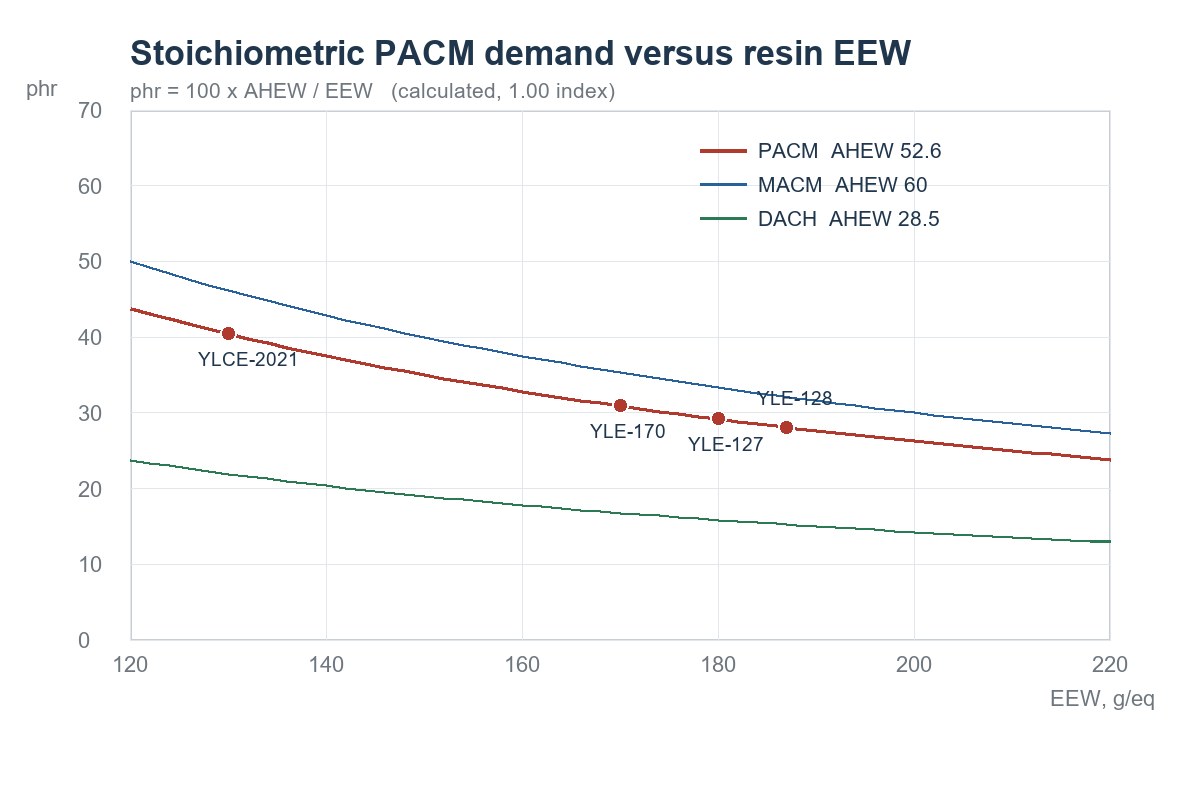
Figure 1. Calculated demand for PACM (52.6 g/eq), MACM (60 g/eq) and DACH (28.5 g/eq) across 120-220 g/eq; marked points are the grades in Table 4.
Alicyclic diamine hardeners suit coatings that must stay hard and stay light in colour but cannot take the short pot life of diethylenetriamine. PACM is the unsubstituted member of that family: two cyclohexane rings joined by a methylene bridge, each carrying one primary amine.
Its published specification is five lines and one CAS number, with viscosity at 50-80 mPa·s at 25 °C. Melting point, flash point and density are not on the page, so they are left out here rather than filled from memory.
Three sources feed the numbers: the PACM product page, three comparable alicyclic diamines from the same catalogue, and stoichiometry.
One CAS number and four lines pin the identity down.
Table 1 lists the identifiers that belong on a purchase order and on the COA review sheet.
Table 1. Product identification of PACM; values marked calculated come from molecular structure, not from the product page.
Item |
Information |
Trade designation |
PACM |
Chemical name |
4,4'-Diaminodicyclohexyl methane |
CAS No. |
1761-71-3 |
Molecular formula (calculated) |
C13H26N2 |
Molecular weight (calculated) |
210.36 g/mol |
Amine hydrogen equivalent weight (calculated) |
52.6 g/eq from four active hydrogens |
Appearance |
Colourless or slightly yellow transparent liquid, packed in drums |
Table 2 repeats the five published limits beside the test basis a laboratory would normally apply to each.
Table 2. Published specification of PACM with the corresponding test method.
Item |
Published limit |
Test basis |
Appearance |
Colourless liquid, no suspended matter |
visual, per current TDS |
Colour |
APHA 30 maximum |
ASTM D1544 |
Viscosity at 25 °C |
50-80 mPa·s |
ASTM D445 |
Purity |
99.0% minimum |
supplier method |
Water |
0.20% maximum |
ASTM E203 |
Resin epoxy equivalent weight is determined by titration according to ASTM D1652, with ISO 3001 as the alternative route. Colour is read according to ASTM D1544 against the Gardner scale, viscosity according to ASTM D445 at 25 °C.
Water moves first after a drum is opened, so it is measured by Karl Fischer titration according to ASTM E203 on duplicate portions, reported as the mean of n = 3.
Amine hydrogen equivalent weight is not printed on the product page. It follows from molecular weight divided by active hydrogens: 210.36 ÷ 4 = 52.59 g/eq.
That arithmetic reproduces two published values on the same catalogue, 60 g/eq for MACM and 28.5 g/eq for DACH, to within 1%, which is why 52.6 g/eq is used in every dosage table here.
Ring geometry, not molecular weight, separates PACM from the linear aliphatic amines.
Both amines sit on a cyclohexane ring, making them primary amines on secondary carbons. Steric hindrance there slows the addition to an epoxide, so a PACM mix stays workable longer than a DETA mix of the same equivalent weight.
Crosslink density moves the other way. At 52.6 g/eq with four hydrogens, PACM creates more network junctions per 100 g of resin than a 60 g/eq hardener, and the rigid ring lifts hardness and heat deflection without aromatic structure.
Colour holds because no aromatic chromophore is present to yellow under UV, although the surface stays a primary amine that reacts with carbon dioxide.
Table 3 sets the PACM epoxy curing agent beside three alicyclic diamines from the same catalogue, on the lines that decide a formulation.
Table 3. Published properties of four alicyclic diamine hardeners; calculated AHEW values follow the method in section 2.2.
Property |
PACM |
MACM |
DACH |
1,3-BAC |
CAS No. |
1761-71-3 |
6864-37-5 |
694-83-7 |
2579-20-6 |
Ring substitution |
none |
two methyl |
none |
aminomethyl arms |
Colour, APHA |
30 max |
30 max |
30 max |
not published |
Viscosity, 25 °C |
50-80 mPa·s |
80-120 mPa·s |
not published |
not published |
Water |
0.20% max |
not published |
0.3% max |
0.3% max |
AHEW |
52.6 g/eq |
60 g/eq |
28.5 g/eq |
35.6 g/eq |
Dosage tracks the equivalent weight almost linearly. On a 187 g/eq bisphenol A resin, DACH needs 15.2 phr, 1,3-BAC 19.0 phr, PACM 28.1 phr and MACM 32.1 phr at the same stoichiometry.
Viscosity is where the grade earns its place: 50-80 mPa·s carries more filler and less solvent than MACM at 80-120 mPa·s, which decides whether a high-solids primer stays under a VOC ceiling.
Speed is the trade-off: DACH reacts fast at 28.5 g/eq and suits thin films in a cold shop, but rules itself out of a 3 mm casting.
Dosage comes from one equation: phr = 100 × AHEW ÷ EEW, with 52.6 g/eq for PACM and the EEW of the resin actually in the pot.
Table 4 applies it to four resins at full and 0.90 stoichiometry.
Table 4. Calculated PACM demand in phr for four Yolatech resins, at 1.00 and 0.90 stoichiometric index.
Resin |
EEW, g/eq |
Dosage at 1.00 index, phr |
Dosage at 0.90 index, phr |
125-135 |
39.0-42.1 |
35.1-37.9 |
|
160-180 |
29.2-32.9 |
26.3-29.6 |
|
176-184 |
28.6-29.9 |
25.7-26.9 |
|
YLE-128 |
184-190 |
27.7-28.6 |
24.9-25.7 |
A 0.90 index leaves about a tenth of the epoxide unreacted. In practice most ambient-cure coatings run there, because a slight amine excess tolerates surface moisture and carbon dioxide better than an exact ratio.
Below 0.85 the film stays soft and chemical resistance drops; above 1.05 the surplus amine plasticises the network and pushes colour up. Neither end recovers with longer curing, so verify the index before scaling up.
The same equivalent weight serves polyurethane work: against an isocyanate equivalent of 42.02 g/eq, 100 g of NCO groups consume 125.2 g of PACM.
Four settings decide whether a PACM system behaves in the plant the way it did in the laboratory.
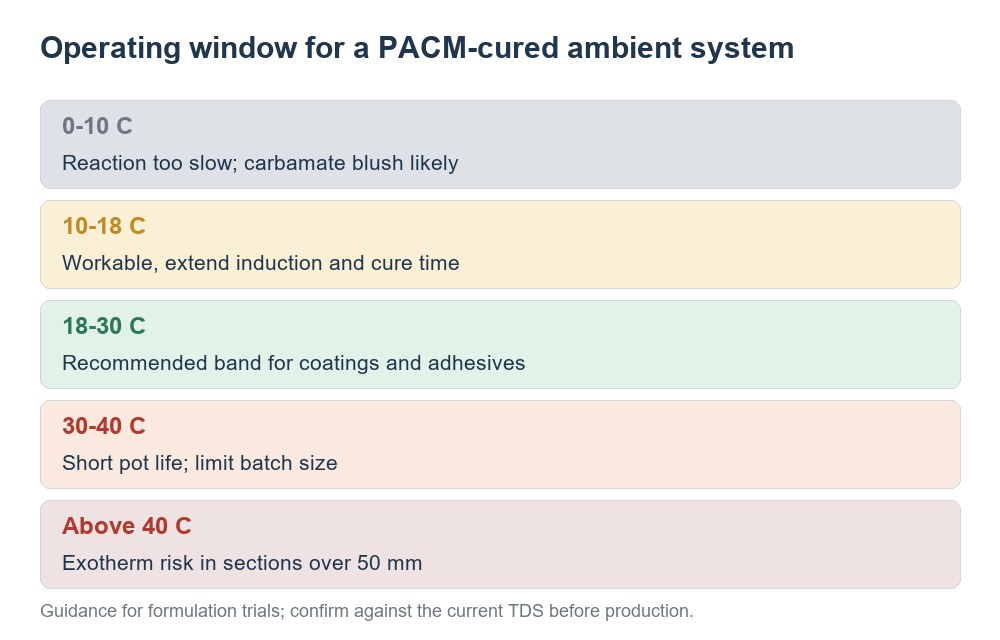
Figure 2. Temperature bands for a PACM-cured ambient system; the 18-30 °C band holds both the published viscosity and a 24-hour cure.
Batch size is the practical control on exotherm. Five kilograms in a thin tray is safe at 25 °C; the same five kilograms in a 20 cm drum will gel in the pot.
Five roles appear on the product page. Typically coatings is trialled first.
Table 5. Application roles of PACM and the property that carries each one.
Segment |
Function of PACM |
Typical level |
What decides success |
Protective coatings |
curing agent |
27-29 phr |
blush resistance, hardness |
Adhesives |
curing agent |
28-31 phr |
colour, bond-line rigidity |
Composites |
curing agent |
28-41 phr |
wet-out viscosity, pot life |
Saturated polyurethane |
chain extender |
125 g per 100 g NCO |
urea segment regularity |
Polyamide hardeners |
amine intermediate |
set by the adduct |
amine value of the adduct |
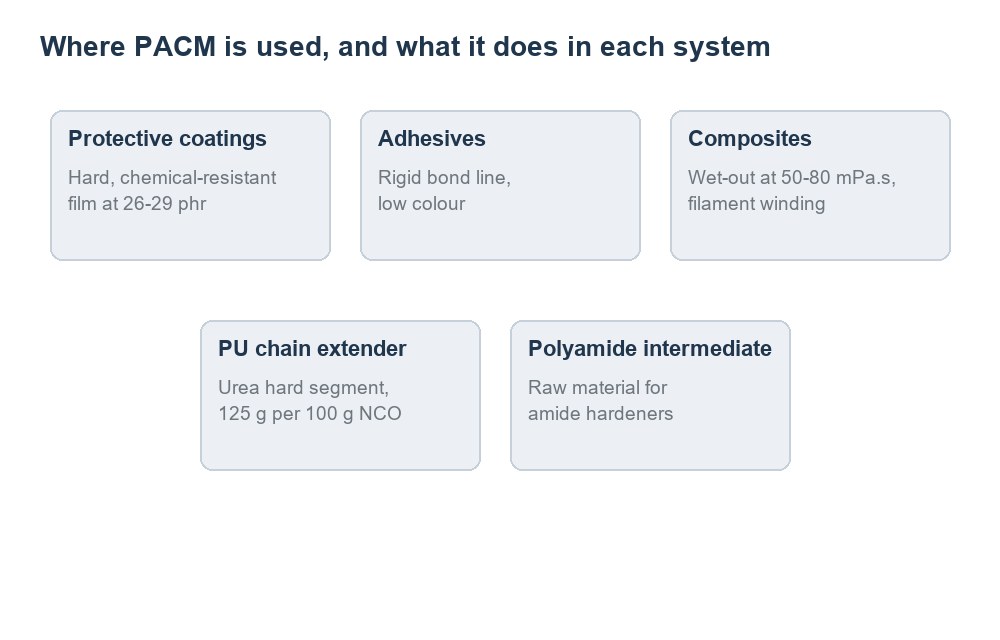
Figure 3. The five roles listed on the product page, with the property that governs each.
Filament winding is the composite case worth checking first, because 50-80 mPa·s wets out roving without solvent yet stays in the bath. For polyamide intermediates the grade is a building block, not a hardener, so the amine value of the finished adduct sets the dosage.
Three limits appear in the first month of use, and none is solved by adding more hardener.
No ring methyl groups means the unmethylated alicyclic diamines are the ones that thicken or crystallise in an unheated store. The page publishes no melting point, so the pour point has to come from the COA of the lot before a winter shipment.
Cold curing is not its strength. At 10 °C a film still cures, but the surface stays tacky far longer than a DACH or DETA film, and dust becomes the limiting factor.
Sections above roughly 50 mm need a slower hardener or a staged ramp; this one alone will crack from exotherm. Food contact, potable water and medical use fall outside the published data, with no migration testing listed.
A receiving check needs four numbers: APHA colour, viscosity at 25 °C, water by Karl Fischer and purity by the supplier method. Anything outside Table 2 goes back before the drum reaches production. Purity at 99.0% leaves up to 1% of other amines and water, enough to shift colour and pot life between lots.
Material ships in drums and keeps at least 12 months from manufacture in the original packing at ambient. Keep the cap closed, away from flame and sunlight, and blanket part-used drums with dry nitrogen. Check with the supplier before blending lots of different dates.
The liquid is alkaline and attacks copper alloys, so gloves, goggles and local exhaust are the minimum; the MSDS governs. RoHS and REACH declarations are issued per shipment on request, and nothing here certifies the grade.
It is 52.6 g/eq: 210.36 g/mol divided by four active hydrogens. The page does not print it; the result matches the published 60 g/eq of MACM and 28.5 g/eq of DACH.
YLE-128 at 184-190 g/eq takes 27.7-28.6 phr at full stoichiometry, or 24.9-25.7 phr at a 0.90 index. The exact figure depends on the lot EEW, so the COA value belongs in the formula.
No. PACM is unsubstituted at CAS 1761-71-3, AHEW 52.6 g/eq and 50-80 mPa·s; MACM carries two ring methyl groups at CAS 6864-37-5, AHEW 60 g/eq and 80-120 mPa·s. They are not interchangeable by weight.
Primary amines react with carbon dioxide and water to form carbamates at the surface. The reaction runs fastest below 15 °C and above 70% relative humidity, and the haze cannot be washed off with solvent.
Yes. It reacts with isocyanate to build a urea segment, and 100 g of NCO groups take 125.2 g of PACM. Reactivity is high, so prepolymer processes suit it better than one-shot systems.
No gel time is published, and none can be calculated from AHEW. Run a 100 g cup test at shop temperature; treat any quoted figure, ours included, as a starting point.
Light colour, 50-80 mPa·s and a calculated AHEW of 52.6 g/eq put dosage at 27.7-28.6 phr on YLE-128. The value sits in hardness and colour retention at high solids, not cure speed, so DACH stays faster and MACM more storage-tolerant.
Two numbers decide most formulations: resin EEW and the index between 0.90 and 1.00. Both can be measured before the drum is opened.
1. Yolatech product page, PACM (CAS 1761-71-3), https://www.yolatech.com/44-diaminodicyclohexyl-methane-pacm-cas-1761-71-3 (accessed 2026-10-23).
2. Yolatech technical data sheet for PACM, specification and pack size (available on request).
3. Yolatech material safety data sheet for PACM, CAS 1761-71-3 (available on request).
4. ASTM D1652, epoxy content of epoxy resins (EEW).
5. ISO 3001, determination of epoxy equivalent.
6. ISO 9702, amine group nitrogen content of amine epoxide hardeners.
7. ASTM D445, kinematic viscosity.
8. ASTM D1544, Gardner color of transparent liquids.
9. ASTM E203, water content by Karl Fischer titration.

 IPv6 network supported