


Language :

Language :
Waterborne epoxy hardener is an amine adduct carried in water instead of solvent. Across the 14 YLH-W grades, AHEW spans 73-300 g/eq, so the hardener mass at a fixed 100 µm film moves from 32 to 70 g/m2. Dosing from the amine value instead under-doses by up to 82%. Water costs dwell time, not money.
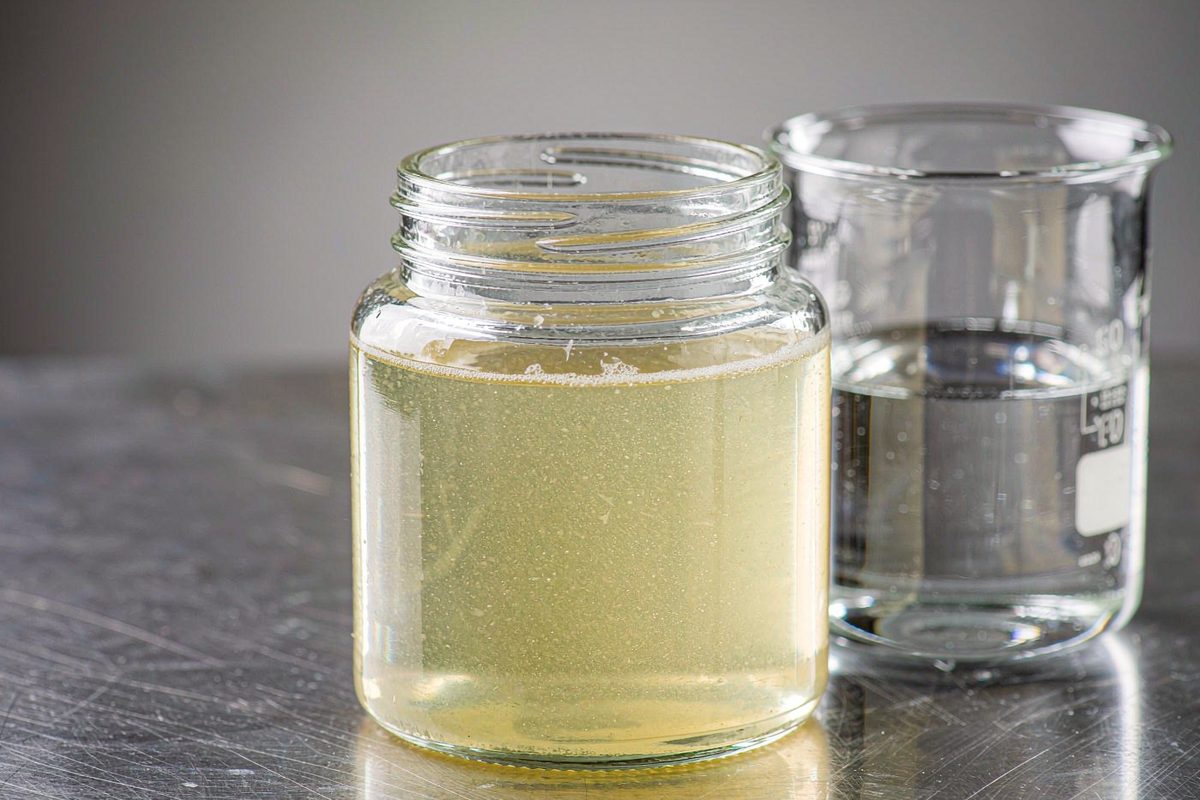
Figure 1. A waterborne amine hardener is a hazy liquid; the beaker beside it is the whole solvent load.
Water is excluded from the VOC figure by definition, so a waterborne coating sells as low-VOC while still carrying an amine. The hardener is part of that package, and the part most often dosed from the wrong number.
Fourteen grades sit in the YLH-W range, from AHEW 73 g/eq to 300 g/eq. Every figure comes from the 2026 Yolatech catalog and its product pages.
The YLH-W series is a set of waterborne amine hardeners, supplied as aqueous adducts for two-pack systems where water is the only carrier.
Table 1 lists the range as printed on catalog page 14; AHEW spreads over a factor of four.
Table 1. Waterborne amine hardeners, YLH-W series, from the 2026 Yolatech catalog, page 14.
Grade |
AHEW, g/eq |
Amine value, mg KOH/g |
Viscosity, mPa·s |
phr |
Pot life, min |
YLH-1002W |
284 |
150-190 |
8,000-12,000 |
145 |
60 |
YLH-1003W |
300 |
150-190 |
25,000-45,000 |
140-180 |
60 |
YLH-1005W |
120 |
250-300 |
6,000-13,000 |
60 |
60-120 |
YLH-1006W |
151 |
185-225 |
12,000-25,000 |
77 |
90 |
YLH-1007W |
73 |
380-420 |
80,000-150,000 |
35-40 |
120 |
YLH-1008W |
240 |
150-180 |
100-400 |
125 |
70 |
YLH-1009W |
145 |
200-230 |
23,000-31,000 |
75 |
30 |
YLH-1011W |
145 |
250-280 |
3,500-5,500 |
70-80 |
40 |
YLH-1013W |
150 |
240-280 |
5,000-10,000 |
77 |
35 |
YLH-1014W |
170 |
200-250 |
500-1,300 |
87 |
60 |
YLH-1501W |
285 |
100-200 |
5,000-20,000 |
115-120 |
not stated |
YLH-2001W |
300 |
140-180 |
8,000-15,000 |
150 |
not stated |
YLH-2003W |
96 |
300-360 |
1,000-1,500 |
50 |
65 |
YLH-3001W |
150 |
280-320 |
8,000-25,000 |
75-80 |
not stated |
No product page is live for these grades, so the catalog is the source; the resin side sits on the solid bisphenol A epoxy resin and liquid bisphenol A epoxy resin pages.
The catalog does not name its methods. The figures correspond to: EEW according to ASTM D1652 or ISO 3001, amine value according to ISO 9702, viscosity measured at 25 °C by ASTM D445.
Pot life carries no test temperature or film thickness; an "18h" suffix on one aromatic grade of the same page fixes the default unit as minutes. Two entries need a note: YLH-1008W is printed at 400-100 mPa·s, read here as an inverted range, and YLH-1501W does not sit on the same phr basis. No duplicate runs are reported.
One number divides the fourteen grades: AHEW. It sets phr, and phr sets hardener mass per square metre.
If every amine group were primary, AHEW would follow 28,050 divided by the amine value. Nine grades break that relation, all in the same direction.
Table 2. Amine value converted to AHEW on an all-primary assumption, against the catalog AHEW.
Grade |
Amine value, midpoint |
AHEW if all primary |
Catalog AHEW |
Gap |
YLH-1007W |
400 |
70 |
73 |
+4% |
YLH-1006W |
205 |
137 |
151 |
+10% |
YLH-2003W |
330 |
85 |
96 |
+13% |
YLH-1005W |
275 |
102 |
120 |
+18% |
YLH-1014W |
225 |
125 |
170 |
+36% |
YLH-1013W |
260 |
108 |
150 |
+39% |
YLH-1008W |
165 |
170 |
240 |
+41% |
YLH-1002W |
170 |
165 |
284 |
+72% |
YLH-1003W |
170 |
165 |
300 |
+82% |
The gap is the neutralised tertiary amine: the acid salt makes the adduct dispersible, that nitrogen titrates as amine value, and it never opens an oxirane ring.
Dosing from the amine value under-charges the system, by 4% on YLH-1007W and 82% on YLH-1003W. Ask for AHEW on the certificate, not the amine value.
The YLH-5022 polyamide is the reference solvent-borne option: 95% solids minimum, AHEW 165-185 g/eq, 30,000-80,000 cps at 25 °C, and xylene for viscosity.
Table 3. Waterborne amine YLH-1005W against the solvent-borne polyamide YLH-5022, at resin EEW 190.
Property |
Waterborne amine YLH-1005W |
Solvent-borne polyamide YLH-5022 |
Carrier |
water |
none, user adds xylene |
AHEW, g/eq |
120 |
165-185 |
phr at EEW 190 |
63 |
87-97 |
Viscosity at 25 °C |
6,000-13,000 mPa·s |
30,000-80,000 cps |
Non-volatile, % |
not published |
95 minimum |
Pot life |
60-120 min |
not published |
Contribution to VOC |
water excluded, acid counts |
solvent is the VOC |
Damp concrete |
YLH-1003W is the damp grade |
not recommended |
Neither wins outright. The polyamide buys a wide application window and pays in solvent; the waterborne grade pays in dwell time.
Dosage follows one line: phr = 100 × AHEW ÷ EEW. At EEW 190, AHEW 120 gives 63 phr and AHEW 300 gives 158 phr.
Table 4. Hardener dosage and mass per square metre at 100 µm dry film, resin EEW 190, cured density 1.15 g/cm3.
AHEW, g/eq |
phr |
Binder, g/m2 |
Hardener mass, g/m2 |
73 |
38.4 |
115 |
31.9 |
120 |
63.2 |
115 |
44.5 |
240 |
126.3 |
115 |
64.2 |
300 |
157.9 |
115 |
70.3 |
That is a 2.2-fold spread in the second-most expensive component of the paint: about USD 0.15/m2 at an illustrative USD 4/kg.
Water adds a cost that never reaches the invoice. Removing 94 g/m2 of water takes 244 kJ/m2; 49 g/m2 of xylene takes 27 kJ/m2.
Table 5. Volatile removal at 100 µm dry film, model systems at 55% and 70% weight solids.
Item |
Waterborne, 55% solids |
Solvent-borne, 70% solids |
Wet coating, g/m2 |
209 |
164 |
Volatile to remove, g/m2 |
94 |
49 |
Heat, kJ/kg |
2,591 |
541 |
Heat, kJ/m2 |
244 |
27 |
Dwell at 1.5 kW/m2, s |
163 |
18 |
Heat is cheap and dwell time is not: at a 1.5 kW/m2 flux the water film needs 163 s against 18 s, which is oven length, not a utility bill. On an air-drying line, the penalty is usually a longer recoat interval.
Three settings decide whether a waterborne amine cures properly: induction time, humidity and wet film thickness. All three are shop variables.
• Induction: 5-10 minutes of standing after mixing lets the dispersion wet out and air escape. Skip it and the film typically shows pinholes.
• Humidity: above 85% RH the water cannot leave fast enough and the amine reacts with CO2 at the surface. White bloom follows within hours.
• Substrate: 10 °C minimum and 3 °C above the dew point. A cold slab pulls moisture from the air and the film never clarifies.
• Cure reading: the film clears as water leaves, but clearing is not cure. A 30-minute pot life turns a 20 kg kit into a 5 kg one.
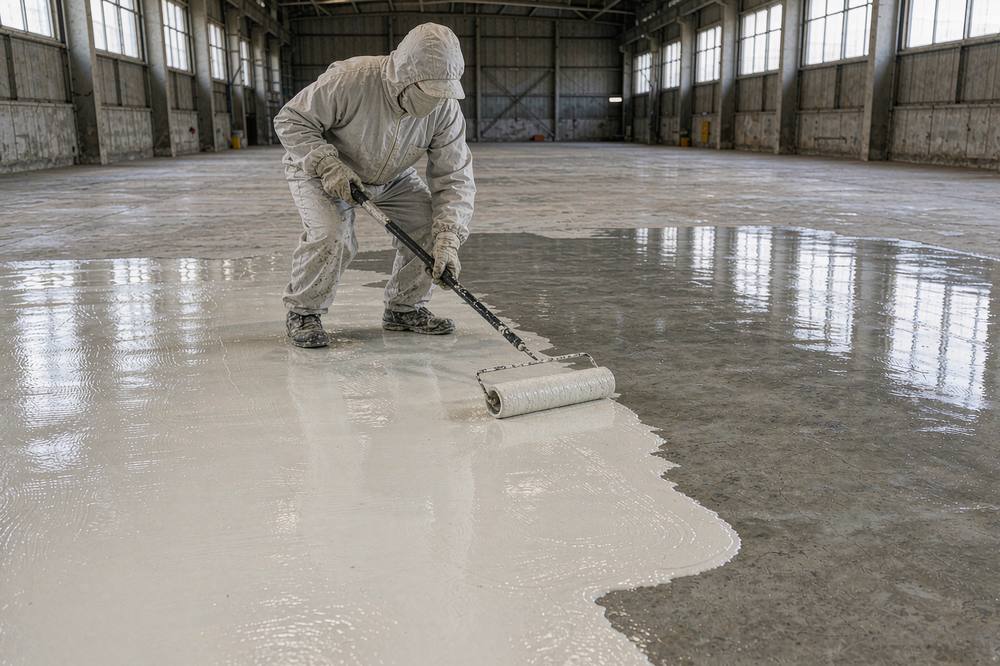
Figure 2. The wet edge stays milky white and the cured strip behind it goes clear; judging dryness at the wet edge is how second coats get locked in.
Four application families account for most of the range, each leaning on a different property.
YLH-1003W is the grade listed for damp surfaces, at 140-180 phr and 60 minutes pot life; YLH-1008W is the non-ionic grade for penetration at 125 phr. Dosage sits high because the slab absorbs water and binder alike; a slab above the project moisture limit fails under any hardener.
YLH-1005W is the non-sagging grade at 60 phr, YLH-1006W the hardness grade at 77 phr, YLH-1011W the impact grade at 70-80 phr. Flash rust on blasted steel is the failure point, and a damp shop closes the window.
YLH-1009W gives high gloss and fast drying at 75 phr with 30 minutes of pot life; YLH-1013W trades speed for chemical resistance at 77 phr. Batch size follows pot life, not convenience.
YLH-2003W is the water-soluble grade at 96 g/eq and 50 phr; YLH-3001W brings flexibility and salt spray resistance at 75-80 phr. Porous substrates starve the bond line by absorbing water. The YLH-3023 cycloaliphatic amine is the solvent-borne comparator.
Table 6. Application map for the waterborne amine range.
Application |
Grade |
Dosage, phr |
Function |
Failure point |
Concrete floor |
YLH-1003W |
140-180 |
adhesion on damp slab |
rising moisture |
Steel primer |
YLH-1005W |
60 |
non-sagging film |
flash rust |
Gloss topcoat |
YLH-1009W |
75 |
gloss and fast set |
30 min pot life |
Cementitious primer |
YLH-3001W |
75-80 |
flexibility, salt spray |
absorption by substrate |
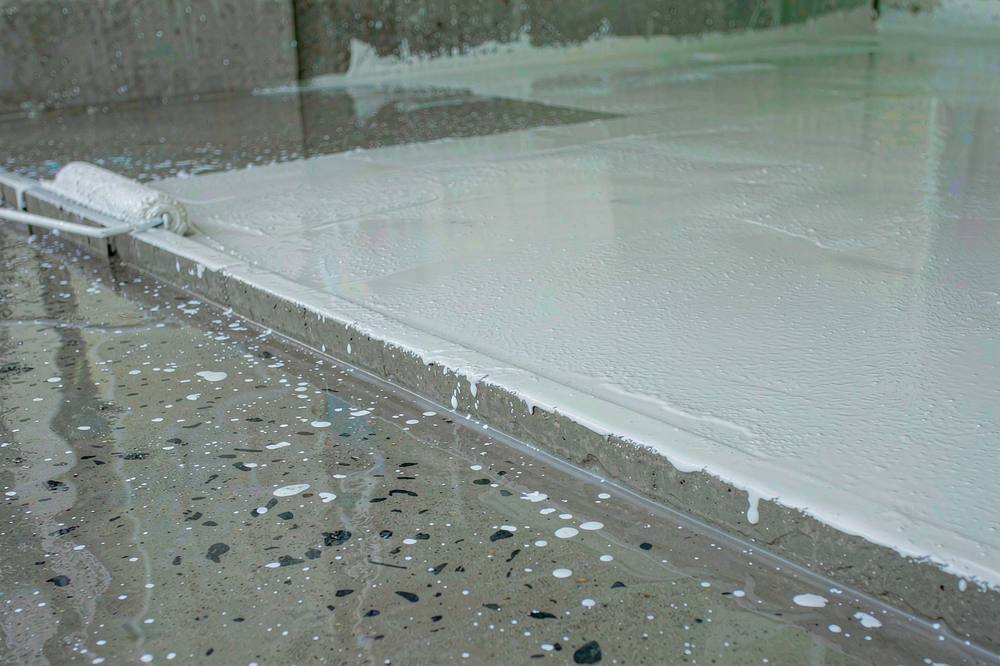
Figure 3. A damp slab is workable and standing water is not; the wet edge in this photograph is the limit, not the target.
Four gaps limit what this dataset can support.
The range covers hardeners only. No waterborne epoxy dispersion is published, so the resin side comes from a solid grade such as the solution-type bisphenol A epoxy resin, and dispersing is a separate step.
Non-volatile content is not printed for any W grade, so VOC per litre cannot be computed from the catalog alone. Salt spray remarks on page 14 are qualitative, with no hours and no data.
YLH-1501W sits off-basis: its phr of 115-120 implies a resin EEW of 243 g/eq, while the other thirteen cluster at 187-200. The range is also wrong for neat casting.
Verify AHEW, water content and viscosity on each lot against the COA. A shift in water content moves the applied solids and the coverage, and viscosity alone will not reveal it.
Drums carry at least 12 months of shelf life in unopened packing at ambient temperature, and the material must be kept from frost. The amine is alkaline and attacks skin and eyes, so the MSDS governs; check every figure here against the current TDS and COA.
AHEW is the mass of hardener carrying one reactive hydrogen, so it drives dosage. Amine value counts every titratable group, including the neutralised nitrogen. The two differ by 4% to 82%.
phr = 100 × AHEW ÷ EEW of the resin as supplied. At EEW 190, AHEW 120 returns 63 phr. Recalculate when the resin lot changes: a 15 g/eq shift in EEW moves phr by 5%.
YLH-1003W is the grade the catalog lists for damp surfaces. A damp slab is not a wet one: standing water and laitance defeat any hardener.
Milky means water is still in the film, from a thick coat or high humidity. Tacky usually means under-dosing from the amine value, or a carbonate bloom from CO2 attack.
Not by construction. Water is excluded from the VOC figure in most jurisdictions, but the neutralising acid and any co-solvent count. Check the local definition before a tender.
Not directly. YLH-5022 is 95% solids and needs solvent to reach application viscosity. A polyamide can be emulsified, but that is a separate step.
Fourteen waterborne amine hardeners span AHEW 73-300 g/eq and phr 35-180. At a fixed 100 µm film the hardener mass moves 32 to 70 g/m2, a 2.2-fold spread the VOC figure does not show.
Amine value cannot substitute for AHEW: the neutralised nitrogen inflates the titration and the derived phr under-doses by 4% to 82%. Water carries nine times the evaporation energy of xylene per square metre, but dwell time, not money, is what the line feels.
1. Yolatech 2026 product catalog, waterborne amine section, page 14; TDS for each grade on request.
2. Yolatech product page: https://www.yolatech.com/solid-bisphenol-a-epoxy-resin (accessed 2026-11-27).
3. Yolatech product page: https://www.yolatech.com/hardener-ylh-5022 (accessed 2026-11-27).
4. ASTM D1652, epoxy content of epoxy resins (EEW).
5. ISO 3001, determination of epoxy equivalent.
6. ISO 9702, amine group nitrogen content of amine epoxide hardeners.
7. ASTM D445, kinematic viscosity.

 IPv6 network supported