Liquid Epoxy Resin for Flooring: YLE-128 at EEW 184-190 g/eq
Nov 20, 2026
Liquid epoxy resin for flooring is normally a general purpose bisphenol A grade such as YLE-128, at EEW 184-190 g/eq and 11,000-15,000 mPa·s at 25 °C. It is the cheapest route to epoxy equivalents in Pakistan and India when the hardener is weighed. Cost per equivalent, dilution, and failures follow.
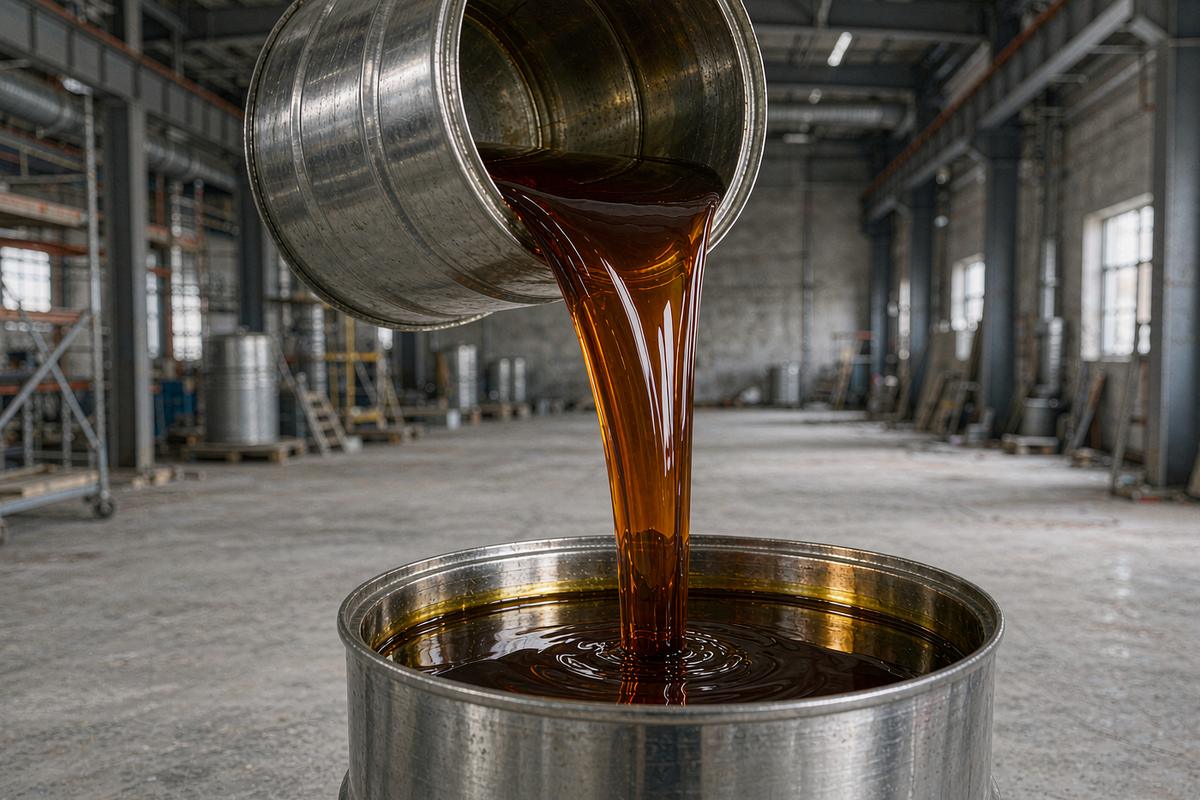
Figure 1. YLE-128 at drum temperature, before it is cut with diluent and filled for a self-levelling pour.
1. Introduction
Flooring is where bisphenol A epoxy is bought by the tonne rather than the drum. A buyer in Lahore or Ahmedabad compares three numbers first: price per kilogram, hardener demand, and how much diluent the viscosity forces into the mix.
YLE-128 sits in the middle of that argument. It is the general purpose liquid grade of the bisphenol A family, and the only bisphenol A liquid here listed for flooring. This report prices that discount in epoxy equivalents. No price is published, so every dollar figure below is illustrative.
2. Materials and Methods: Testing Liquid Epoxy Resin for Flooring
2.1 Product Identification and Specification
YLE-128 is the unbranded workhorse of the liquid bisphenol A epoxy resin range. The product page publishes no CAS number for it, so the field is recorded as not published rather than borrowed from a sister grade.
Table 1. Published specification of YLE-128.
Item
Information
Grade
YLE-128
Chemical name
bisphenol A diglycidyl ether
CAS No.
not published on the product page
EEW
184-190 g/eq
Viscosity at 25 °C
11,000-15,000 mPa·s
Hydrolyzable chlorine
500 ppm maximum
Colour
50 APHA, 2026 catalogue
Listed applications
composites, adhesives, coating, flooring
Packaging, shelf life
drum; 12 months in the original pack
2.2 Test Methods and Data Sources
EEW is reported as determined by ASTM D1652 titration, with ISO 3001 as the equivalent route. Viscosity is measured at 25 °C according to ASTM D445, and colour per ASTM D1544.
Two quantities are calculated rather than measured: epoxy equivalents per tonne and cost per equivalent. The catalogue prints EEW 184-194 g/eq, the product page 184-190; this report uses the page value and treats the spread in 7.1.
3. Results and Discussion: EEW, Viscosity and the Cost per Equivalent
3.1 What EEW 184-190 Buys and Costs
One tonne of YLE-128 at EEW 187 carries 5.35 epoxy equivalents; YLE-127 at EEW 180 carries 5.56. That 3.7% gap is the entire cost argument.
Hardener is dosed against equivalents, so hardener mass per tonne rises as EEW falls: 61.1 kg of YLH-3101 per 100 kg of YLE-127 against 58.8 kg for YLE-128. Hardener cost per equivalent does not move.
Cost per equivalent reduces to (EEW × resin price + AHEW × hardener price) ÷ 1000. YLE-127 wins only while it costs under 96.2% of the YLE-128 price. That ratio decides most purchases of liquid epoxy resin for flooring, and 127 rarely clears it.
The low-chlorine tier is the trap. YLE-128K to 128P carry EEW 165-175 at 3,500-5,500 mPa·s, which reads like cheaper epoxy. They are crystalline electronic potting grades, total chlorine 1,000 down to 300 ppm.
Viscosity is the second bill. At 11,000-15,000 mPa·s, YLE-128 will not level over 3 mm alone; YLE-127 at 8,000-11,000 takes about a third less diluent to reach 6,000 mPa·s.
3.2 Comparison with the Grades That Sit Beside It
Table 2. YLE-128 against the three grades a flooring buyer most often weighs instead of it.
Attribute
YLE-128
YLE-127
YLE-170
YLE-128R
EEW, g/eq
184-190
176-184
160-180
185-220
Viscosity, mPa·s
11,000-15,000
8,000-11,000
2,000-5,000
11,000-25,000
Hydrolyzable Cl
500 ppm max
500 ppm max
500 ppm max
printed 2%, unverified
Equivalents per tonne
5.35
5.56
5.88
4.55-5.41
YLH-3101 demand
58.8 phr
59.8-62.5 phr
64.7 phr
50.0-59.5 phr
Crystallisation
not marked
not marked
not marked
non-crystal type
Flooring listed
yes
no
no
yes
Bisphenol F is the paper alternative: YLE-170 pours at 2,000-5,000 mPa·s with no diluent, but must land below 84-98% of the YLE-128 price to break even, and is not listed for flooring. YLE-128R runs the other way: non-crystal, listed for flooring, EEW to 220.
4. Formulation and Dosage Calculation
Hardener demand follows phr = 100 × AHEW ÷ EEW. YLH-3101 publishes AHEW 110 g/eq at 55-60 phr, which back-calculates to a resin EEW of 183-200 g/eq, a band YLE-128 sits inside.
Table 3. Blends of YLE-128 with the AGE reactive diluent and with bisphenol F, calculated at EEW 187 for the base resin.
Blend
Blend EEW
Viscosity, mPa·s
YLH-3101, phr
Note
YLE-128, neat
187
13,000
58.8
will not level at 3 mm
plus 10 phr YLD-9005
183-193
6,200
56.9-60.1
pourable, small cap loss
plus 15 phr YLD-9005
182-196
4,500
56.1-60.4
usual cost-line compromise
plus 20 phr YLD-9005
180-199
3,400
55.3-61.1
recheck solvent resistance
70:30 with YLE-170
182
8,800
60.4
no monofunctional cap
Two cautions apply. Those viscosities are logarithmic mixing estimates from mid-band values, not measurements, and the EEW bands widen because the diluent is published as 155-285 g/eq. YLD-9005 also carries one epoxy group per molecule, so it caps a chain.
Filler dominates mass, binder dominates cost. A 3:1 screed on 100 kg of YLE-128 holds 58.8 kg of hardener and 476 kg of filler, so binder is 25% of the mass. At assumed prices of USD 2.30, 3.20 and 0.09 per kg, illustrative only, it is 91% of the cost.
That ratio decides where to negotiate. A 5% resin rise adds about USD 11.5 per tonne of floor; a 5% filler rise adds 2.1.
5. Processing Notes and Operating Window
The operating window is set by the hardener. YLH-3101 gels in 40-70 min at 25 °C, surface dries in 3.5 h, hard dries in 7 h, and at 5 °C those stretch to 10 h and 24 h.
The YLH-3101 hardener is listed for self-levelling floor topcoats, the reference here. Five points carry most of the risk:
Pour in 20-25 m² batches; a 40-70 min gel will not hold a wet edge across 100 m² at 35 °C.
Keep the mixed binder under 6,000 mPa·s at the pour, and add diluent rather than solvent.
Warm drums to 25-35 °C; 40-60 °C heat bands are common in winter, and hotter is not better.
Prime at 0.3-0.4 kg/m² and broadcast silica sand while the film is still wet.
Check slab moisture and dew point; a cold slab in humid air blushes whatever the ratio.
Figure 2. Self-levelling compound at 3 mm, spread in batches that match a 40-70 min gel time.
6. Applications
Four floor types carry almost all the volume in cost-sensitive markets, and each one fails for a different reason.
6.1 Self-Levelling Topcoat, 1-3 mm
The volume application is a 1-3 mm coloured wear layer. Dosage runs 100:58.8 with 1.2-1.5 kg of binder per m² plus 3:1 filler. A surface that scratches white after a month almost always carries more than 15 phr of diluent.
6.2 Chemical-Resistant Screed and Mortar
Binder content of 25-30% by mortar mass gives the acid and spill resistance a dairy or plating shop needs. Below 25% the mortar turns porous, above 35% it cracks in shrinkage. Quartz grading follows binder content, not the reverse.
6.3 Secondary Containment and Sumps
A 3-4 mm joint-free lining over bund walls takes the same 100:58.8 binder, sometimes accelerated with 1,3-BDX for early rain resistance. Still air in a sump is the hazard: amine carbonate skins over and the next coat will not bond.
6.4 Primer on Damp or Green Concrete
At 0.3-0.4 kg/m² the same resin binds dust and keys the screed to the slab. On a slab poured three weeks earlier, moisture drives through and blisters the film. 1,3-BDX is the grade to test there, since wet-surface adhesion is claimed for it and not for bisphenol A.
Table 4. Floor types, dose windows and the failure each one is prone to.
Application
Dose
Function
Failure point
Self-levelling topcoat
1.2-1.5 kg/m² binder
flow, gloss, wear
white scratch above 15 phr diluent
Chemical-resistant screed
25-30% binder by mass
acid and spill resistance
porosity below 25%, cracks above 35%
Containment lining
3-4 mm, two coats
barrier without joints
amine carbonate in still air
Primer on damp slab
0.3-0.4 kg/m²
adhesion, dust binding
blistering on a cold slab
Car park deck
2-3 mm, sand broadcast
abrasion, tyre marking
yellowing under skylights
Figure 3. A 2 mm deck coating on YLE-128; the aromatic backbone limits it to interiors or to a pigmented topcoat.
7. Limitations and Material Verification
7.1 Where YLE-128 Is the Wrong Choice
Four jobs should not be quoted on grade 128. UV topcoats yellow on the aromatic backbone; hot solvent immersion needs a bisphenol F epoxy resin; castings over 50 mm run away on exotherm. A spec capping total chlorine near 300 ppm is an electronic job.
The EEW spread matters more than buyers expect. A lot titrating at 194 g/eq against a recipe set at 58.8 phr lands 3.7% amine-rich, which plasticises the film. Retitrate before changing anything else.
7.2 Incoming Inspection, Packaging and Storage
Three tests catch most bad lots: EEW by titration, water by Karl Fischer, colour against a Gardner or APHA standard. Run each on a duplicate sample and hold the drum on a 5 g deviation.
The product page states drum packaging and at least 12 months from manufacture in the original pack. A general purpose grade can crystallise in a cold warehouse; warm to 50-60 °C, roll the drum, and confirm the crystals are gone.
Safety data sits with the MSDS, not this report. Uncured resin is a skin sensitiser and amine hardeners are corrosive as supplied. The TDS, MSDS and COA for the delivered lot override every number here.
8. Frequently Asked Questions
Is YLE-128 or YLE-127 the better buy for a flooring plant?
It depends on two numbers. YLE-127 stays cheaper per epoxy equivalent only while it costs under 96.2% of the YLE-128 price. If the plant also buys 15 phr of diluent, the 3.8% gap usually closes.
How much YLH-3101 does one tonne of YLE-128 need?
At EEW 187, one tonne of YLE-128 takes 588 kg of YLH-3101, which is the 58.8 phr figure. At 190 g/eq demand falls to 579 kg; at 184 g/eq it rises to 598 kg.
Can a 1 mm topcoat be poured without any diluent?
No. Neat YLE-128 at 11,000-15,000 mPa·s will not level to 1 mm over a large area, and solvent thinning leaves pinholes. Use 10-15 phr of a reactive diluent, or start from YLE-127 at 8,000-11,000 mPa·s.
Why does a floor turn white during the monsoon?
Amine carbonate. Moisture and carbon dioxide react with unreacted amine at the film surface when the slab sits at or below dew point. The fix is schedule: prime later in the day, keep the slab 3 °C above dew point, and never coat a slab that is still cooling.
How much diluent before chemical resistance is lost?
Above roughly 15 phr of a monofunctional diluent, crosslink density drops enough to show in solvent rubs. Verify with a 24 h immersion coupon in the actual spill medium rather than trusting a generic table.
What must the COA show before a drum is accepted?
EEW, hydrolyzable chlorine, water and colour, each against the lot number. Reject or retitrate any lot above 190 g/eq if the recipe was written at 58.8 phr, because the hardener dose is no longer stoichiometric.
9. Conclusions
YLE-128 is a cost instrument, not a performance grade. It delivers 5.35 epoxy equivalents per tonne at 11,000-15,000 mPa·s, and stays the cheaper epoxy only while it holds 3.8% below the YLE-127 price.
Hardener and diluent decide whether that saving survives. Binder is a quarter of a filled screed by mass and about 91% of its cost at the illustrative prices used here, so negotiation belongs on the resin line, not the filler pile.
10. References
1. Yolatech product page: https://www.yolatech.com/bisphenol-a-epoxy-resin (accessed 2026-11-20).
2. Yolatech product page: https://www.yolatech.com/curing-agent-ylh-3101 (accessed 2026-11-20).
3. Yolatech product page: https://www.yolatech.com/allyl-glycidyl-ether-yld-9005 (accessed 2026-11-20).
4. Yolatech Technical Data Sheet (TDS) for YLE-128, EEW 184-190 g/eq (available on request).
5. ASTM D1652, epoxy content of epoxy resins (EEW).
6. ASTM D445, kinematic viscosity.
7. ASTM D1544, Gardner color of transparent liquids.
Read More






 IPv6 network supported