Built for Heat: What 4,4'-DDS Brings to Epoxy Systems
Aug 12, 2026
A curing agent does not simply harden the resin. It helps decide whether the finished network can keep working when temperature becomes the real test.
When an epoxy component must retain shape, insulation and mechanical integrity at elevated temperature, changing the resin alone may not be enough. The curing agent becomes part of the final structure. That is where 4,4'-DDS earns its place.
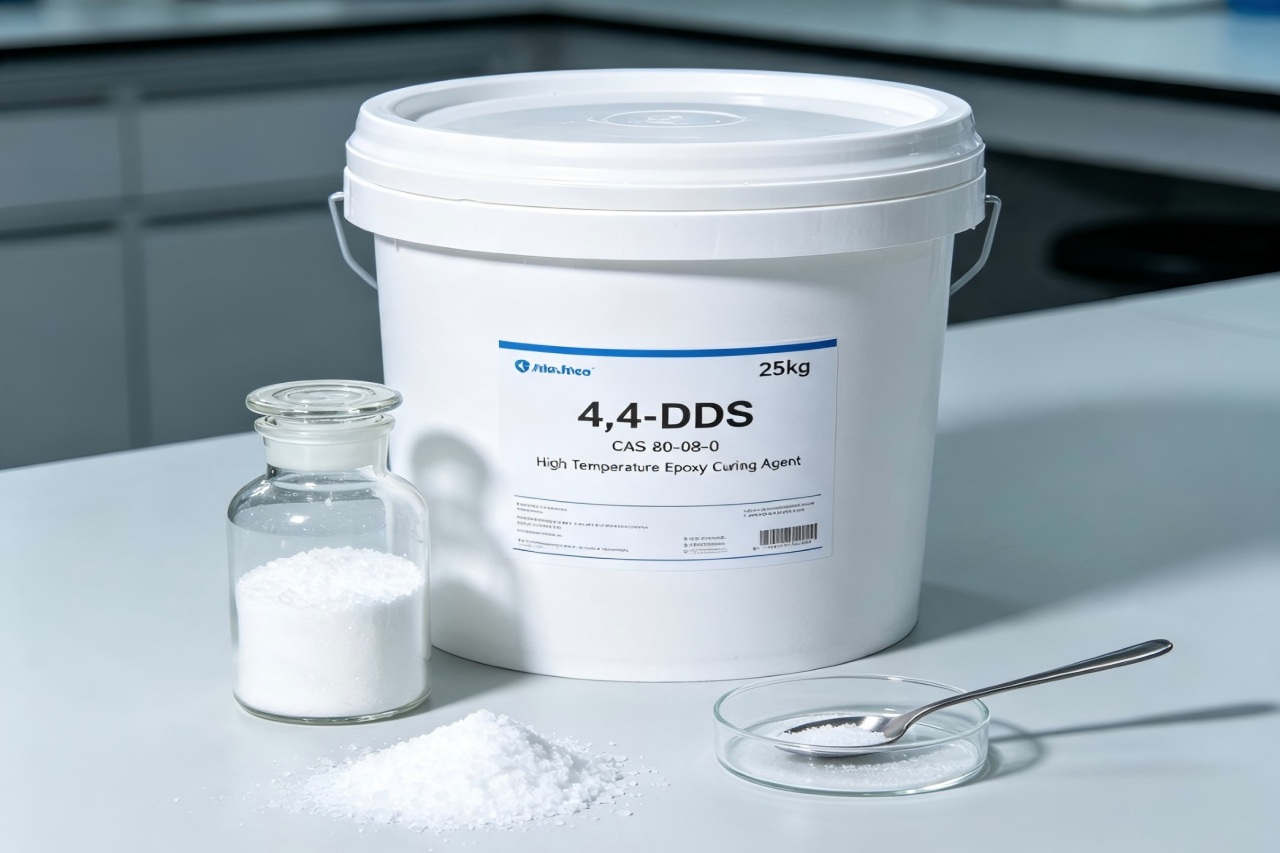
4,4'-Diaminodiphenyl sulfone is a crystalline aromatic diamine used in high-temperature epoxy systems. Its rigid sulfone-bridged structure can support a high-Tg, thermally stable network after an appropriate cure. Just as important, its relatively slow reaction at low temperature can leave useful time for mixing, impregnation or casting before heat drives the cure forward.
DDS is not a shortcut to one fixed Tg. It is a route to a high-temperature epoxy network.
Why This Molecule Behaves Differently
The molecule contains two primary aromatic amines linked through two phenyl rings and a central sulfone group. The sulfone group withdraws electron density from the amines, reducing their low-temperature reactivity. Once the system is heated and properly cured, the same rigid aromatic framework becomes part of a tightly crosslinked network.
Figure . Structure of 4,4'-DDS
Product fact
Value
Chemical name
4,4'-Diaminodiphenyl sulfone
CAS number
80-08-0
Molecular formula
C12H12N2O2S
Molar mass
248.30 g/mol
Theoretical AHEW
Approx. 62.1 g/eq; calculated value
The Advantage Comes with a Trade-Off
DDS is attractive because it can combine processing time before cure with strong high-temperature potential after cure. The trade-off is clear: it is a solid powder and normally needs controlled dispersion or dissolution, followed by a suitable heat-cure and post-cure program. Incomplete dispersion or insufficient conversion can prevent the formulation from reaching its intended Tg and aged performance.
What Published Test Data Shows
A published TGPAP/BPF epoxy study varied blend composition and the amine-to-epoxy ratio while using DDS as the hardener. Across 11 experimental runs, a longer processing window did not automatically produce a higher Tg. The optimized verification result balanced a Tg of 181.2 ± 0.8°C with a processing window of about 140 minutes. This is a literature example, not a YolaTech product test, but it makes the central point visible: DDS performance belongs to the complete formulation.
Original chart based on Junid et al., Polymers 2021, 13, 3304. Design runs n=3. Literature case only .
Optimized literature case
Predicted
Verified
Glass-transition temperature
180°C
181.2 ± 0.8°C
Processing window
136.1 min
≈140 min
Optimized formulation reported in the study: 55.6 wt.% BPF in the BPF/TGPAP blend and an amine-to-epoxy stoichiometric ratio of 0.60.
Where DDS Makes the Most Sense
Composite prepregs and high-temperature laminates
In multifunctional epoxy matrices, DDS can provide the controlled processing stage needed for impregnation and layup, followed by a heat-cured network suited to demanding composite service. The finished result still depends on resin flow, fiber wet-out, void control, cure pressure and post-cure - not on the hardener name alone.
Electrical insulation and encapsulation
Transformers, coils, power modules and related electrical components may need an epoxy system that keeps both insulation and mechanical integrity during heat exposure. DDS is relevant to these formulations when the production process can accommodate an elevated-temperature cure and the finished part is validated for dielectric behavior, thermal cycling and moisture aging.
Adhesives, coatings and specialty polymers
DDS can also be evaluated in high-temperature structural adhesives, protective coatings and sulfone-containing polymer synthesis. These uses benefit from the same rigid aromatic chemistry, but toughness, adhesion, color and chemical resistance must be balanced in the complete formulation.
What Must Be Clear Before a Trial
Resin and ratio. Start with the epoxy type and EEW, then calculate the DDS level from equivalents. Equal-weight substitution for another hardener is not reliable.
Processing. Confirm how the powder will be dispersed or dissolved and record the temperature, viscosity and usable processing time.
Cure. Use DSC or another suitable method to check reaction onset, conversion and residual cure before fixing the production schedule.
Proof. Measure Tg and the properties that matter after heat, moisture, chemicals or thermal cycling. Initial room-temperature strength is only the beginning.
YolaTech 4,4'-DDS at a Glance
Property
TDS value
Appearance
White crystal powder
Purity
≥99.0%
Melting point
175-181°C
Loss on drying
≤0.30%
Primary industrial use
High-temperature epoxy curing agent
Additional TDS use
Material for polysulfone amide and other polymers
Storage
Cool, dry place; avoid direct sunlight
Storage life
12 months in the original sealed container at ambient temperature
Packaging
25 kg fiber drum
The Right Message for DDS
DDS is not the first answer for every epoxy. If a process demands very fast ambient cure, another hardener may fit better. When the application can use a controlled heat cure and the finished part must perform at elevated temperature, 4,4'-DDS becomes a strong formulation option.
The most useful customer discussion therefore starts with the target service temperature, resin and EEW, available cure conditions, component geometry and required aging tests. Those details turn the promise of 'high temperature' into a result that can be measured and qualified.
Read More






 IPv6 network supported