


Language :

Language :
YLH-3054 is a chemical-resistant epoxy hardener developed for heavy-duty epoxy corrosion protection. This modified polyamine epoxy hardener offers outstanding chemical resistance against most organic acids, alcohols, edible oils, fats, and solvents. Its chemical resistance is further improved when combined with phenolic novolac epoxy resin, supporting epoxy novolac pipeline coating formulations where greater chemical resistance is required.
As a high-temperature epoxy hardener for pipeline coatings and internal linings, YLH-3054 combines chemical resistance, early water resistance, thick-film crack resistance, and high-temperature performance in one epoxy curing system. The evaluation below covers thermal aging at 200°C for 168 h and thermal cycling from 230°C to -60°C. The data are relevant to petroleum pipeline coating development and to the use of this epoxy hardener for steel pipe coating and other high-temperature anticorrosive coating systems.
|
Chemical-Resistant Epoxy Hardener for Pipeline Corrosion Protection |
Chemical tank lining; Pipeline internal lining; Heavy-duty steel anti-corrosion primers.
|
|
Early Water Resistance and Thick-Film Performance |
Excellent early water resistance, good flexibility, providing good crack resistance in thick film applications. |
|
Cathodic Protection Compatible Coating Systems |
Excellent compatibility with cathodic protection systems. Suitable for the design of related pipeline corrosion-protection systems. |
|
High-Temperature Pipeline Coating Performance |
After 200°C/168 h exposure and thermal cycling from 230°C to -60°C, the tested system showed no chalking, cracking, or peeling. |
|
Appearance |
Light yellow liquid |
|
Viscosity, mPa.s@25°C |
0-100 |
|
Amine value, mg KOH/g |
280-320 |
|
AHEW, g/eq |
160 |
|
Added Weight, PHR |
75-85 |
To evaluate YLH-3054 as an epoxy curing agent for pipeline coating applications, Formulation A was compared with the control formulation for curing, adhesion, and high-temperature performance. YLH-3054 was added separately as the curing component (Part B) at 20.8 g. The formulation and test results are shown below.
Formulation A (YLH-3054 Curing System)
|
No. |
Raw Material |
Amount |
|
1 |
Xylene |
13.5 |
|
2 |
n-Butanol |
3.4 |
|
3 |
YLEP-638 |
23.5 |
|
4 |
Talc |
19.8 |
|
5 |
Yellow Iron Oxide |
1 |
|
6 |
Barium Sulfate |
31.9 |
|
7 |
Titanium Dioxide |
6 |
|
8 |
Carbon Black |
0.1 |
|
9 |
Ultra |
0.8 |
|
Hardener |
YLH-3054 (Part B) |
20.8 g |
|
Item |
Surface Dry (25°C) |
Hard Dry (25°C) |
|
Formulation A |
2h |
3h |
|
Control Formulation B |
1.5 |
≥6h |
At 25°C, Formulation A reached surface dry in 2 h and hard dry in 3 h. The control reached surface dry in 1.5 h but required ≥6 h for hard dry. Although Formulation A was slightly slower to reach surface dry, it completed effective crosslinking much faster.
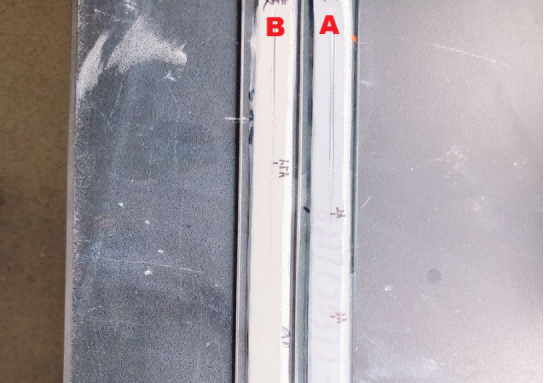
Figure 1 BK Drying Test
|
Item |
Pull-off Adhesion (Before) / MPa |
Pull-off Adhesion (After) / MPa |
|
Formulation A |
23.32 23.03 |
21.63 18.36 |
|
Control Formulation B |
7.62 8.22 |
21.14 21.08 |
Before heat exposure, pull-off adhesion of Formulation A was 23.32/23.03 MPa, compared with 7.62/8.22 MPa for the control. This shows that Formulation A developed higher initial adhesion under ambient curing conditions.
Note: "Before" and "After" refer to before and after baking at 200°C for 168 h.
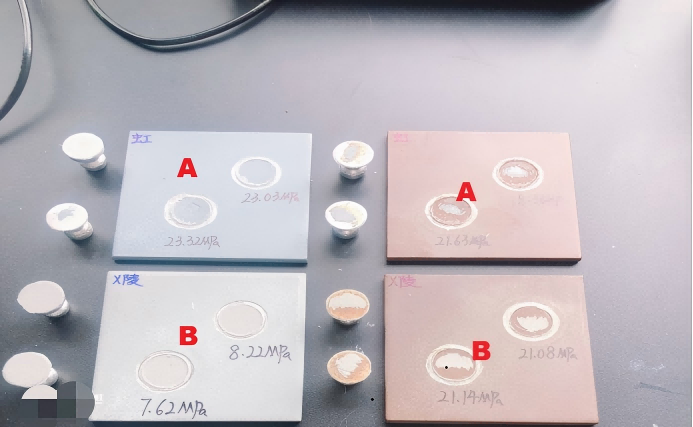
Figure 2 Adhesion Test
|
Item |
Film Surface Condition After Baking at 200°C for 168 h |
|
Formulation A |
Discoloration observed; no chalking, cracking, or peeling. |
|
Control Formulation B |
Discoloration observed; no chalking, cracking, or peeling. |
After baking at 200°C for 168 h, both coatings showed discoloration but no chalking, cracking, or peeling, and the coating films remained intact.
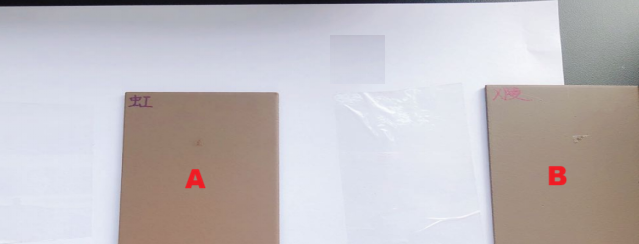
Figure 3 Thermal Aging Test
|
Item |
Film Surface Condition After 3 Thermal Cycles of 230°C (16 h) and -60°C (8 h) |
|
Formulation A |
Discoloration observed; no chalking, cracking, or peeling. |
|
Control Formulation B |
Discoloration observed; no chalking, cracking, or peeling. |
After 3 thermal cycles between 230°C (16 h) and -60°C (8 h), both coatings showed discoloration but no chalking, cracking, or peeling, demonstrating stable resistance to thermal cycling.
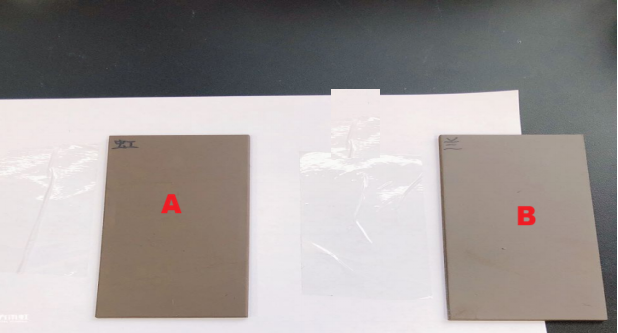
Figure 4 Thermal Cycling Test
5. Conclusion
Comparative results show that the main strengths of Formulation A are faster hard-dry development and earlier adhesion build. Its surface-dry time was 2 h, slightly longer than the control at 1.5 h, but Formulation A reached hard dry in 3 h while the control required ≥6 h. In addition, pull-off adhesion after ambient cure reached 23.32/23.03 MPa for Formulation A, compared with 7.62/8.22 MPa for the control.
After baking at 200°C for 168 h and thermal cycling between 230°C and -60°C, neither coating showed chalking, cracking, or peeling. These results indicate that Formulation A achieved a good balance among curing efficiency, initial adhesion, and coating film integrity under high-temperature conditions.

 IPv6 network supported