


Language :

Language :
How 3,3'-Diaminodipropylamine Affects Slurry Rheology, Degassing, Gelation and Green-Body Formation
Ceramic gelcasting presents a practical contradiction. Before entering the mold, the slurry must remain low in viscosity, easy to degas, and capable of filling fine details. After filling, it should quickly develop an organic network strong enough to hold the powder particles in place. DPTA is not merely a generic “gelling promoter” in this process; it is a polyamine curing component that directly participates in epoxy ring opening. The real design question is when the viscosity begins to rise significantly and whether the wet green body can pass through demolding and drying without damage.
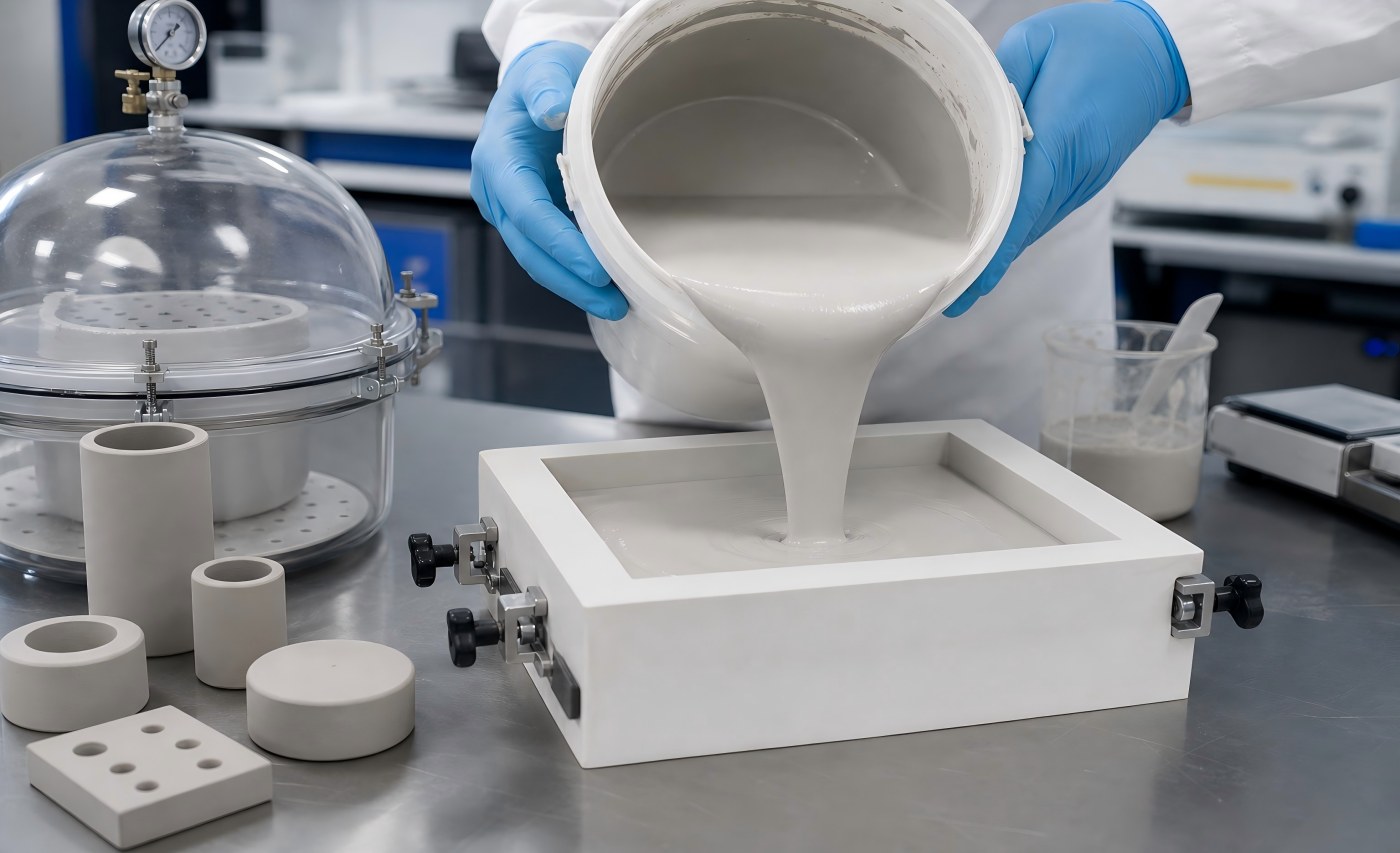
Figure 1. Epoxy-based ceramic gelcasting application schematic
Gelcasting begins with a flowable ceramic suspension. After degassing and mold filling, an in-situ reaction creates an organic network that fixes the powder particles in place. DPTA has been investigated as a hardener in epoxy-based gel systems, including aqueous sorbitol polyglycidyl ether systems and non-aqueous aluminum nitride gelcasting based on hydantoin epoxy resin.
These studies confirm that DPTA can harden an epoxy gelling phase, but their dosage, temperature, and gel time should not be transferred directly to another ceramic powder or resin. Changes in powder surface, solids loading, solvent, dispersant, and epoxy functionality can all alter the induction period and the rate of viscosity build-up.
|
Item |
Information |
|
Chinese Name |
3,3'-二氨基二丙胺 |
|
English Name |
3,3'-Diaminodipropylamine |
|
Common Synonyms |
Bis(3-aminopropyl)amine; Dipropylenetriamine |
|
Abbreviation |
DPTA |
|
CAS No. |
56-18-8 |
|
EC No. |
200-261-2 |
|
Molecular Formula |
C₆H₁₇N₃ |
|
Molecular Weight |
131.22 g/mol |
|
Amine Structure |
Two primary amines and one secondary amine; five N-H active hydrogens in the ideal structure |
|
Theoretical AHEW |
Approx. 26.24 g/eq (calculated for the ideal pure compound; not a guaranteed specification) |
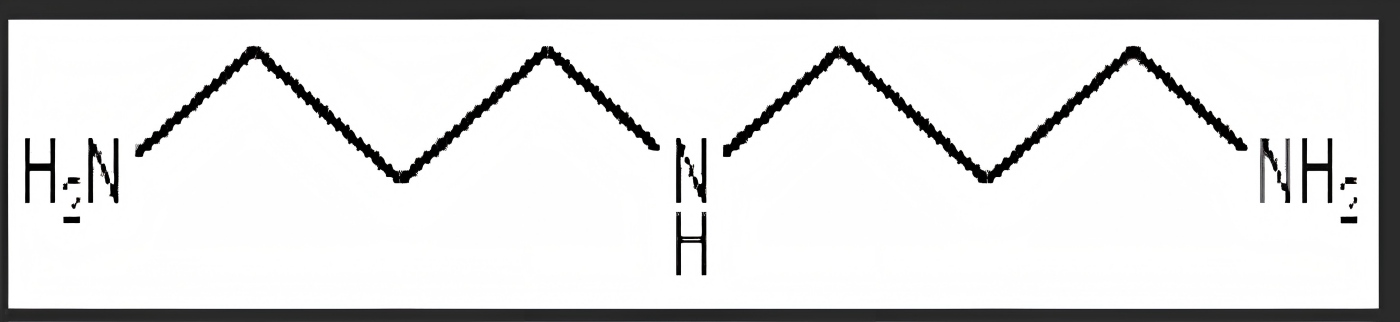
Figure 2. Chemical structure of DPTA
The primary and secondary amine N-H groups in DPTA can attack epoxy groups and open the oxirane ring. As the reaction proceeds, small molecules dispersed in the continuous phase become connected into an organic network, which then fixes the ceramic particles at their existing positions. The aim in gelcasting is not the fastest possible reaction. The induction period must first cover mixing, degassing, and filling, after which sufficient green-body strength should develop inside the mold.
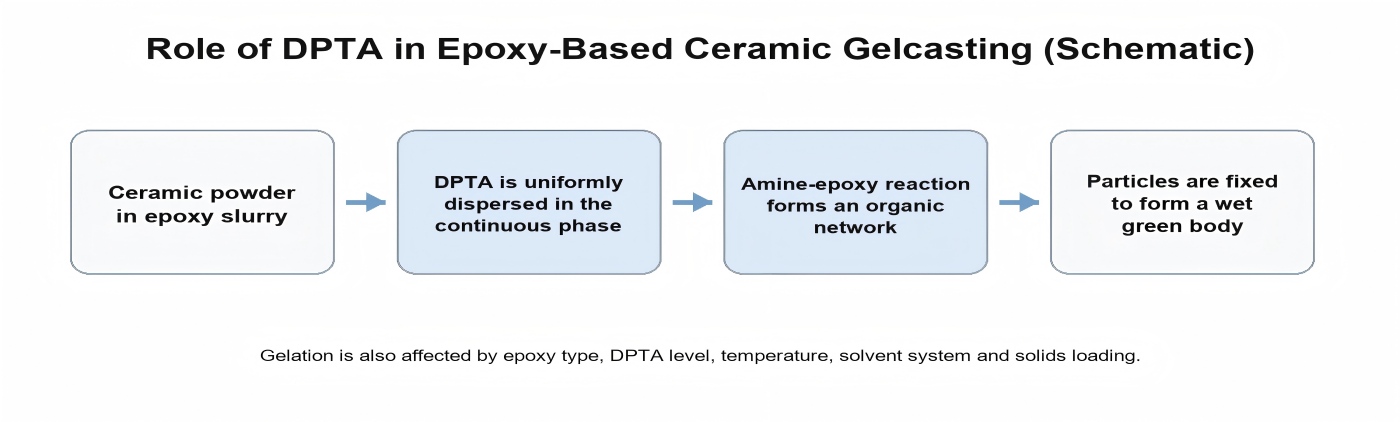
Figure 3. Role of DPTA in epoxy-based ceramic gelcasting
The theoretical AHEW is useful only for establishing an initial stoichiometric reference. The effective level in gelcasting is also influenced by epoxy functionality, resin content, solvent, and adsorption at the powder surface. A production-ready formulation cannot be derived from 26.24 g/eq alone.
A high-solids ceramic slurry may already show shear thinning, settling, or agglomeration. If DPTA is added before dispersion is stable, the subsequent viscosity increase can mask the original problem and may lock agglomerates into the green body. Trials should first establish a repeatable initial viscosity for the powder, resin, and dispersant system before introducing cure as another variable.
Once DPTA is introduced, the processing clock has started. Inadequate mixing can produce localized gelation, while unnecessarily long mixing consumes the mold-filling window. A practical method is to fix the addition order, mixing energy, material temperature, and interval from addition to casting, and then compare whether the viscosity-time curves overlap from batch to batch.
Bubbles can escape only while the material remains sufficiently mobile. Filling corners and fine mold features also requires time. A slurry that has not yet gelled in a cup may already be unable to fill a complex cavity. Evaluation of the DPTA level should therefore include vacuum degassing, transfer, mold filling, and leveling, rather than recording only a static gel point.
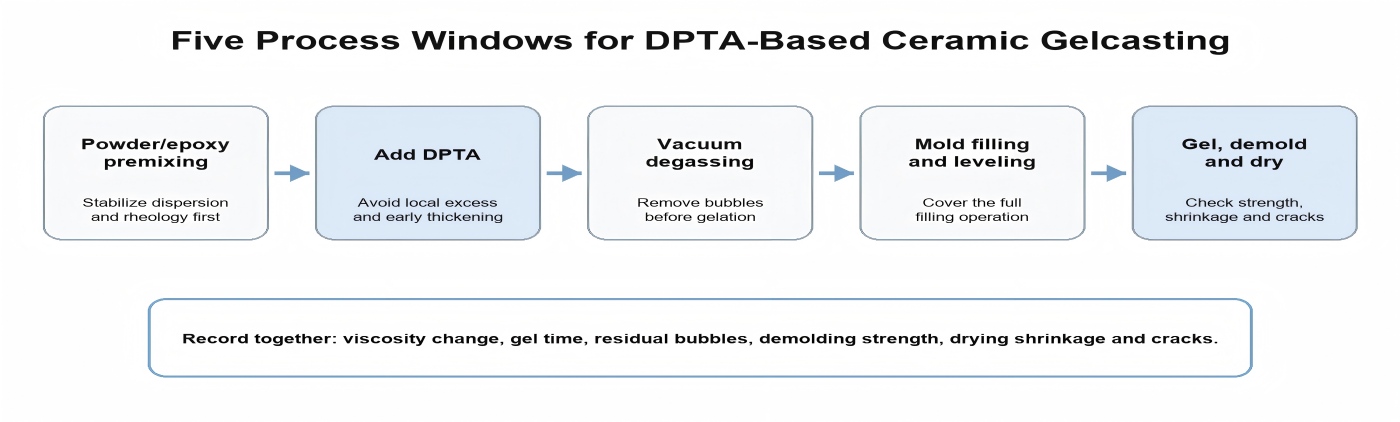
Figure 4. Process windows in DPTA-based gelcasting
A newly demolded green body contains ceramic powder, solvent, and an organic network. If the network is too weak, edges may break during demolding. If local cure is too fast or the drying gradient is too steep, differential shrinkage and cracking may appear later. DPTA evaluation should therefore continue beyond the observation that the slurry has gelled, and include dimensions, appearance, and internal defects after drying.
Demolding strength. At the same holding time, compare whether the green body can be removed intact, whether edges shed powder, and whether complex mold features remain complete.
Drying uniformity. Record mass change, linear shrinkage, and crack location to distinguish nonuniform gelation, trapped bubbles, and overly rapid drying.
Subsequent binder removal. If the part will be sintered, the debinding schedule should reflect the thermal decomposition of the resin and cured network. High green strength does not justify rapid heating during binder removal.
A useful first series keeps the ceramic powder, solids loading, epoxy resin, and dispersant constant, varies only internal incremental levels of DPTA, and includes a blank without DPTA. All samples should use the same mixing, material temperature, degassing, and mold conditions so that changes can be attributed to DPTA rather than slurry-preparation variation.
|
Stage |
Recommended Records |
Question to Be Answered |
|
Slurry preparation |
Solids loading, initial viscosity, settling, and agglomeration |
Is the baseline dispersion stable and the filling behavior repeatable? |
|
After DPTA addition |
Viscosity-time profile and gel time at the selected temperature |
Does the induction period cover degassing and filling, or does gelation start too early? |
|
Inside the mold |
Leveling, corner filling, bubbles, and gel uniformity |
Are complex features completely filled without localized early gelation? |
|
Wet/dried green body |
Demolding strength, mass change, shrinkage, cracks, and internal defects |
Can the network support demolding and remain uniform through drying? |
|
Before binder removal |
TGA or suitable mass-loss/residue assessment when sintering is required |
Can the organic network be removed smoothly under the proposed schedule? |
The most suitable level is usually not the formulation that gels first. It is the one that completes degassing and filling, develops uniform green-body strength within a practical time, and remains low in defects after drying.
If the epoxy resin is incompatible with water or the selected solvent, adding DPTA alone will not prevent phase separation. For large parts, complex cavities, or processes with material-temperature variation, excessive reactivity can also amplify local differences in gelation. In these cases, the resin/solvent system, dispersion process, or a modified curing component should be reconsidered before simply increasing the DPTA level.
DPTA is corrosive and presents significant inhalation and dermal-contact hazards. Laboratory and production handling should follow the latest SDS and use closed handling, ventilation, and appropriate personal protective equipment. Open manual charging should not be treated as routine practice.
In epoxy-based ceramic gelcasting, DPTA controls the key transition from a flowable slurry to a demoldable wet green body. Its suitability can be judged only when initial rheology, viscosity build-up after addition, gel time, green-body strength, and drying defects are evaluated together, rather than relying on a single gel-time result.
Product specifications, packaging, storage, and safe handling should follow the company’s latest TDS, COA, and SDS. Formulations and performance values reported in research literature are provided only to explain the method and are not guaranteed product values.

 IPv6 network supported