Cycloaliphatic Epoxy Resin: YLCE-2021 Dosage and Blends
Nov 12, 2026
YLCE-2021 is a cycloaliphatic epoxy resin with two internal epoxy groups, an EEW of 125–135 g/eq and a viscosity of 200–300 mPa·s at 25 °C. Total chlorine is capped at 50 ppm and the cured ester network reaches a published Tg of up to 195 °C. Clear castings and UV-curable coatings are the main uses.
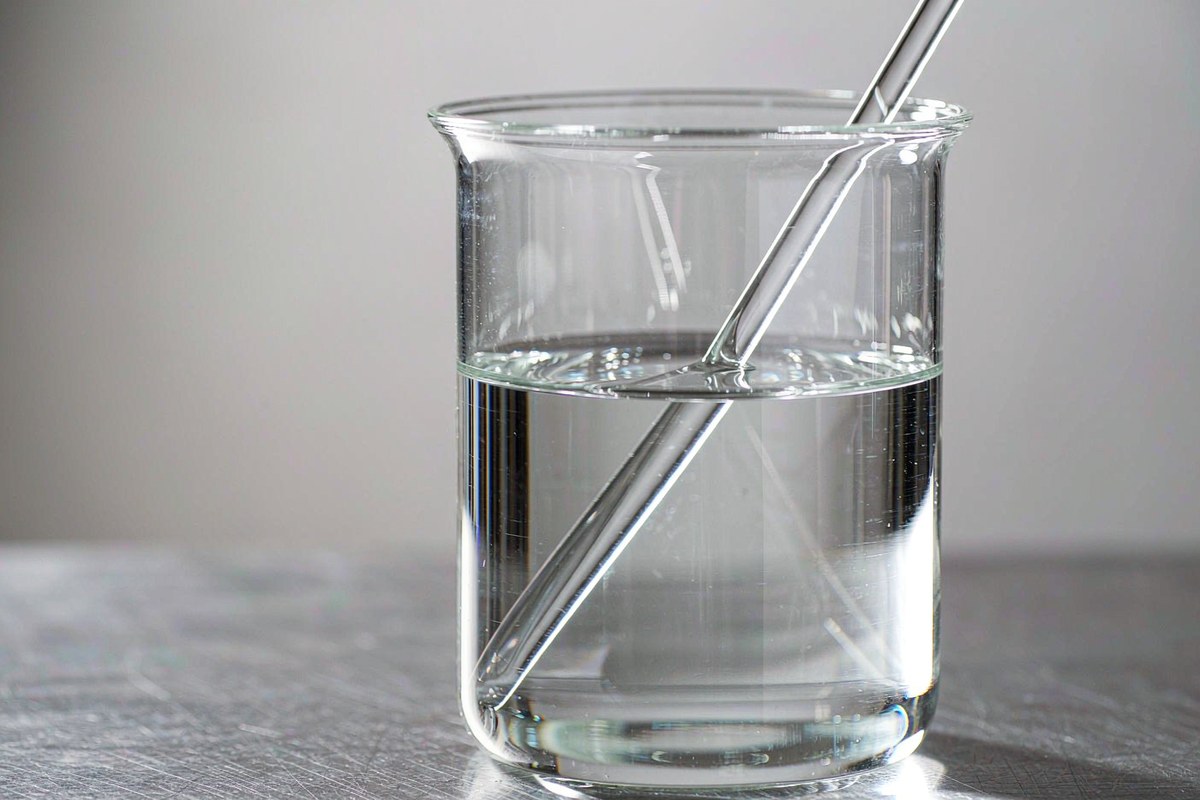
Figure 1. YLCE-2021 as delivered, 200–300 mPa·s at 25 °C. The bench reads through the beaker, which is the first test most receiving bays apply.
1. Introduction
Alicyclic diepoxides sit apart from the bisphenol A family. YLCE-2021 carries two epoxy groups fused into cyclohexane rings and bridged by an ester link, so the reactive site is the ring, not a glycidyl ether tail.
That difference decides where the grade earns its price. An aromatic ring absorbs ultraviolet light and oxidises into coloured products; a saturated ring does not. Clear coatings start from alicyclic stock when colour drift matters.
This report fixes the published window, converts epoxide equivalent into hardener weight, and compares the grade with a glycidyl ester and a bisphenol A liquid. It also names the jobs the resin cannot do.
2. Materials and Methods: Test Basis for Cycloaliphatic Epoxy Resin Data
2.1 Product identification and published specification
Table 1 holds the identity fields a purchase order needs. Table 2 holds the specification lines the supplier publishes, next to the fields left blank.
Table 1. Identity data for YLCE-2021 as published on the product page, accessed 2026-11-12.
Item
YLCE-2021
Chemical name
3,4-Epoxycyclohexylmethyl 3,4-epoxycyclohexanecarboxylate
CAS number
2386-87-0
Epoxide groups
2, both internal (alicyclic)
Appearance
Colourless liquid
Packaging
Drums; IBC tanks
Shelf life
24 months from manufacture
Storage
5–30 °C, dry, out of sunlight
Table 2. Published specification of the YLCE-2021 grade, with the test basis normally applied.
Item
Published value
Usual test basis
Colour, Pt-Co
Max. 50
ASTM D1544
Epoxy equivalent weight
125–135 g/eq
ASTM D1652 or ISO 3001
Viscosity at 25 °C
200–300 mPa·s
Rotational spindle; ASTM D445 for kinematic
Total chlorine
Max. 50 ppm
Combustion and titration, method not stated
Tg of cured casting
up to 195 °C
Supplier statement, method not stated
Density
Not published
Request on TDS
Water content
Not published
ASTM E203, Karl Fischer
Flash point
Not published
ASTM D93
Three fields formulators ask for early are missing. None changes the stoichiometry, but density decides whether a 200 L batch fills the mould, and water above 0.05% slows a cationic cure.
2.2 Test methods and data source
Every value in Table 2 was read from the product page on 2026-11-12. The page does not name the titration behind the 125–135 g/eq window, so the window is a purchase specification, not one measurement.
Viscosity carries more uncertainty than a datasheet suggests. A 250 mPa·s liquid sits low on most spindles, where geometry and shear rate move the reading by several percent; duplicate runs agree only at a held 25 °C.Calculated values come from the named structure and the published EEW. Field figures are labelled as such. A purchase decision should rest on a triplicate titration from the lot COA.
3. Results and Discussion: Structure, Reactivity and Alternatives
3.1 Structure and reactivity
The named structure gives 252.31 g/mol for C14H20O4 and two epoxides, so the theoretical EEW is 126.2 g/eq. The published 125–135 g/eq window brackets that figure: the grade is close to a pure diepoxide.
Epoxy content follows at 0.74–0.80 eq per 100 g, against 0.53 eq per 100 g for a 187 g/eq bisphenol A liquid. That is 45% more reactive groups per kilogram, which is how a tight network forms at 250 mPa·s.
The internal epoxide also changes cure chemistry. Ring-opening runs through a cationic path, so strong acids and photogenerated acids start it fast under heat or ultraviolet light. Anhydrides need heat; aliphatic amines barely react.
Chlorine separates this grade from glycidyl ethers. Total chlorine is capped at 50 ppm, while the bisphenol A liquid YLE-128 permits 500 ppm hydrolyzable chlorine. Under humid bias, mobile chloride feeds ionic migration, so the cap matters in encapsulation.
Treat the 195 °C figure with care. Published Tg tracks the hardener and the schedule, and a casting held 2 h at 120 °C will miss a post-cured value. Confirm it by DMA on your own coupon.
3.2 Comparison with alternative systems
Table 3 sets the grade against the two resins a buyer usually shortlists.
Table 3. Cycloaliphatic epoxy resin YLCE-2021 against YLCE-186 glycidyl ester and bisphenol A liquid grades.
Property
YLCE-2021
YLCE-186
YLE-128
Epoxide type
Alicyclic, ester bridge
1 alicyclic + 2 glycidyl ester
Glycidyl ether
Functionality
2
3
2
EEW, g/eq
125–135
100–125 (186 / 186C)
184–190
Viscosity, 25 °C
200–300 mPa·s
2,000–5,000 cps
11,000–15,000 mPa·s
Chlorine
≤50 ppm total
Not published
≤500 ppm hydrolyzable
Colour
Pt-Co ≤50
APHA ≤50
Not published
State
Colourless liquid
Colourless to light yellow
Clear liquid
YLCE-186 reacts faster with anhydrides, because two glycidyl esters join the alicyclic ring, but its viscosity runs eight to twenty times higher. YLE-128 costs less per kilogram and brings adhesion.
Read the columns as a process decision. Low viscosity buys filler loading; ester groups buy reactivity; aromatic rings buy toughness and price. None wins on all three.
4. Formulation and Dosage Calculation
Hardener weight follows from the epoxide equivalent: phr = 100 × AEW ÷ EEW, where AEW is the active hydrogen equivalent weight. A factor k of 0.80–0.90 is usual for anhydrides, and 0.85 suits MHHPA hardener in castings.
Table 4. Hardener demand across the published EEW window, calculated with MHHPA (AEW 168.19 g/eq) and DETA (AHEW 20.6 g/eq).
EEW, g/eq
Epoxy content, eq/100 g
MHHPA, k = 1.00
MHHPA, k = 0.85
DETA, phr
125
0.80
134.6 phr
114.4 phr
16.5
130
0.77
129.4 phr
110.0 phr
15.8
135
0.74
124.6 phr
105.9 phr
15.3
Worked example at the mid-point: EEW 130 g/eq with MHHPA at 168.19 g/eq gives 129.4 phr at k = 1.00, or 110.0 phr at k = 0.85. A 500 g batch therefore takes 550 g of anhydride.
Amine hardeners look cheap on paper and behave badly here. DETA at 15.8 phr is stoichiometrically correct, yet the internal epoxide reacts slowly at room temperature and the film stays tacky for hours. A polyetheramine such as YLH-6005 curing agent at 73.1 phr cures, but only with heat.
Table 5. Viscosity and EEW of YLCE-2021 blended with bisphenol A liquid, estimated by the log-mixing rule at 25 °C.
YLE-128 share
Blend EEW
Viscosity estimate
Practical effect
0%
130 g/eq
250 mPa·s
fastest wet-out
10%
134 g/eq
370 mPa·s
slight toughening
20%
138 g/eq
550 mPa·s
better adhesion to metal
30%
143 g/eq
820 mPa·s
cheaper, slower flow
These are log-mixing estimates, not measurements. The trade-off is plain: 10% bisphenol A costs 50% more viscosity, and that is about all a casting shop absorbs.
5. Processing Notes and Operating Window
Five habits keep a 250 mPa·s casting out of trouble.
• Hold the drum at 20–25 °C; at 15 °C viscosity doubles and de-airing drags.
• Meter anhydride by weight; density differences skew phr by 5%.
• Degas at 5–10 mbar for 10–15 min, in a shallow layer.
• Pre-heat the mould; a cold wall traps air at the surface.
• Dose 1–3 phr of cationic photoinitiator for UV work, and expect oxygen inhibition.
Figure 2. Pouring YLCE-2021 into an open mould. At 200–300 mPa·s the stream breaks cleanly and finds fine detail without vacuum.
Cationic cure is easily poisoned. Trace amine from an earlier batch, silicone release agent, or water above 0.05% will slow or stop it. The symptom is a tacky skin over a hard body: it reads as undercure and is contamination.
6. Applications
Table 6 ties each published use to the property that carries it.
Table 6. Published applications of YLCE-2021 and the property each one depends on.
Application
Function of the resin
Property that decides it
Electrical casting
Insulation and mechanical support
Low viscosity fills fine windings
LED packaging
Optical path and protection
Pt-Co ≤50, no aromatic ring
Light-curing coating
Fast ambient cure
Cationic ring-opening under UV
3D printing resin
Photopolymer backbone
Low viscosity at 25 °C
Cable core composite
Binder with low void content
Wet-out at low pressure
Insulation material
Dielectric support, UV stability
Saturated ring; UV and radiation resistance
Figure 3. A cured YLCE-2021 casting around a threaded insert. Clarity of this order needs a filtered mix and a mould at cure temperature.
Two of those uses pull in opposite directions. Optical potting wants the lowest colour, electrical casting the lowest chlorine, and both point at one grade, so a single drum serves both lines. The YLSE-721 amine epoxy covers 200–260 °C structural work.
7. Limitations and Material Verification
7.1 Known limitations and non-applicable cases
YLCE-2021 is the wrong choice in four situations, and each shows up in the first trial.
• Room-temperature amine cure: the internal epoxide reacts slowly, so a DETA system stays soft overnight.
• Hot caustic or strong acid service: the ester bridge hydrolyses before the part visibly discolours.
• Thick sections in one shot: low viscosity plus high exotherm can crack a 50 mm block.
• High fracture toughness: the tight saturated network is brittle, so blend it or move to an aromatic system.
7.2 Incoming inspection, packaging and safety
Incoming inspection covers EEW, total chlorine and colour. EEW by titration according to ASTM D1652 catches a blended or aged drum; chlorine above 50 ppm matters for electrical work; colour drift points to oxidation.
The grade ships in drums and IBC tanks and keeps 24 months between 5 and 30 °C, away from sunlight, oxidants and acids. Handling data sits in the MSDS, lot values in the COA. Values here describe the grade, not one drum.
8. Frequently Asked Questions
Is YLCE-2021 a glycidyl ether or an alicyclic epoxy?
Alicyclic. Both epoxy groups sit inside cyclohexane rings joined by an ester bridge, so no glycidyl ether tail is present and total chlorine stays at or below 50 ppm.
Which hardener works with a cycloaliphatic epoxy resin like YLCE-2021?
Anhydrides and cationic initiators. MHHPA runs 106–135 phr across the EEW window, and a photoacid serves UV cure. Aliphatic amines react too slowly at room temperature.
Why does a UV-cured YLCE-2021 film stay tacky?
Water, amine contamination or oxygen inhibition. Dry the resin below 0.05% water, clean the mixer between product families, and cure under nitrogen if the surface must come out hard.
Can YLCE-2021 be blended with bisphenol A resin?
Up to about 30% by weight. Expect 370 mPa·s at 10% and 820 mPa·s at 30%, with blend EEW rising from 130 to 143 g/eq.
What pot life does an YLCE-2021 and MHHPA system give?
Several days at 25 °C and weeks at 5 °C. The mix stays latent until roughly 120 °C, which suits one-shot casting.
How should YLCE-2021 be stored, and how long does it keep?
Sealed between 5 and 30 °C, out of sunlight, 24 months from manufacture. A drum opened repeatedly picks up moisture, so purge the headspace with dry air before closing it.
9. Conclusions
YLCE-2021 is a low-viscosity alicyclic diepoxide: 125–135 g/eq, 200–300 mPa·s at 25 °C, 50 ppm total chlorine, and a colourless body that resists yellowing under UV.
Stoichiometry is the easy part. MHHPA at 110 phr covers the mid-point EEW, DETA at 15.8 phr works only in an oven, and 10% bisphenol A is about all the flow window takes.
Cure chemistry is the hard part. Cationic systems fail on trace moisture and amine, and the failure looks like a tacky skin. Cast a coupon before the production mould is cut.
10. References
1. Yolatech product page, YLCE-2021: https://www.yolatech.com/34-epoxycyclohexylmethyl-ylce-2021-cas-2386-87-0
2. Yolatech product page, YLCE-186: https://www.yolatech.com/45-epoxytetrahydrophthalic-acid-diglycidylester-ylse-186-cas-25293-64-5
3. Yolatech product page, bisphenol A grades: https://www.yolatech.com/bisphenol-a-epoxy-resin
4. Yolatech product page, MHHPA: https://www.yolatech.com/34-methyl-hexahydrophthalic-anhydride-cas-no-25550-51-0-mhhpa
5. Technical Data Sheet, Material Safety Data Sheet and Certificate of Analysis (COA) for YLCE-2021, CAS 2386-87-0, Yolatech (available on request).
6. ASTM D1652, epoxy content of epoxy resins; ISO 3001, determination of epoxy equivalent.
7. ASTM D445, kinematic viscosity; ASTM D1544, Gardner color; ASTM E203, water by Karl Fischer; ASTM D93, flash point by Pensky-Martens.
Read More






 IPv6 network supported