


Language :

Language :
Trifunctional glycidylamine epoxy resin YLSE-0500 is a low-viscosity triglycidyl p-aminophenol liquid at EEW 95-105 g/eq, CAS 5026-74-4. Two siblings, YLSE-0510 and YLSE-0510L, reach 400-1,000 cps at 25 °C. Flow fills fine windings and thin sections, and that same reactivity can char a 5 kg casting.
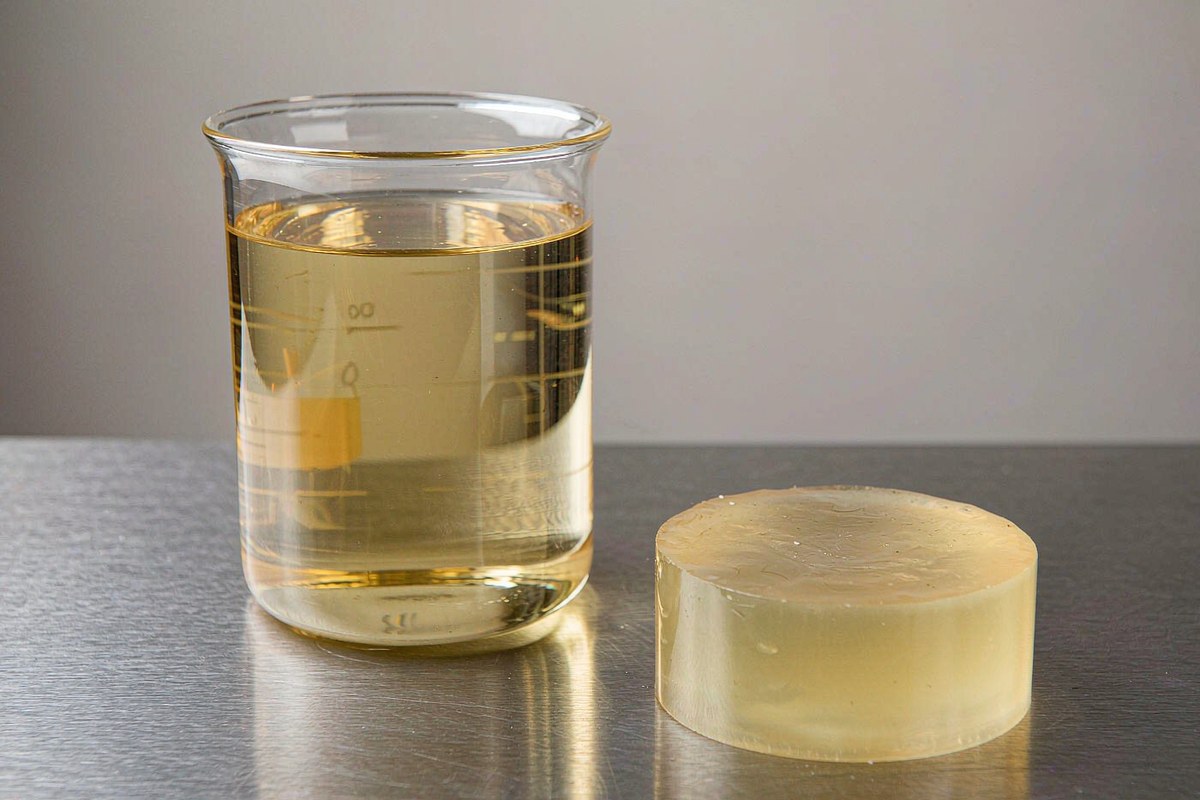
Figure 1. YLSE-0510 in the beaker and a cured disc from the same lot. Colour and thin flow are what buyers check first; neither predicts a 5 kg mould.
All three grades share one molecule: N,N-diglycidyl-4-glycidyloxyaniline, a triglycidyl ether of p-aminophenol with two glycidyl groups on the nitrogen and one on the phenolic oxygen. A bisphenol A liquid carries 2.0.
Low viscosity is why buyers pick this family: YLSE-0510 pours at 400-900 cps, so it wets glass roving and copper inserts without solvent. The cost appears after demoulding, when castings crack at inserts and cores char.
One chemistry at three viscosity bands, so one identity table covers all three.
Table 1. Identity data for YLSE-0500, YLSE-0510 and YLSE-0510L as published, accessed 2026-11-13.
Item |
YLSE-0500 / 0510 / 0510L |
Chemical name |
N,N-diglycidyl-4-glycidyloxyaniline |
CAS number |
5026-74-4 |
Epoxide groups |
3 (trifunctional) |
Molecular formula |
C15H19NO4 (calculated, 277.32 g/mol) |
Package |
Drum |
Shelf life |
At least 12 months, original closed drum, ambient |
Table 2 repeats the parameter block as printed; a dash means empty.
Table 2. Published parameters for YLSE-0500, YLSE-0510 and YLSE-0510L, accessed 2026-11-13.
Property |
YLSE-0500 |
YLSE-0510 |
YLSE-0510L |
Appearance |
Brown liquid |
Yellow liquid |
Yellow liquid |
EEW, g/eq |
95-105 |
93-106 |
95-105 |
Viscosity, cps at 25 °C |
1,500-6,000 |
400-900 |
500-1,000 |
Volatiles, % |
Max. 1.5 |
Max. 1.0 |
Max. 1.0 |
Total chlorine, ppm |
- |
- |
Max. 800 |
Hydrolyzable chlorine, ppm |
2,000 |
1,000 |
Max. 200 |
Epoxy equivalent weight is titrated under ASTM D1652, and each lot carries that value on its certificate. Viscosity is quoted at 25 °C, where a 10 °C fall can double the figure.
Two sources feed this report: the published pages and arithmetic. EEW windows, viscosities and chlorine limits are quoted as printed; molecular weight and hardener weights are calculated and labelled as such.
The theoretical EEW of 92.4 g/eq is 277.32 g/mol divided by three epoxide groups. Published windows sit above it because lots carry a few percent of higher oligomers. Duplicate titration is normal; treat one reading as provisional.
Three epoxide groups in 277 g/mol give about 10.5 eq/kg, against 5.3 eq/kg at EEW 188. Double the sites, double the heat.
Ring opening of a glycidyl ether by an amine releases about 105 kJ/mol, so a kilogram of YLSE-0500 carries near 1,050 kJ. At 1.7 kJ/kg·K, an adiabatic core would pass 500 °C.
Geometry decides. A 100 g cup in a 25 °C room sheds heat through the wall. A 5 kg block in a steel mould keeps it, so charring starts at the core.
The aniline nitrogen also accelerates the reaction, so the resin gels sooner than 400 cps suggests. Gel time shortens as the shop warms, and not linearly.
Table 3. Field symptoms, causes and countermeasures for YLSE-0500, YLSE-0510 and YLSE-0510L castings.
Symptom |
Cause |
Countermeasure |
Smoke, dark core |
Exotherm above 2 kg with a fast aliphatic amine |
Cap batch mass, chill the mould, or use an anhydride |
Cracks at inserts |
Shrinkage stress locked in by fast gel |
Stage the cure, pre-warm inserts to 60 °C |
Tg below 200 °C |
Hardener dosed from the datasheet midpoint |
Recalculate phr, post-cure 2 h at 160 °C |
Bubbles, pinholes |
1.5% volatiles plus air held by a 400 cps liquid |
Degas 10-15 min at 5 mbar |
Leakage current rise |
2,000 ppm hydrolyzable chlorine in a DC field |
Move the part to YLSE-0510L at 200 ppm |
Brown resin rejected |
The 0500 grade is brown by specification |
Judge against the grade descriptor |
Gel in the line |
Pot life collapsed at 35 °C ambient |
Hold at 25-30 °C, meter on demand |
Two rows of Table 3 are grade-selection problems, not process problems. Chlorine and colour cannot be degassed, filtered or post-cured out of a part.
The closest alternative is YLSE-0600, the 3-isomer of the same molecule, at 10,000-25,000 cps: same formula, fifty times the viscosity.
Table 4. Property comparison, with EEW-derived heats for ranking only: YLSE-0500 family against YLSE-0600, YLSE-721 and a bisphenol A liquid.
Property |
YLSE-0500 family |
YLSE-0600 |
YLSE-721 |
YLE-128 |
Epoxide groups |
3 |
3 |
4 |
2 |
EEW, g/eq |
93-106 |
100-110 |
105-125 |
184-190 |
Viscosity at 25 °C, cps |
400-6,000 |
10,000-25,000 |
3,000-7,000 |
11,000-15,000 |
Hydrolyzable chlorine, ppm |
200-2,000 |
Not published |
Not published |
Max. 500 |
Heat per kg at full cure |
About 1,050 kJ |
About 980 kJ |
About 830 kJ |
About 540 kJ |
Typical role |
Casting, RTM, winding |
Adhesive, laminating |
Aerospace composites |
General purpose |
Pick YLSE-0600 when the resin must stay put, and 0500 or 0510 when it must flow into a closed mould. Their EEW windows overlap, so viscosity settles it.
Hardener weight follows one line: phr = 100 × AHEW ÷ EEW. Stoichiometry failures start with dosing from the EEW midpoint instead of the lot certificate.
Table 5. Hardener demand per 100 g of resin at three EEW points inside the published window.
Hardener |
AHEW, g/eq |
phr at EEW 95 |
phr at EEW 100 |
phr at EEW 106 |
Diethylenetriamine, theoretical |
20.6 |
21.7 |
20.6 |
19.4 |
95 |
100.0 |
95.0 |
89.6 |
|
MHHPA anhydride, k = 0.85 |
142.96 |
150.5 |
143.0 |
134.9 |
Worked example. A 20 kg batch of YLSE-0500 arrives at 104 g/eq. Against YLH-6005 at AHEW 95 the correct addition is 91.3 phr, or 18.26 kg. The nominal 100 g/eq gives 95.0 phr, or 19.0 kg, so the gap is 0.74 kg and 4% excess amine.
Surplus amine plasticises the network, lowers Tg and raises water uptake. A 4% surplus can pull a 200 °C system into the 180s, and the drop gets blamed on the resin.
Anhydrides invert the arithmetic. MHHPA carries 168.19 g/eq, and practice applies 0.85 of that, giving 143 phr at EEW 100. The heavy addition is why anhydride casting runs at 80-100 °C.
Four settings keep it workable: batch mass, resin temperature, vacuum, and cure ramp.
• Cap batches at 2 kg with an aliphatic amine at 25 °C, and halve that above 30 °C.
• Hold resin at 25-30 °C. Warming to 40 °C halves pot life unless the section is under 3 mm.
• Degas at 5 mbar for 10-15 minutes. The 1.5% volatile limit on YLSE-0500 makes the step non-optional.
• If the system is aromatic-amine and aimed at the 200 °C class, ramp to 80 °C, hold 2 h, then post-cure 2 h at 160 °C.
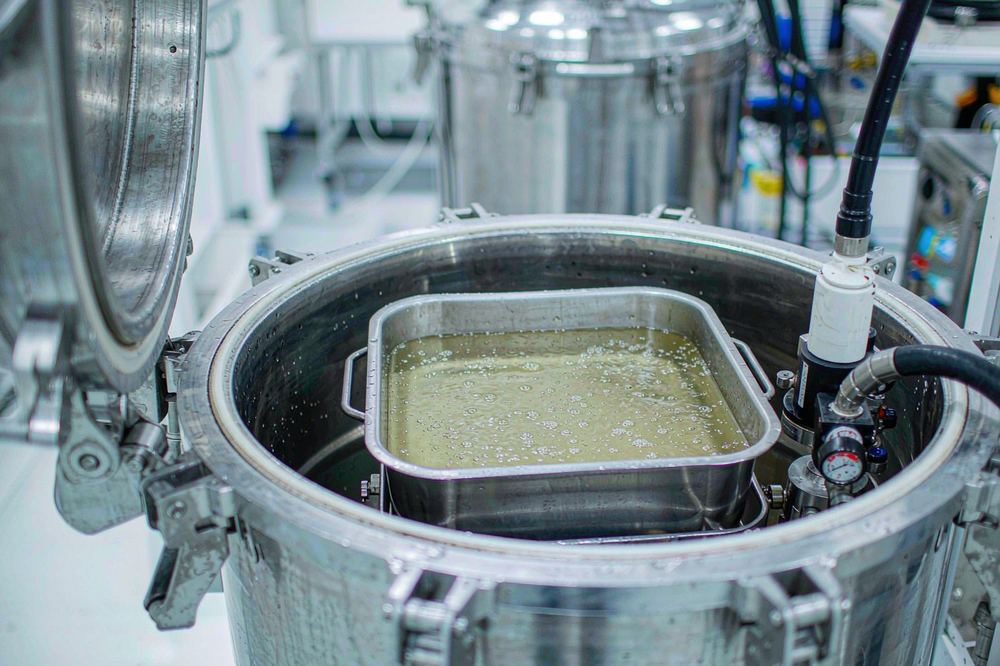
Figure 2. Degassing a YLSE-0510 mix at 5 mbar. Foam rises, collapses, then the resin clears from the centre outwards.
Bubbles that survive degassing usually come from the hardener. Polyetheramine takes up water in an open drum, and 0.5% water there foams a casting that looked clear in the cup.
The published list runs from electrical casting to composite winding; grade choice follows chlorine and viscosity.
Table 6. Grade selection by application and process.
Application |
Process |
Grade |
Reason |
HV bushings, insulators |
APG, vacuum casting |
YLSE-0510L |
200 ppm hydrolyzable chlorine |
Micro-motor sealing |
Vacuum casting |
YLSE-0510 |
400-900 cps wets fine wire |
Carbon fibre winding |
Filament winding |
YLSE-0510 |
Low drag through the bath |
RTM and VARTM panels |
Resin injection |
YLSE-0510 |
Fills a 2 m flow path at 25 °C |
High-temperature adhesive |
Hand mix, bonded joint |
YLSE-0500 |
1,500-6,000 cps stays on the bondline |
Reactive diluent |
Blend at 5-15 phr |
YLSE-0510L |
Trifunctional, so Tg retention beats BGE |
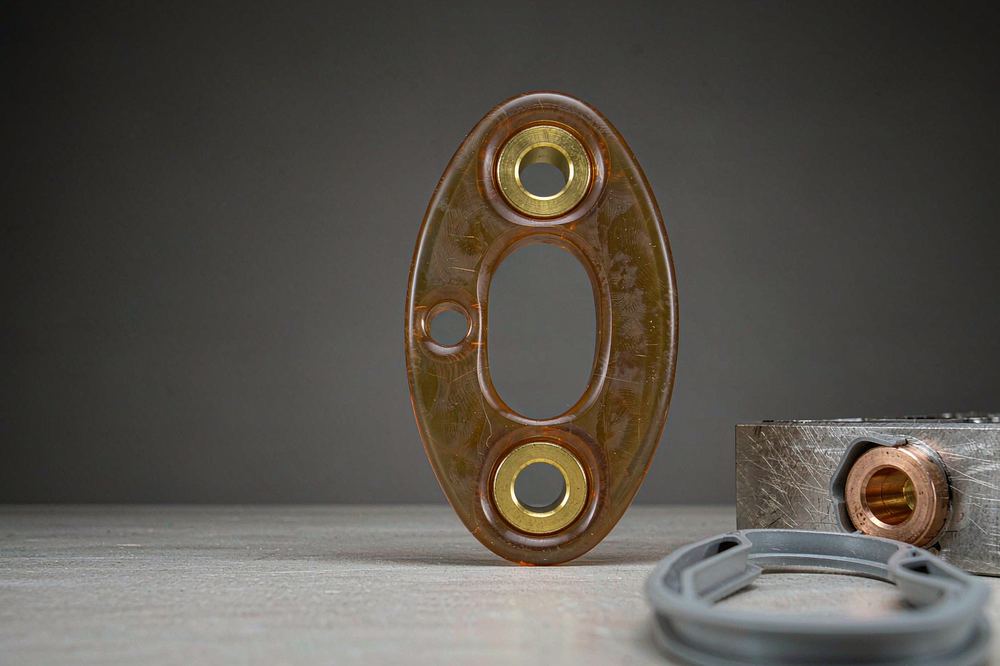
Figure 3. A cast insulator plate with brass inserts, moulded from YLSE-0510L. Shrinkage stress concentrates at the bosses, where the cure ramp matters more than the mix ratio.
For high-voltage parts the 200 ppm figure matters more than viscosity. Ionic chlorine migrates under a DC field in humid air, so leakage current appears months after the part passed its test.
The 200 °C glass transition figure is a class statement for post-cured systems, not a measured value. The product URL still reads 44-methylenebisnn-diglycidylaniline while the page describes the triglycidyl p-aminophenol grades, so order by CAS. Grade windows differ inside one family, 93-106 g/eq across the three, so the lot certificate decides.
Chlorine is the other constraint. At 2,000 ppm, hydrolyzable chlorine rules YLSE-0500 out of high-voltage insulation, while YLSE-0510L caps that at 200. The pages print no Gardner number; appearance is brown for YLSE-0500 and yellow for the other two, so a dark drum is specification, not age.
Do not run unfilled sections above 5 kg with an aliphatic amine, or specify YLSE-0510 where the drawing names a chlorine ceiling under 200 ppm.
Checks for every drum: EEW by titration with n = 3, viscosity at 25 °C, and water by Karl Fischer according to ASTM E203. Chlorine matters only for electrical parts, and then on every lot.
Viscosity is measured at 25 °C under ASTM D445, and colour, where quoted, under ASTM D1544. If a drum titrates at 104 g/eq it still sits inside the YLSE-0510 window, and the dosage follows the titration.
Storage runs 12 months from manufacture in the closed original drum. Resin from a warm warehouse still titrates in window, and still gels faster.
Safety data comes from the MSDS, limits from the TDS. Skin contact is the routine risk with glycidyl ethers, and gloves rated for epoxy beat nitrile examination gloves.
Viscosity and chlorine. YLSE-0500 pours at 1,500-6,000 cps with 2,000 ppm hydrolyzable chlorine, YLSE-0510 at 400-900 cps with 1,000 ppm, YLSE-0510L at 500-1,000 cps with 200 ppm.
Fast gel at high crosslink density locks shrinkage stress into the part, and it concentrates at inserts. Stage the cure, pre-warm inserts, and hold the part at 60 °C before the post-cure ramp.
In thin sections, yes. Above about 2 kg the exotherm outruns the mould, and the core chars while the surface still looks sound. Chill the mould or move to an anhydride above that mass.
Check two things first: whether the hardener weight came from the lot EEW, and whether the post-cure reached 160 °C in the core. Both give the same 20-40 °C shortfall.
It is the grade intended for that duty, at 200 ppm hydrolyzable chlorine. Suitability still depends on the cured system, the design field and the applicable standard; a low chlorine figure is not a certification.
Yes, at 5-15 phr in a bisphenol A or phenolic system. Trifunctional dilution costs less Tg than butyl ether and more per kilogram, so the trade-off is thickness against budget.
YLSE-0500, YLSE-0510 and YLSE-0510L are one triglycidyl p-aminophenol molecule at three viscosity and purity bands, and the band decides the application.
Cure enthalpy near 1,050 kJ/kg sits behind most field failures here. Mass limits, a staged cure and lot-specific hardener weights address it; extra degassing does not.
Chlorine rather than viscosity separates 0510L from 0510, and 200 ppm against 2,000 ppm is a factor of ten. Take EEW from the certificate: on a 20 kg batch the midpoint habit costs 0.74 kg of hardener.
1. Yolatech, N,N-diglycidyl-4-glycidyloxyaniline YLSE-0500 / 0510 / 0510L, https://www.yolatech.com/44-methylenebisnn-diglycidylaniline (accessed 2026-11-13).
2. Yolatech, 3-glycidyloxy-N,N-diglycidylaniline YLSE-0600, https://www.yolatech.com/3-glycidyloxy-nn-diglycidylaniline-ylse-0600-afg-90m-cas-71604-74-5 (accessed 2026-11-13).
3. Yolatech, 4,4'-methylenebis(N,N-diglycidylaniline) YLSE-721, https://www.yolatech.com/44-methylenebisnn-diglycidylaniline-ylse-721721c721l (accessed 2026-11-13).
4. Yolatech Technical Data Sheet (TDS) and Certificate of Analysis (COA) for YLSE-0500, YLSE-0510 and YLSE-0510L, CAS 5026-74-4.
5. ASTM D1652, epoxy content of epoxy resins; ISO 3001, epoxide equivalent.
6. ASTM E203, water by Karl Fischer titration; ASTM D445, kinematic viscosity; ASTM D1544, Gardner colour.
7. Yolatech, bisphenol A epoxy resin grade table, https://www.yolatech.com/bisphenol-a-epoxy-resin (accessed 2026-11-13).

 IPv6 network supported