Home

MXDA

  • Common Amine Curing Agents and Application Conditions
    Common Amine Curing Agents and Application Conditions
    Jul 08, 2026
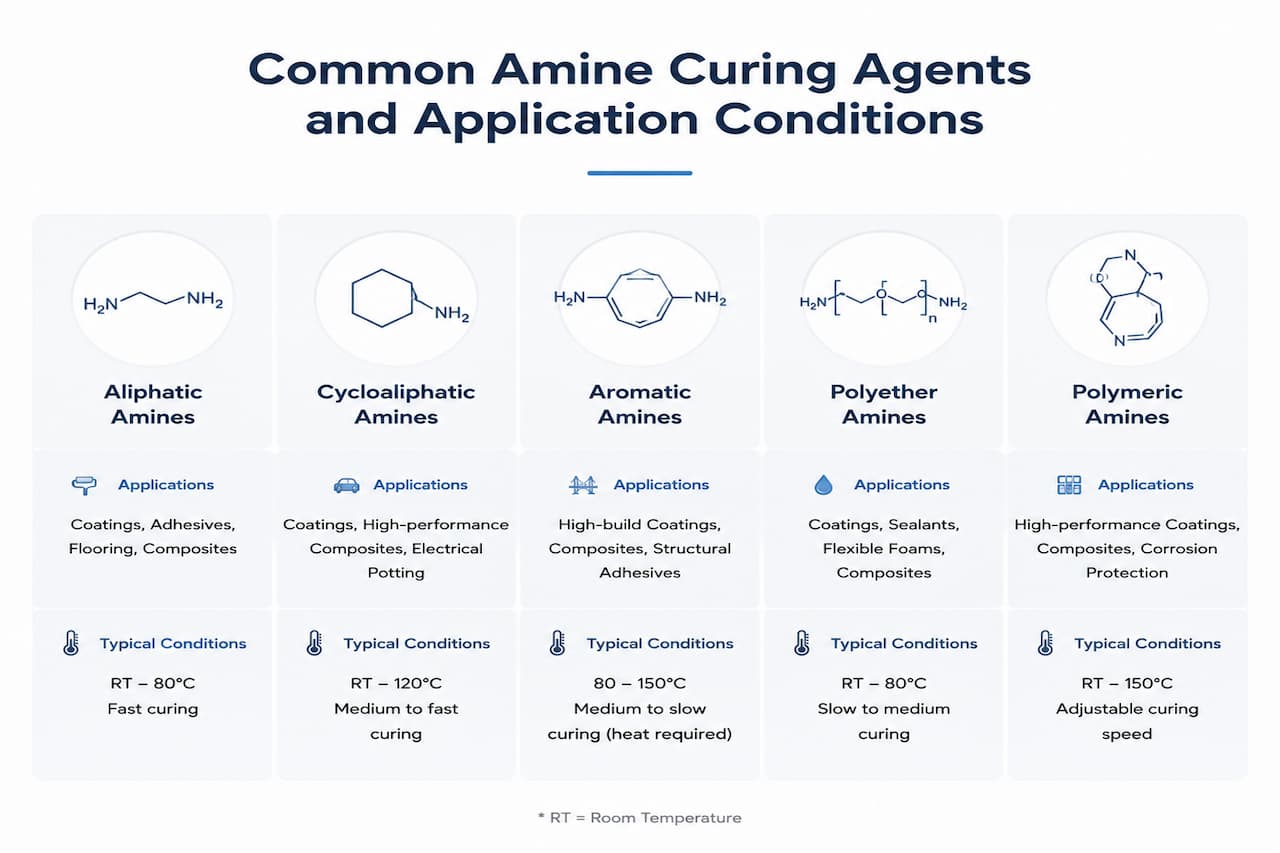
    DETA (Diethylenetriamine)   Appearance: Colorless to pale yellow transparent liquidChemical formula: C₄H₁₃N₃Molecular weight: 103.166CAS No.: 111-40-0Melting point: -40 °CBoiling point: 206 °CDensity: 0.96 g/cm³Amine value (mg KOH/g): 1300–1400Viscosity (25 °C) mPa·s: 5–20Mixing ratio: YLE-128 (E-51) epoxy resin : DETA (Diethylenetriamine) = 100 g : 10–11 g (by weight) YLE-220 (E-44) epoxy resin : DETA (Diethylenetriamine) = 100 g : 10 g (by weight)Curing conditions: 25 °C / 3–6 hours or 60 °C / 1–2 hours   TETA (Triethylenetetramine)   Appearance: Colorless to slightly yellow viscous liquidChemical formula: C₆H₁₈N₄Molecular weight: 146.234CAS No.: 112-24-3Melting point: 12 °CBoiling point: 266–267 °CDensity: 0.982 g/cm³Flash point: 135 °C (CC)Amine value (mg KOH/g): 1100–1200Viscosity (25 °C) mPa·s: 5–30Mixing ratio: YLE-128 (E-51) epoxy resin : TETA (triethylenetetramine) = 100 g : 13–14 g (by weight) YLE-220 (E-44) epoxy resin : TETA (triethylenetetramine) = 100 g : 11–13 g (by weight)Curing conditions: 25 °C / 3–6 hours or 60 °C / 1–2 hours   Polyether amine curing agent Chemical name: Polyether amine; Polyether polyamine; Polyetheramine (PEA); Aliases: Polypropylene glycol bis(2-aminopropyl ether); 2-(Aminooxy)propan-1-amineCAS No.: 9046-10-0   Polyether amine curing agent D-230 Mixing ratio: YLE-128 (E-51) epoxy resin : D-230 = 100 g : 30 gCuring conditions: 25 °C / 36 hours or 60 °C / 3 hours or 80 °C / 1 hourCured product characteristics: Colorless and transparent, high hardness, high toughness, not easily brittle. Suitable for handicrafts, nameplates, and potting applications with special requirements.   Polyether amine curing agent D-400 Mixing ratio: YLE-128 (E-51) epoxy resin : D-400 = 100 g : 50 gCharacteristics: Good toughness after curing, low viscosity, high mechanical performance of the cured product, and resistance to high-low temperature thermal shock (-35 °C to 120 °C).   Polyether amine curing agent D-2000 Mixing ratio: YLE-128 (E-51) epoxy resin : D-2000 = 40 g : 100 gCuring conditions: 80 °C / 6–10 hoursCharacteristics: D-2000 is colorless and transparent. The cured product exhibits excellent elasticity, high peel strength, colorless transparency, high toughness, not easily brittle, and strong adhesion. Suitable for potting applications with special requirements, and resistance to high-low temperature thermal shock (-40 °C to 130 °C). When combined with liquid epoxy resin, D-2000 is used for colorless and transparent applications in composites, wind power, handicrafts, and nameplates. TYPE D-230 D-400 T403 D-2000 D-5000 Appearance Colorless transparent liquid Colorless transparent liquid Colorless transparent liquid Colorless transparent liquid Colorless transparent liquid Viscosity (MPa·s / 25℃) 3~10 10~50 500~200 260~280 300~600 Density (25℃, g/cm³) 0.92~0.98 0.92~0.98 0.92~0.98 0.92~0.98 0.92~0.98 Active Hydrogen Equivalent 58 100 85 500 1250 Film Drying Time (25℃) 36 hours 72 hours 24 hours 100 hours 500 hours Recommended Mixing Ratio (with E51) 10g : 3g 10g : 5g 10g : 4.5g 10g : 25g 10g : 65g Pot Life (Min / 25℃) ≥3 hours ≥6 hours ≥4 hours ≥24 hours ≥48 hours Curing Conditions 80°C / 6~10 hrs 80°C / 6~10 hrs 80°C / 6~10 hrs 80°C / 6~10 hrs 80°C / 6~10 hrs Cured Hardness (Shore) 90D 65D 85D D20 --     1,3-BAC (1,3-Bis(aminomethyl)cyclohexane)  CAS No.: 2579-20-6 13-BAC is primarily used as an epoxy curing agent or for the preparation of modified epoxy curing agents. Compared to aromatic amine curing agents, it not only has lower viscosity and better handling properties but also yields cured products with outstanding resistance to ultraviolet light (anti-yellowing), as well as excellent weather resistance, temperature resistance, water resistance, and chemical resistance. Moreover, it cures rapidly and can be used for curing at either room temperature or low temperatures. It is widely applied in high-end outdoor floor coatings, stone adhesives, electronic potting compounds, composite materials (such as automotive parts and wind turbine blades), and in the fields of jewelry adhesives and crystal adhesives where appearance and color quality are of paramount importance.Mixing ratio: YLE-128 (E-51) epoxy resin : 1,3-BAC = 100 g : 18–20 gCuring conditions: 25 °C / 6–12 hours   MXDA (m-Xylylenediamine)  CAS No.: 1477-55-0Characteristics: m-Xylylenediamine is a high-performance and widely used epoxy resin curing agent, and also an important fine chemical intermediate. It can be used in the synthesis of polyurethanes, a range of epoxy resins, rubber additives, photosensitive plastics, pesticides, fiber finishing agents, rust inhibitors, chelating agents, lubricants, paper processing agents, and electronic chemicals. In nylon products such as MXD6 (a polycondensate of MXDA and adipic acid), and in the synthesis of functional epoxy resins, MXDA is widely utilized due to its unique structure, which imparts various excellent physical and chemical properties.Mixing ratio: YLE-128 (E-51) epoxy resin : MXDA = 100 g : 18–20 gCuring conditions: 50–60 °C / 3 hours + 120–150 °C / 2 hours   DETDA (Diethyltoluenediamine)  CAS No.: 68479-98-1Characteristics: DETDA is equivalent to Ethancure 100 and Lonza DETDA 80. It is a highly effective chain extender for polyurethane elastomers, and can also be used as a curing agent for polyurethanes and epoxy resins, as an antioxidant for epoxy resins, and in industrial oils and lubricants. Additionally, it serves as an intermediate for organic synthesis.Mixing ratio: YLE-128 (E-51) epoxy resin : DETDA = 100 g : 25 gCuring conditions: 100 °C / 4 hours + 150 °C / 1 hour   PACM: 4,4'-Diaminodicyclohexylmethane CAS No.: 1761-71-3PACM curing agent (hydrogenated MDA) has performance equivalent to Air Products' Amicure PACM and BASF's DC (i.e., Baxxodur EC330). It is used as an epoxy resin curing agent and as a curing agent for epoxy composite materials. It is also applied as a chain extender and additive in polyaspartic esters, polyamides (PA), polyurethanes (PU), and polyurea spray elastomers (SPUA). Application fields include high-grade composites, filament winding, lamination, casting, RIM, pultrusion, etc.Mixing ratio: YLE-128 (E-51) epoxy resin : PACM = 100 g : 25–30 gCuring conditions: 25 °C / 24 hours or 60 °C / 3 hours   DDS: 4,4'-Diaminodiphenyl sulfone CAS No.: 80-08-04,4'-Diaminodiphenyl sulfone is an epoxy resin curing agent with excellent high-temperature resistance. It is used in high-temperature-resistant prepregs, high-temperature-resistant molded products (automotive molds, rail transit, aerospace, etc.), and high-temperature-resistant laminates.Mixing ratio: YLE-128 (E-51) epoxy resin : DDS = 100 g : 25–35 gCuring conditions: 130 °C / 2 h + 200 °C / 2 h   DDM: 4,4'-Diaminodiphenylmethane CAS No.: 101-77-9Liquid DDM product is a mixture containing approximately 60% 4,4'-diaminodiphenylmethane and 40% polyphenyl polymethylene polyamine, appearing as a light yellow viscous liquid at room temperature. DDM is an important chemical intermediate. In addition to being primarily used in the production of MDI and HMDI, it is also extensively used in the preparation of polyimide (PI) insulating varnishes, polyesterimide (PEI) insulating varnishes, bismaleimide resins, and other electrical insulation materials. It can also be used as a curing agent for epoxy resins and as a chain extender for polyurethane elastomers.Mixing ratio: YLE-128 (E-51) epoxy resin : liquid DDM = 100 g : 30–35 g (flexible)Curing conditions: 80 °C / 3–4 hours
    Read More
  • The 50 types of Amine-Based Fine Chemicals
    The 50 types of Amine-Based Fine Chemicals
    Jul 03, 2026
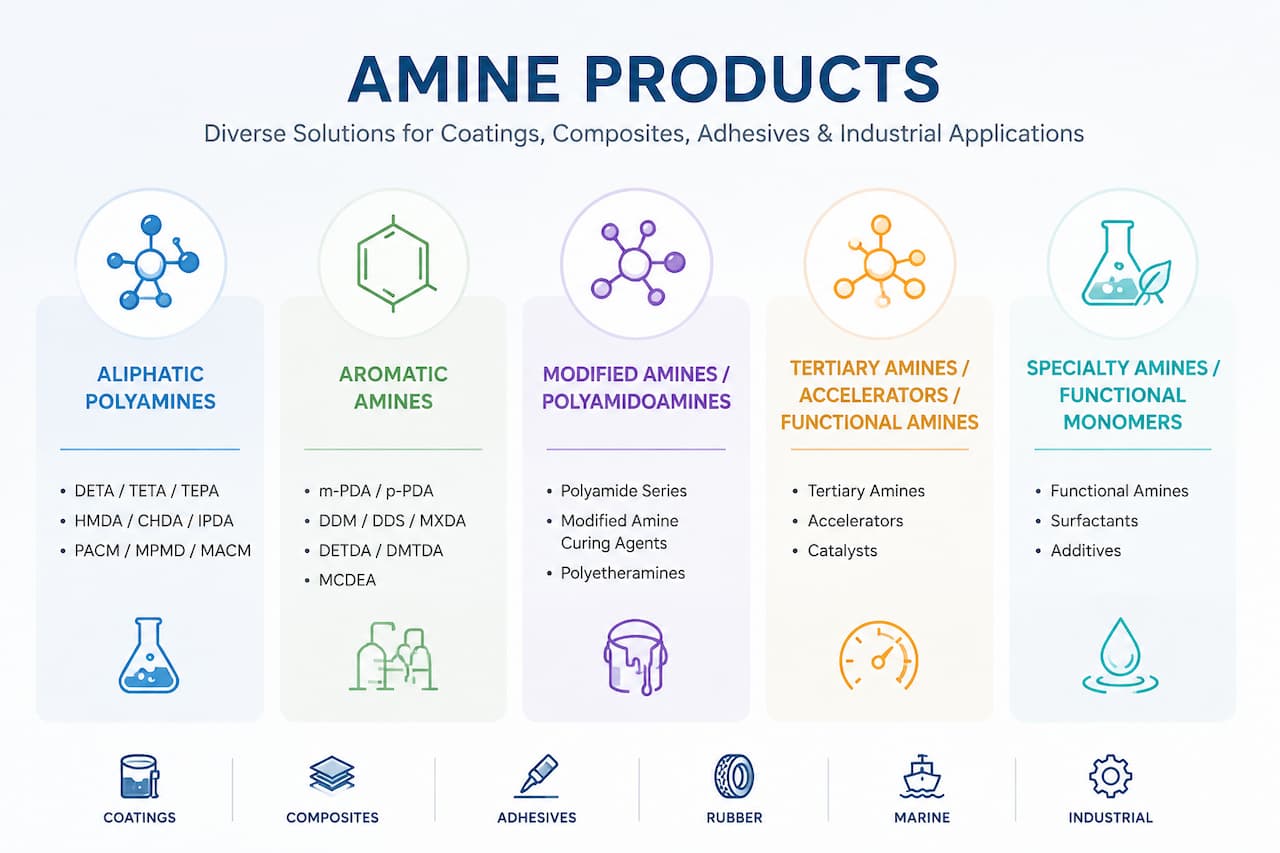
        Aliphatic Polyamines Diethylenetriamine (DETA) – Aliphatic polyamine; ambient-temperature epoxy curing agent used in flooring, anticorrosion, and adhesion applications. Features high reactivity and low viscosity. Triethylenetetramine (TETA) – Polyethylene polyamine; epoxy curing agent with excellent chemical resistance, widely used in heavy-duty anticorrosion and composite materials. Tetraethylenepentamine (TEPA) – Highly reactive polyamine; used in epoxy curing, ion-exchange resins, and as a raw material for oilfield auxiliaries. Pentaethylenehexamine (PEHA) – High-amino polyamine; applied in epoxy curing, chelating agents, and water treatment chemicals. 1,6-Hexamethylenediamine (HMDA) – Aliphatic diamine; used in nylon 66, polyurethanes, and epoxy curing agents to enhance heat resistance and hardness. 1,2-Cyclohexanediamine (CHDA) – Cycloaliphatic diamine; high-temperature epoxy curing agent offering yellowing resistance, high gloss, and high mechanical strength. Isophoronediamine (IPDA) – Cycloaliphatic diamine; weather-resistant epoxy curing agent with low yellowing tendency, used in topcoats and anticorrosion coatings. Bis(4-aminocyclohexyl)methane (PACM/DACM) – Cycloaliphatic diamine; offers high heat resistance and low moisture absorption; used in epoxy, polyamide, and PU curing. 2-Methylpentamethylenediamine (MPMD) – Modified aliphatic diamine; low viscosity and low volatility; used in epoxy flooring and fast-cure systems. 3,3'-Dimethyl-4,4'-diaminodicyclohexylmethane (MACM) – Cycloaliphatic modified diamine; low viscosity and high toughness; applied in epoxy composites and LED encapsulation.   Aromatic Amines m-Phenylenediamine (m-PDA) – Aromatic diamine; used in high-temperature epoxy curing, polyimides, and aramid fiber production; offers high heat resistance. p-Phenylenediamine (p-PDA) – Aromatic diamine; used in high-temperature-resistant resins, epoxy curing, and dye intermediates. 4,4'-Diaminodiphenylmethane (DDM) – Aromatic diamine; high-temperature epoxy curing agent providing high Tg, high heat resistance, and high strength. 4,4'-Diaminodiphenylsulfone (DDS) – Highly heat-resistant aromatic amine; used in aerospace epoxy, electronic potting, and heat-resistant structural adhesives. m-Xylylenediamine (MXDA) – Aromatic-aliphatic mixed diamine; low toxicity and high adhesion; used in epoxy, nylon, and coatings. Diethyltoluenediamine (DETDA) – Aromatic diamine; PU chain extender and epoxy curing agent with fast reaction and high elasticity. 3,5-Dimethylthio-2,4-toluenediamine (DMTDA) – Low-temperature-active aromatic diamine; used in PU elastomers, adhesives, and CASE applications. 4,4'-Methylenebis(3-chloro-2,6-diethylaniline) (MCDEA) – Sterically hindered aromatic diamine; slow-reacting PU chain extender offering high resilience and abrasion resistance.   Modified Amines / Polyamidoamines Polyamide 650 – Condensate of dimer acid and polyamine; low toxicity and good toughness; general-purpose epoxy curing agent. Polyamide 651 – High-viscosity polyamide; enhances adhesion and flexibility; used in anticorrosion coatings and marine paints. Low-Molecular-Weight Polyamide Curing Agent (300#) – Fast-drying and low-volatility; used in flooring, self-leveling compounds, and adhesives. Modified Cycloaliphatic Amine Curing Agent (EH-260) – Modified IPDA type; low viscosity, weather resistance, and high gloss; used in topcoat systems. Phenalkamine (T-31) – Phenol-formaldehyde-polyamine condensate; cures at low temperature and under damp conditions; used in underground engineering and anticorrosion. Modified Phenalkamine (T-33) – High-solid, low-odor; suitable for winter construction and damp-surface curing. Mannich Base Modified Polyamine (EH-36) – High activity and water resistance; used in underwater curing and heavy-duty steel anticorrosion. Polyetheramine D230 – Polyether diamine; low viscosity and high toughness; used in epoxy flooring and lightweight composites. Polyetheramine D400 – Good flexibility and low moisture absorption; used in adhesives, composites, and decorative coatings. Polyetheramine D2000 – Long-chain flexible diamine; enhances impact resistance and toughness; used in PU and epoxy toughening. Polyetheramine T403 – Trifunctional polyether amine; high crosslinking density; used in structural adhesives and wear-resistant flooring. Polyetheramine T5000 – Ultra-flexible triamine; used in high-elasticity systems, adhesives, and elastic coatings.   Tertiary Amines / Accelerators / Functional Amines Triethanolamine (TEA) – Tertiary amine; used as neutralizer, emulsifier, cement grinding aid, and PU catalyst. Diethanolamine (DEA) – Alkanolamine; used in desulfurization, emulsification, PU chain extension, and as a pH regulator in coatings. Monoethanolamine (MEA) – Basic absorbent, neutralizer; used in metalworking fluids and as a surfactant raw material. N,N-Dimethylethanolamine (DMEA) – Tertiary amine catalyst; used in PU foaming, epoxy acceleration, and aqueous neutralization. N,N-Dimethylbenzylamine (BDMA) – Tertiary amine accelerator; used in fast epoxy curing, casting, and electronic potting. 2,4,6-Tris(dimethylaminomethyl)phenol (DMP-30) – Tertiary amine accelerator; significantly increases epoxy curing speed; suitable for low-temperature applications. Triethylenediamine (DABCO) – Tertiary amine; PU foaming catalyst and gel catalyst; used in sponge and rigid foams. N-Methylmorpholine (NMM) – Cyclic tertiary amine; used as PU catalyst, solvent, and organic synthesis base. N-Ethylmorpholine (NEM) – Basic catalyst; used in polyurethane foaming and coating auxiliaries. 1,8-Diazabicyclo[5.4.0]undec-7-ene (DBU) – Superbase catalyst; used in epoxy, polyurethane, and resin synthesis catalysis.   Specialty Amines / Functional Monomers N-Aminoethylpiperazine (AEP) – Polyamine; used as epoxy curing agent, intermediate, lubricant, and chelating agent. Piperazine (PIP) – Cyclic diamine; used in pharmaceutical intermediates, polyurethanes, epoxy curing, and desulfurization agents. N,N'-Di-sec-butyl-p-phenylenediamine (DBPD) – Antioxidant/antiozonant amine; used in rubber, plastics, and oil products for antioxidation and anti-aging. Octyl/Dibutyl Diphenylamine Compound (ODPA/BDPA) – High-temperature antioxidant amine; used in lubricating oils, transformer oils, and industrial oils. 3-Methoxypropylamine (MOPA) – Alkoxy monoamine; low viscosity and low volatility; used in waterborne resins and epoxy auxiliaries. N-(3-Aminopropyl)imidazole (API) – Imidazole-modified amine; used in medium-temperature epoxy curing, adhesives, and copper-clad laminates. 2-Methylimidazole-Modified Amine (2MZ Curing Agent) – Imidazole adduct; used in epoxy powder coatings, electronic encapsulation, and latent curing. Quaternary Ammonium-Type Cationic Amines (1831, 1227 series) – Cationic surfactants; used as bactericides, softeners, antistatic agents, and emulsifiers. Fatty Amine Polyoxyethylene Ethers (C12-amine EO5, C18-amine EO10) – Nonionic surfactants; used in emulsification, dispersion, wetting, and pesticide adjuvants. Trioctylmethylammonium Chloride (TOMAC) – Quaternary ammonium phase-transfer catalyst; used in organic synthesis, extraction, and phase-transfer catalysis.
    hot Tags : IPDA DETA TETA MXDA DETDA HMDA
    Read More
  • Synthesis, Applications, and Derivatives of m-Xylylenediamine
    Synthesis, Applications, and Derivatives of m-Xylylenediamine
    Jun 25, 2026
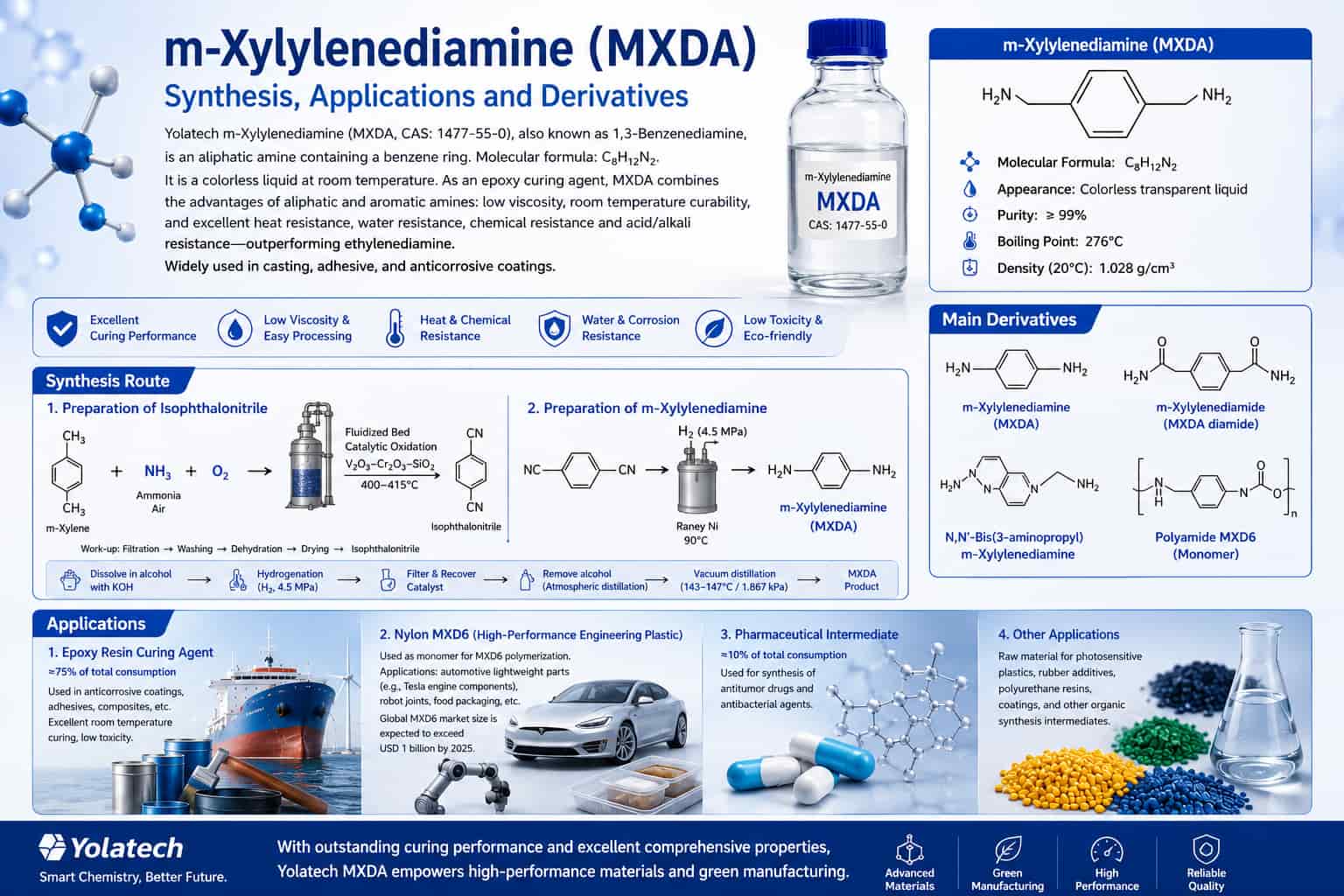
    Yolatech's m-Xylylenediamine (MXDA, CAS No.: 1477-55-0), also known as 1,3-benzenedimethanamine, is an epoxy resin curing agent belonging to the class of aliphatic amines containing a benzene ring. It has the molecular formula C8H12N2 and appears as a colorless liquid at room temperature.   As an epoxy resin curing agent, it combines the characteristics of both aliphatic and aromatic amines. It features low viscosity and can cure at room temperature. The benzene ring in its molecular structure endows the cured product with superior heat resistance, water resistance, acid and alkali resistance, and chemical resistance compared to ethylene amines. Consequently, it is widely used in casting, bonding, and anti-corrosion coatings. It also serves as a raw material for producing photosensitive plastics, rubber auxiliaries, polyurethane resins, and coatings, as well as an intermediate in organic synthesis.   1. m-Xylylenediamine and its Derivatives  (1)MXDA → Hydrogenation → 1,3-BAC Features: Low viscosity Low freezing point Good gloss (2)MXDA + ECH → G-328 Features: Good chemical resistance Good adhesion Good low-temperature properties Low CO₂ absorption (3)MXDA → Deamination → PMDA Features: Good electrical properties Low toxicity High and low temperature resistance (4)Modified G-328 Produced by reacting with condensed glycerol ester mixtures Features: Good metal adhesion (5)MXDA + Styrene → Gaskamine 240 Features: Long operating time (long pot life) Stable color Low CO₂ absorption     2. Synthesis of m-Xylylenediamine (Yolatech MXDA) (1) Preparation of Isophthalonitrile Isophthalonitrile is prepared by the ammoxidation of m-xylene with ammonia and air in a fluidized bed catalytic reactor. The catalyst used is V2O5-Cr2O3-SiO2, and the reactor bed temperature is maintained at 400–415℃. The generated isophthalonitrile is collected via thin-walled condensation, then washed with water, dehydrated by centrifugation, and dried to obtain the final product. The consumption per ton of isophthalonitrile is 1200 kg of m-xylene (90%), 1200 kg of liquid ammonia (99%), and 3 kg of catalyst.   (2) Preparation of m-Xylylenediamine Isophthalonitrile, alcohol, and potassium hydroxide are mixed and dissolved, then added to a high-pressure autoclave, followed by the addition of a Raney nickel catalyst paste. The relevant valves are closed, and the air inside the autoclave is evacuated. The vessel is purged with nitrogen several times until all air is removed. After evacuating the nitrogen, hydrogen is pressurized into the autoclave. Under stirring, the temperature is raised to about 90℃, and the hydrogen pressure is regulated and maintained at 4.5 MPa. Under these reaction conditions, hydrogen is continuously supplied until absorption ceases. The mixture is then cooled, excess pressure is released, and the material is discharged and filtered to recover the catalyst. The filtrate is sent to a fractional distillation unit. The alcohol is first distilled off at atmospheric pressure, followed by vacuum distillation. The fraction collected at 143–147℃ under 1.867 kPa is the finished product.     3. Application Fields of Yolatech MXDA (1) Epoxy Resin Curing Agent: Accounts for 75% of total consumption, used in anti-corrosion coatings, adhesives, and other fields due to its excellent room-temperature curing performance and low toxicity. (2) Nylon MXD6: Used as a polymerization monomer to prepare high-performance engineering plastics. It is applied in automotive lightweighting (e.g., Tesla engine components), robot joints, food packaging, and other fields. The global MXD6 market size is expected to exceed $1 billion by 2025. (3) Pharmaceutical Intermediate: Used in the synthesis of anti-tumor drugs and antibacterial agents, accounting for about 10% of the market.    
    Read More
  • Popular Science | Application of MXDA in Epoxy Curing Agents
    Popular Science | Application of MXDA in Epoxy Curing Agents
    Jun 18, 2026
    m-Xylylenediamine (MXDA) is a class of aliphatic amine compound containing an aromatic ring. It is produced from m-xylene through ammoniation oxidation and hydrogenation. As a fundamental amine product, MXDA is widely used in epoxy resin curing agents. Its characteristics as an epoxy curing agent are as follows: the aliphatic primary amine group in its molecular structure allows it to be used as a room-temperature curing agent. Meanwhile, the benzene ring in the structure gives the cured product better heat resistance than aliphatic polyamines, along with excellent chemical resistance, while its irritation and toxicity are lower than those of ethylene amines. Typical Physical and Chemical Data of MXDA (For Reference Only): Property Item Specification / Value Model MXDA Product Name m-Xylylenediamine Appearance Colorless transparent liquid Color (Gardner) 1.0 Max. Density 1.048 ~ 1.056 Viscosity (cps/20℃) 6.8 Freezing Point (℃) 14.1 Active Hydrogen Equivalent 34 The dosage of MXDA for Bisphenol A epoxy resin YLE-128 (epoxy equivalent 185) is approximately 16%-18%. The pot life is about 50 minutes at room temperature for 100g of epoxy resin YLE-128, and complete curing at room temperature takes about 7 days. Performance Characteristics of MXDA as an Epoxy Curing Agent: ✓ Colorless and transparent appearance, imposing no color burden on the cured product; ✓ Low viscosity, making it convenient to handle; ✓ Low active hydrogen equivalent, requiring a small addition amount; ✓ Excellent chemical resistance, showing great resistance to toluene and 10%wt sulfuric acid; ✓ Good thermal stability; ✓ Good water resistance; ✓ Good salt spray resistance. Application Examples of yolatech MXDA: Battery Sealing and Terminal Adhesives MXDA can be used in battery sealing compounds and terminal adhesives (also known as red and black glue or marking glue), which are used for sealing and marking the positive and negative terminals of batteries. Since the adhesive layer is in direct contact with acid gas and liquid while often being subjected to external impact, the adhesive is required to have low viscosity, high fluidity, and excellent penetration. After curing, it must possess superior bonding strength, good sealing, excellent acid and alkali resistance, high hardness, and Excellent resistance to humid heat aging.. As a low-viscosity liquid that cures at room temperature, MXDA yields cured products with excellent heat and chemical resistance, perfectly meeting the performance requirements for battery sealing and terminal adhesives. Anti-corrosion Coatings With its excellent resistance to acid, toluene, and salt spray, MXDA can be combined with epoxy resin for anti-corrosion coatings in bridge repair, pipeline coatings, ships, containers, and flooring. It performs particularly well in bonding adhesion in humid environments. Waterborne Epoxy Curing Agents Modified into waterborne epoxy curing agents, MXDA can shorten the surface drying time of epoxy films and provide better gloss and hardness without affecting the impact resistance and flexibility of the coating. It is especially suitable for the preparation of waterborne anti-corrosion coatings. Construction Repairs MXDA can be modified to prepare epoxy curing agents widely used for repairs in humid environments such as bridge construction. Other Applications MXDA is also used in polyamide wax powder, nylon, pesticides, rubber, isocyanates, carbon fiber composites, and other fields.
    Read More

leave a message

leave a message
If you are interested in our products and want to know more details,please leave a message here,we will reply you as soon as we can.
submit

home

products

WhatsApp

Contact Us