Home

TETA

  • Common Amine Curing Agents and Application Conditions
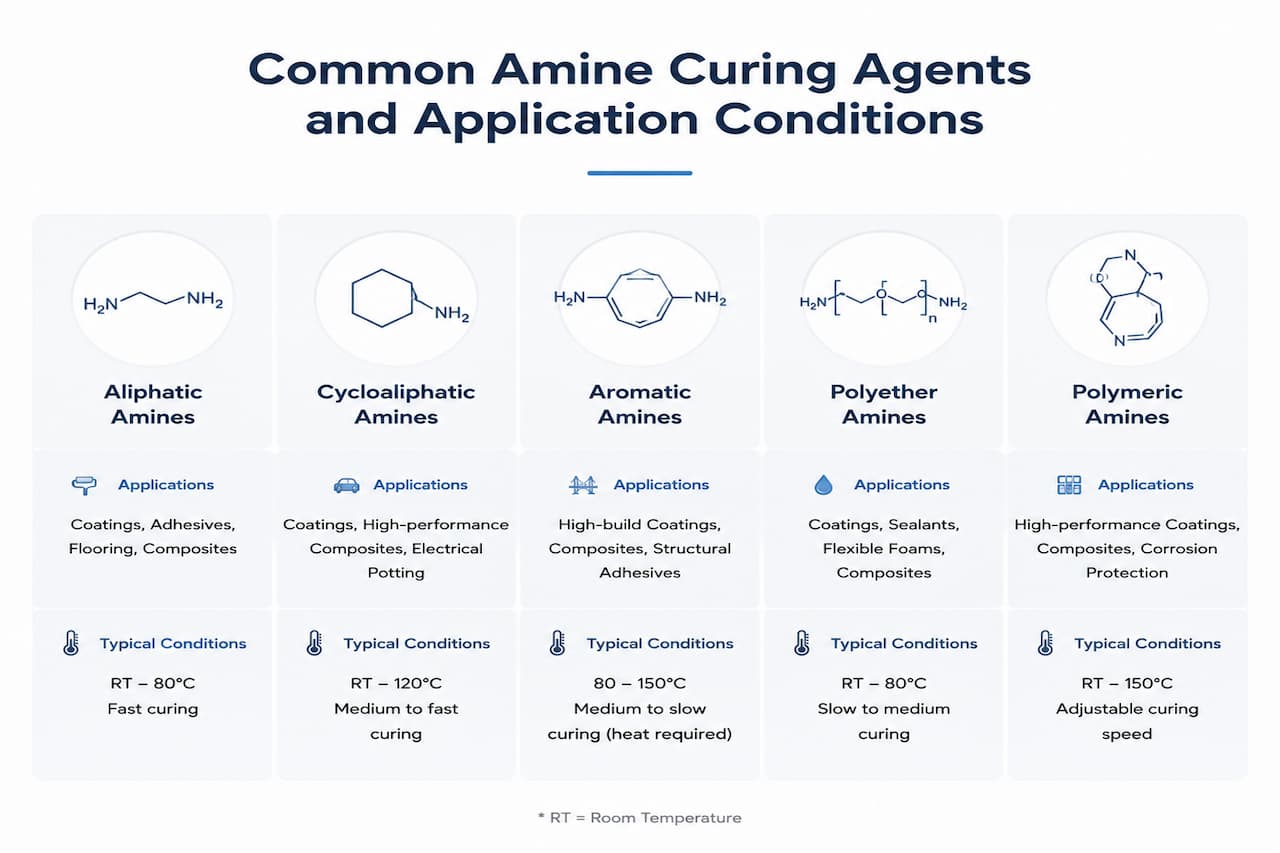
    Common Amine Curing Agents and Application Conditions
    Jul 08, 2026
    DETA (Diethylenetriamine)   Appearance: Colorless to pale yellow transparent liquidChemical formula: C₄H₁₃N₃Molecular weight: 103.166CAS No.: 111-40-0Melting point: -40 °CBoiling point: 206 °CDensity: 0.96 g/cm³Amine value (mg KOH/g): 1300–1400Viscosity (25 °C) mPa·s: 5–20Mixing ratio: YLE-128 (E-51) epoxy resin : DETA (Diethylenetriamine) = 100 g : 10–11 g (by weight) YLE-220 (E-44) epoxy resin : DETA (Diethylenetriamine) = 100 g : 10 g (by weight)Curing conditions: 25 °C / 3–6 hours or 60 °C / 1–2 hours   TETA (Triethylenetetramine)   Appearance: Colorless to slightly yellow viscous liquidChemical formula: C₆H₁₈N₄Molecular weight: 146.234CAS No.: 112-24-3Melting point: 12 °CBoiling point: 266–267 °CDensity: 0.982 g/cm³Flash point: 135 °C (CC)Amine value (mg KOH/g): 1100–1200Viscosity (25 °C) mPa·s: 5–30Mixing ratio: YLE-128 (E-51) epoxy resin : TETA (triethylenetetramine) = 100 g : 13–14 g (by weight) YLE-220 (E-44) epoxy resin : TETA (triethylenetetramine) = 100 g : 11–13 g (by weight)Curing conditions: 25 °C / 3–6 hours or 60 °C / 1–2 hours   Polyether amine curing agent Chemical name: Polyether amine; Polyether polyamine; Polyetheramine (PEA); Aliases: Polypropylene glycol bis(2-aminopropyl ether); 2-(Aminooxy)propan-1-amineCAS No.: 9046-10-0   Polyether amine curing agent D-230 Mixing ratio: YLE-128 (E-51) epoxy resin : D-230 = 100 g : 30 gCuring conditions: 25 °C / 36 hours or 60 °C / 3 hours or 80 °C / 1 hourCured product characteristics: Colorless and transparent, high hardness, high toughness, not easily brittle. Suitable for handicrafts, nameplates, and potting applications with special requirements.   Polyether amine curing agent D-400 Mixing ratio: YLE-128 (E-51) epoxy resin : D-400 = 100 g : 50 gCharacteristics: Good toughness after curing, low viscosity, high mechanical performance of the cured product, and resistance to high-low temperature thermal shock (-35 °C to 120 °C).   Polyether amine curing agent D-2000 Mixing ratio: YLE-128 (E-51) epoxy resin : D-2000 = 40 g : 100 gCuring conditions: 80 °C / 6–10 hoursCharacteristics: D-2000 is colorless and transparent. The cured product exhibits excellent elasticity, high peel strength, colorless transparency, high toughness, not easily brittle, and strong adhesion. Suitable for potting applications with special requirements, and resistance to high-low temperature thermal shock (-40 °C to 130 °C). When combined with liquid epoxy resin, D-2000 is used for colorless and transparent applications in composites, wind power, handicrafts, and nameplates. TYPE D-230 D-400 T403 D-2000 D-5000 Appearance Colorless transparent liquid Colorless transparent liquid Colorless transparent liquid Colorless transparent liquid Colorless transparent liquid Viscosity (MPa·s / 25℃) 3~10 10~50 500~200 260~280 300~600 Density (25℃, g/cm³) 0.92~0.98 0.92~0.98 0.92~0.98 0.92~0.98 0.92~0.98 Active Hydrogen Equivalent 58 100 85 500 1250 Film Drying Time (25℃) 36 hours 72 hours 24 hours 100 hours 500 hours Recommended Mixing Ratio (with E51) 10g : 3g 10g : 5g 10g : 4.5g 10g : 25g 10g : 65g Pot Life (Min / 25℃) ≥3 hours ≥6 hours ≥4 hours ≥24 hours ≥48 hours Curing Conditions 80°C / 6~10 hrs 80°C / 6~10 hrs 80°C / 6~10 hrs 80°C / 6~10 hrs 80°C / 6~10 hrs Cured Hardness (Shore) 90D 65D 85D D20 --     1,3-BAC (1,3-Bis(aminomethyl)cyclohexane)  CAS No.: 2579-20-6 13-BAC is primarily used as an epoxy curing agent or for the preparation of modified epoxy curing agents. Compared to aromatic amine curing agents, it not only has lower viscosity and better handling properties but also yields cured products with outstanding resistance to ultraviolet light (anti-yellowing), as well as excellent weather resistance, temperature resistance, water resistance, and chemical resistance. Moreover, it cures rapidly and can be used for curing at either room temperature or low temperatures. It is widely applied in high-end outdoor floor coatings, stone adhesives, electronic potting compounds, composite materials (such as automotive parts and wind turbine blades), and in the fields of jewelry adhesives and crystal adhesives where appearance and color quality are of paramount importance.Mixing ratio: YLE-128 (E-51) epoxy resin : 1,3-BAC = 100 g : 18–20 gCuring conditions: 25 °C / 6–12 hours   MXDA (m-Xylylenediamine)  CAS No.: 1477-55-0Characteristics: m-Xylylenediamine is a high-performance and widely used epoxy resin curing agent, and also an important fine chemical intermediate. It can be used in the synthesis of polyurethanes, a range of epoxy resins, rubber additives, photosensitive plastics, pesticides, fiber finishing agents, rust inhibitors, chelating agents, lubricants, paper processing agents, and electronic chemicals. In nylon products such as MXD6 (a polycondensate of MXDA and adipic acid), and in the synthesis of functional epoxy resins, MXDA is widely utilized due to its unique structure, which imparts various excellent physical and chemical properties.Mixing ratio: YLE-128 (E-51) epoxy resin : MXDA = 100 g : 18–20 gCuring conditions: 50–60 °C / 3 hours + 120–150 °C / 2 hours   DETDA (Diethyltoluenediamine)  CAS No.: 68479-98-1Characteristics: DETDA is equivalent to Ethancure 100 and Lonza DETDA 80. It is a highly effective chain extender for polyurethane elastomers, and can also be used as a curing agent for polyurethanes and epoxy resins, as an antioxidant for epoxy resins, and in industrial oils and lubricants. Additionally, it serves as an intermediate for organic synthesis.Mixing ratio: YLE-128 (E-51) epoxy resin : DETDA = 100 g : 25 gCuring conditions: 100 °C / 4 hours + 150 °C / 1 hour   PACM: 4,4'-Diaminodicyclohexylmethane CAS No.: 1761-71-3PACM curing agent (hydrogenated MDA) has performance equivalent to Air Products' Amicure PACM and BASF's DC (i.e., Baxxodur EC330). It is used as an epoxy resin curing agent and as a curing agent for epoxy composite materials. It is also applied as a chain extender and additive in polyaspartic esters, polyamides (PA), polyurethanes (PU), and polyurea spray elastomers (SPUA). Application fields include high-grade composites, filament winding, lamination, casting, RIM, pultrusion, etc.Mixing ratio: YLE-128 (E-51) epoxy resin : PACM = 100 g : 25–30 gCuring conditions: 25 °C / 24 hours or 60 °C / 3 hours   DDS: 4,4'-Diaminodiphenyl sulfone CAS No.: 80-08-04,4'-Diaminodiphenyl sulfone is an epoxy resin curing agent with excellent high-temperature resistance. It is used in high-temperature-resistant prepregs, high-temperature-resistant molded products (automotive molds, rail transit, aerospace, etc.), and high-temperature-resistant laminates.Mixing ratio: YLE-128 (E-51) epoxy resin : DDS = 100 g : 25–35 gCuring conditions: 130 °C / 2 h + 200 °C / 2 h   DDM: 4,4'-Diaminodiphenylmethane CAS No.: 101-77-9Liquid DDM product is a mixture containing approximately 60% 4,4'-diaminodiphenylmethane and 40% polyphenyl polymethylene polyamine, appearing as a light yellow viscous liquid at room temperature. DDM is an important chemical intermediate. In addition to being primarily used in the production of MDI and HMDI, it is also extensively used in the preparation of polyimide (PI) insulating varnishes, polyesterimide (PEI) insulating varnishes, bismaleimide resins, and other electrical insulation materials. It can also be used as a curing agent for epoxy resins and as a chain extender for polyurethane elastomers.Mixing ratio: YLE-128 (E-51) epoxy resin : liquid DDM = 100 g : 30–35 g (flexible)Curing conditions: 80 °C / 3–4 hours
    Read More
  • The 50 types of Amine-Based Fine Chemicals
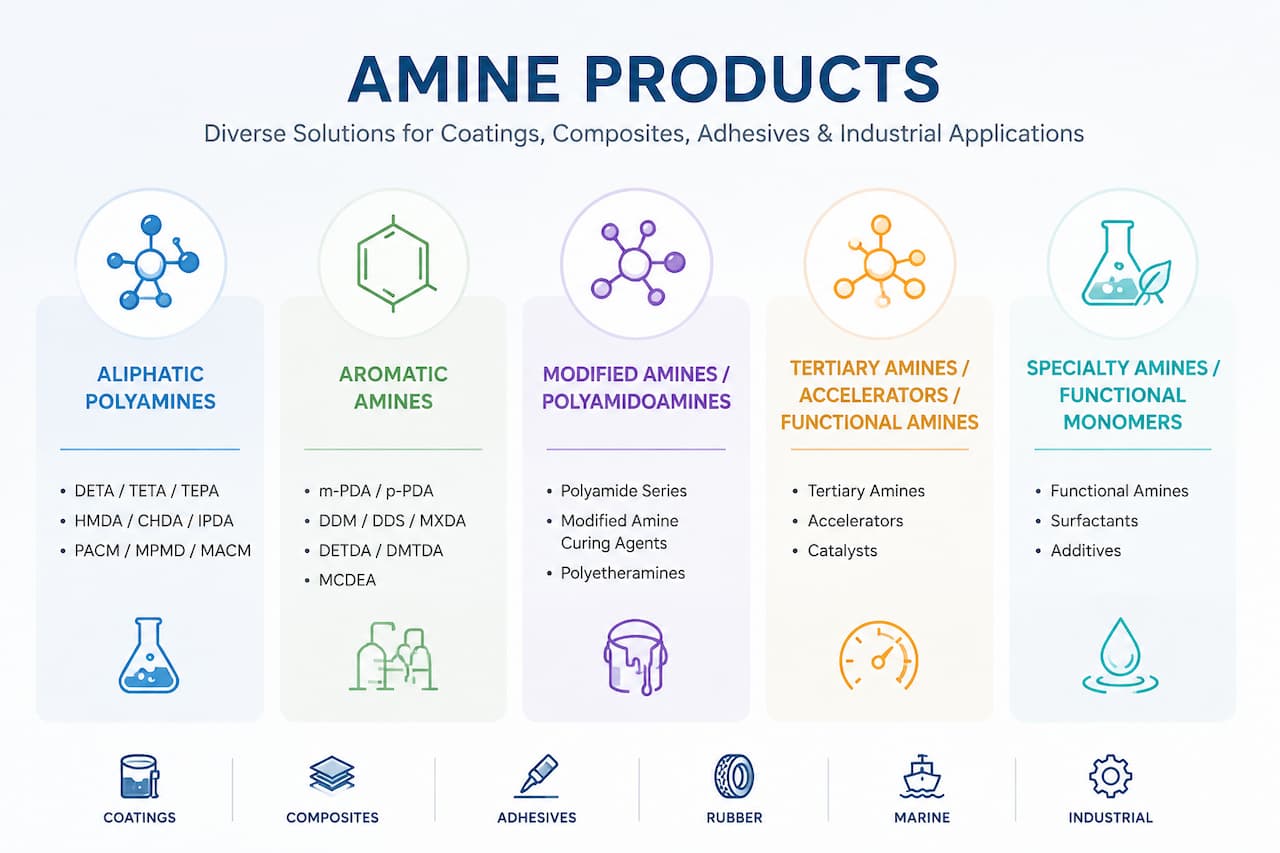
    The 50 types of Amine-Based Fine Chemicals
    Jul 03, 2026
        Aliphatic Polyamines Diethylenetriamine (DETA) – Aliphatic polyamine; ambient-temperature epoxy curing agent used in flooring, anticorrosion, and adhesion applications. Features high reactivity and low viscosity. Triethylenetetramine (TETA) – Polyethylene polyamine; epoxy curing agent with excellent chemical resistance, widely used in heavy-duty anticorrosion and composite materials. Tetraethylenepentamine (TEPA) – Highly reactive polyamine; used in epoxy curing, ion-exchange resins, and as a raw material for oilfield auxiliaries. Pentaethylenehexamine (PEHA) – High-amino polyamine; applied in epoxy curing, chelating agents, and water treatment chemicals. 1,6-Hexamethylenediamine (HMDA) – Aliphatic diamine; used in nylon 66, polyurethanes, and epoxy curing agents to enhance heat resistance and hardness. 1,2-Cyclohexanediamine (CHDA) – Cycloaliphatic diamine; high-temperature epoxy curing agent offering yellowing resistance, high gloss, and high mechanical strength. Isophoronediamine (IPDA) – Cycloaliphatic diamine; weather-resistant epoxy curing agent with low yellowing tendency, used in topcoats and anticorrosion coatings. Bis(4-aminocyclohexyl)methane (PACM/DACM) – Cycloaliphatic diamine; offers high heat resistance and low moisture absorption; used in epoxy, polyamide, and PU curing. 2-Methylpentamethylenediamine (MPMD) – Modified aliphatic diamine; low viscosity and low volatility; used in epoxy flooring and fast-cure systems. 3,3'-Dimethyl-4,4'-diaminodicyclohexylmethane (MACM) – Cycloaliphatic modified diamine; low viscosity and high toughness; applied in epoxy composites and LED encapsulation.   Aromatic Amines m-Phenylenediamine (m-PDA) – Aromatic diamine; used in high-temperature epoxy curing, polyimides, and aramid fiber production; offers high heat resistance. p-Phenylenediamine (p-PDA) – Aromatic diamine; used in high-temperature-resistant resins, epoxy curing, and dye intermediates. 4,4'-Diaminodiphenylmethane (DDM) – Aromatic diamine; high-temperature epoxy curing agent providing high Tg, high heat resistance, and high strength. 4,4'-Diaminodiphenylsulfone (DDS) – Highly heat-resistant aromatic amine; used in aerospace epoxy, electronic potting, and heat-resistant structural adhesives. m-Xylylenediamine (MXDA) – Aromatic-aliphatic mixed diamine; low toxicity and high adhesion; used in epoxy, nylon, and coatings. Diethyltoluenediamine (DETDA) – Aromatic diamine; PU chain extender and epoxy curing agent with fast reaction and high elasticity. 3,5-Dimethylthio-2,4-toluenediamine (DMTDA) – Low-temperature-active aromatic diamine; used in PU elastomers, adhesives, and CASE applications. 4,4'-Methylenebis(3-chloro-2,6-diethylaniline) (MCDEA) – Sterically hindered aromatic diamine; slow-reacting PU chain extender offering high resilience and abrasion resistance.   Modified Amines / Polyamidoamines Polyamide 650 – Condensate of dimer acid and polyamine; low toxicity and good toughness; general-purpose epoxy curing agent. Polyamide 651 – High-viscosity polyamide; enhances adhesion and flexibility; used in anticorrosion coatings and marine paints. Low-Molecular-Weight Polyamide Curing Agent (300#) – Fast-drying and low-volatility; used in flooring, self-leveling compounds, and adhesives. Modified Cycloaliphatic Amine Curing Agent (EH-260) – Modified IPDA type; low viscosity, weather resistance, and high gloss; used in topcoat systems. Phenalkamine (T-31) – Phenol-formaldehyde-polyamine condensate; cures at low temperature and under damp conditions; used in underground engineering and anticorrosion. Modified Phenalkamine (T-33) – High-solid, low-odor; suitable for winter construction and damp-surface curing. Mannich Base Modified Polyamine (EH-36) – High activity and water resistance; used in underwater curing and heavy-duty steel anticorrosion. Polyetheramine D230 – Polyether diamine; low viscosity and high toughness; used in epoxy flooring and lightweight composites. Polyetheramine D400 – Good flexibility and low moisture absorption; used in adhesives, composites, and decorative coatings. Polyetheramine D2000 – Long-chain flexible diamine; enhances impact resistance and toughness; used in PU and epoxy toughening. Polyetheramine T403 – Trifunctional polyether amine; high crosslinking density; used in structural adhesives and wear-resistant flooring. Polyetheramine T5000 – Ultra-flexible triamine; used in high-elasticity systems, adhesives, and elastic coatings.   Tertiary Amines / Accelerators / Functional Amines Triethanolamine (TEA) – Tertiary amine; used as neutralizer, emulsifier, cement grinding aid, and PU catalyst. Diethanolamine (DEA) – Alkanolamine; used in desulfurization, emulsification, PU chain extension, and as a pH regulator in coatings. Monoethanolamine (MEA) – Basic absorbent, neutralizer; used in metalworking fluids and as a surfactant raw material. N,N-Dimethylethanolamine (DMEA) – Tertiary amine catalyst; used in PU foaming, epoxy acceleration, and aqueous neutralization. N,N-Dimethylbenzylamine (BDMA) – Tertiary amine accelerator; used in fast epoxy curing, casting, and electronic potting. 2,4,6-Tris(dimethylaminomethyl)phenol (DMP-30) – Tertiary amine accelerator; significantly increases epoxy curing speed; suitable for low-temperature applications. Triethylenediamine (DABCO) – Tertiary amine; PU foaming catalyst and gel catalyst; used in sponge and rigid foams. N-Methylmorpholine (NMM) – Cyclic tertiary amine; used as PU catalyst, solvent, and organic synthesis base. N-Ethylmorpholine (NEM) – Basic catalyst; used in polyurethane foaming and coating auxiliaries. 1,8-Diazabicyclo[5.4.0]undec-7-ene (DBU) – Superbase catalyst; used in epoxy, polyurethane, and resin synthesis catalysis.   Specialty Amines / Functional Monomers N-Aminoethylpiperazine (AEP) – Polyamine; used as epoxy curing agent, intermediate, lubricant, and chelating agent. Piperazine (PIP) – Cyclic diamine; used in pharmaceutical intermediates, polyurethanes, epoxy curing, and desulfurization agents. N,N'-Di-sec-butyl-p-phenylenediamine (DBPD) – Antioxidant/antiozonant amine; used in rubber, plastics, and oil products for antioxidation and anti-aging. Octyl/Dibutyl Diphenylamine Compound (ODPA/BDPA) – High-temperature antioxidant amine; used in lubricating oils, transformer oils, and industrial oils. 3-Methoxypropylamine (MOPA) – Alkoxy monoamine; low viscosity and low volatility; used in waterborne resins and epoxy auxiliaries. N-(3-Aminopropyl)imidazole (API) – Imidazole-modified amine; used in medium-temperature epoxy curing, adhesives, and copper-clad laminates. 2-Methylimidazole-Modified Amine (2MZ Curing Agent) – Imidazole adduct; used in epoxy powder coatings, electronic encapsulation, and latent curing. Quaternary Ammonium-Type Cationic Amines (1831, 1227 series) – Cationic surfactants; used as bactericides, softeners, antistatic agents, and emulsifiers. Fatty Amine Polyoxyethylene Ethers (C12-amine EO5, C18-amine EO10) – Nonionic surfactants; used in emulsification, dispersion, wetting, and pesticide adjuvants. Trioctylmethylammonium Chloride (TOMAC) – Quaternary ammonium phase-transfer catalyst; used in organic synthesis, extraction, and phase-transfer catalysis.
    hot Tags : IPDA DETA TETA MXDA DETDA HMDA
    Read More
  • N4-Amine: The Sibling Aliphatic Amine of Triethylenetetramine (TETA)
    N4-Amine: The Sibling Aliphatic Amine of Triethylenetetramine (TETA)
    May 14, 2026
      Today, we are excited to introduce a product touted as the "twin brother of Triethylenetetramine (TETA)" — N4-Amine.     Appearance Colorless clear liquid Purity 98% min Color (APHA) 50 max Water Content 0.5 max Amine Value mgKOH/g 1200 min Density 25°C 0.95g/cm³ Boiling Point 314.9 °C Flash Point 153.1 °C   N4-AMINE (N,N'-Bis(3-aminopropyl)ethylenediamine) is a propylene-based aliphatic amine. As a colorless, transparent liquid, it serves as an excellent substitute for ethylene polyamines. Classified as an aliphatic polyfunctional amine, N4-AMINE offers a powerful alternative beyond standard ethylene amines. With its low viscosity and rapid gelation speed, its active hydrogen characteristics make modification a breeze. It not only boasts exceptional toughness but also delivers outstanding adhesion, making its performance advantages clear and evident.   Need fast drying and high strength? → Choose N4-Amine. In daily applications, it reacts incredibly fast. When paired with YLE-128, it handles both low-temperature environments and rapid curing requirements with ease. N4-AMINE is truly an all-rounder. Looking for an efficient, powerful, and stable adhesive material? You can't go wrong choosing N4-AMINE! Moreover, N4-AMINE can replace traditional ethylene amines in modification processes. For modified polyamides, it offers faster gelation speeds and stronger paint film adhesion.   From epoxy resin curing agents to polyurethane accelerators, N4-AMINE has a wide range of applications, bringing convenience to various industries. Its packaging options are equally flexible: while the standard is a 190KG drum, we can also provide IBC totes to meet your specific needs.    
    Read More

leave a message

leave a message
If you are interested in our products and want to know more details,please leave a message here,we will reply you as soon as we can.
submit

home

products

WhatsApp

Contact Us