Home

Blog

  • Cardanol Glycidyl Ether YLD-9006: Bio-Based Reactive Diluent
    Cardanol Glycidyl Ether YLD-9006: Bio-Based Reactive Diluent
    Oct 02, 2026
    Cardanol glycidyl ether YLD-9006 is a bio-based monofunctional reactive diluent with viscosity 30-50 mPa·s at 25 °C and EEW 355-500 g/eq. It thins epoxy coatings, adhesives and potting compounds, and it comes from cashew nut shell liquid (CNSL). It carries one epoxide group on a C15 aliphatic chain.   Product Code: YLD-9006 — Cardanol Glycidyl Ether, monofunctional reactive diluentKey Raw Material: Cardanol from cashew nut shell liquid (CNSL) — CAS No. 171263-25-5Product Category: Reactive Diluent / Glycidyl Ether (Diluent & Glycidyl Ether line) 1. Product Information Item Information Product Name Cardanol glycidyl ethers YLD-9006 Chemical Family Glycidyl ether of cardanol, a C15 phenolic alcohol distilled from cashew nut shell liquid CAS No. 171263-25-5 Epoxide Functionality 1 — the product page describes YLD-9006 as a single epoxy-based active diluent Appearance Transparent liquid Primary Use Viscosity reduction in coatings, adhesives, potting and casting compounds, and composites Packaging Drum 2. Product Description: What Cardanol Glycidyl Ether YLD-9006 Does in an Epoxy System Cardanol glycidyl ether YLD-9006 is a reactive diluent, so it cures into the network instead of evaporating from the film. One epoxide group sits at the end of a C15 aliphatic chain, and that structure explains most of what you see at the bench. A single epoxide pushes the EEW up to 355-500 g/eq, which is high for a diluent, while the same long chain holds viscosity at 30-50 mPa·s at 25 °C. BGE reaches 147-157 g/eq by comparison, so the two products are not interchangeable gram for gram. Cardanol is distilled from cashew nut shell liquid, which makes YLD-9006 a renewable feedstock product rather than a petrochemical one. The phenol ring carries a C15 side chain that occurs naturally as a mixture of saturated, monoene, diene and triene forms. That mixture is why two drums of the same grade can differ slightly in colour and EEW, and why incoming EEW checks pay for themselves. Against fatty-chain monofunctional glycidyl ethers, the product page reports less impact on the thermal properties of the cured material, a clear toughening effect, and no irritating odour. The C15 chain acts as a built-in flexibilizer, so one additive delivers both viscosity reduction and impact improvement. YLD-9006 mixes well with aliphatic and aromatic epoxy resins, so it can be dropped into an existing high-solids coating or electronic potting formula without a compatibilizer. The product page also lists modified curing agents, a smaller outlet that few buyers ask about. 3. YLD-9006 Compared with Conventional Reactive Diluents Four diluents cover most of the market, and they are not interchangeable by weight because their epoxide contents differ threefold. The table below uses published data from the Yolatech product pages for each grade, so every row can be checked at source. Read the EEW column first, then viscosity; the first sets hardener consumption, the second sets how far it can thin a system. Attribute YLD-9006 (cardanol mono) YLD-7004 (C8-10 AGE) YLD-9004A (BGE) YLD-9014 (cardanol di) Epoxide groups 1 1 1 2 EEW, g/eq 355-500 220-250 147-157 290-350 Viscosity at 25 °C 30-50 mPa·s 3-10 mPa·s max 2 mPa·s 1000-3000 mPa·s Appearance Transparent liquid Transparent, APHA max 40 Transparent, APHA max 20 Reddish brown, colour G max 18 Hydrolyzable chloride max 0.5% max 0.2% max 0.1% not published Water max 0.1% max 0.1% max 0.5% max 0.2% Feedstock base CNSL, renewable C8-C10 synthetic alcohol Butanol CNSL, renewable Thermal effect on cured resin Less impact than fatty-chain mono diluents (supplier claim) Reference product for that claim Shortest chain, largest Tg drop Difunctional, adds crosslink density Toughening behaviour C15 chain flexibilizes Moderate None to slight High flexibility grade of the series Typical fit High-solids coatings, electronic potting Low-cost viscosity control Fast viscosity knock-down Flexible adhesives and sealants Weight-for-weight substitution is the most common mistake. Fifteen phr of BGE carries roughly 0.10 equivalents of epoxide, while the same loading of YLD-9006 carries about 0.04, so a straight swap leaves the mix under-cured unless the hardener is recalculated. If the requirement is crosslink density rather than viscosity, the monofunctional YLD-9006 is the wrong tool. Move to a cardanol diglycidyl ether YLD-9014 or the higher-flexibility cardanol diglycidyl ether YLD-9016, both of which carry two epoxide groups on the same renewable backbone. For a cost-driven viscosity cut on an unexposed substrate, a butyl glycidyl ether BGE YLD-9004 or a C8-10 alkyl glycidyl ether YLD-7004 costs less per unit of reduction. Workplace rules usually decide the rest. Many formulators have moved away from BGE for handling reasons rather than technical ones, so check the current SDS and your local exposure limits first. 4. Typical Technical Information of Cardanol Glycidyl Ether YLD-9006 The table below is the published specification for YLD-9006 and doubles as an incoming-inspection checklist. Item Specification Appearance Transparent liquid Viscosity at 25 °C 30-50 mPa·s EEW, g/eq 355-500 Hydrolyzable chloride Max. 0.5% Inorganic chlorine Max. 200 mg/kg Water Max. 0.1% Shelf life At least 12 months in original packing at ambient temperature These are typical values from the product page. Verify each lot against the TDS, MSDS and COA, and treat the EEW band as a range that drives hardener calculation rather than a fixed number. 5. Formulation and Selection Guidance A reactive diluent changes the epoxide equivalent weight of the blend, and the hardener dose follows that number. For two epoxy-bearing streams the mixing rule is simple: blend EEW = total mass divided by total epoxide equivalents. Hardener then follows phr = 100 × AHEW ÷ blend EEW, using the AHEW printed on the curing agent data sheet. Take a bisphenol F epoxy resin at EEW 170 g/eq and 3500-4500 mPa·s as the base, with a DMDC curing agent CAS 6864-37-5 at AHEW 60 g/eq as the hardener. Compare three blends at 15 phr diluent loading. Epoxy side Blend EEW, g/eq DMDC, phr Bisphenol F resin alone 170 35.3 Plus 15 phr YLD-9006 184 32.6 Plus 15 phr BGE YLD-9004A 167 35.8 The numbers use the mid-point of each published EEW band: 400 g/eq for YLD-9006 and 152 g/eq for BGE. Because YLD-9006 consumes less hardener per gram, a 15 phr addition lowers the DMDC demand by about 2.7 phr against the neat resin. That is a real cost offset that most buyers miss. Start at 5 phr and step up in 5 phr increments. Most formulators stop between 10 and 20 phr, because above that the monofunctional fraction acts as a plasticizer and pulls hardness, chemical resistance and glass transition temperature down. Viscosity does not fall in a straight line. A log-mixing estimate for the 15 phr blend above lands near 2000-2500 mPa·s at 25 °C, down from 3500-4500 mPa·s for the neat resin. Estimate only — in practice, confirm it with a laboratory reading on your own resin lot, since temperature and shear history both shift the result. 6. Processing Notes Most field problems trace back to loading, moisture or mixing order rather than to the diluent itself. • Add the diluent to the resin at 25-40 °C under low shear, then blend until uniform before charging filler or hardener. • Keep the drum sealed. The specification caps water at 0.1%, and an open drum in a humid season pulls headspace moisture that shows up later as a hazy film. • Never count YLD-9006 as solvent. It stays in the film and becomes part of the network, so solvent-release calculations do not apply. • Re-check EEW on arrival. Cardanol is a natural feedstock, so EEW shifts between lots and the hardener dose should follow it. • Store in a well-ventilated area, away from flames and direct sunlight, and close the cap tightly after use. • Watch pot life at high loading. More diluent extends pot life, which helps a short line and hurts a fast-cure process. • Measure mix viscosity at line temperature on composites work, because a diluent reading 40 mPa·s at 25 °C behaves differently in a 35 °C bath. 7. Applications of Cardanol Glycidyl Ether YLD-9006 The product page lists five application fields, and each one asks something different from the diluent. Application Role of YLD-9006 Field note High-solids coatings Cuts viscosity so solvent demand falls Watch sag resistance above 20 phr Electronic potting Low mix viscosity for void-free fill Confirm chloride limits with the customer Adhesives Toughening from the C15 chain Check peel strength, not just shear Casting compounds Improves flow around inserts Exotherm rises with batch size Composites, FRP winding Lowers bath viscosity for fibre wet-out Recheck bath viscosity as it ages Composites, pultrusion Improves impregnation of dense reinforcement Balance against green strength Modified curing agents Reactive building block, per the product page Develop in-house, not off the shelf Coatings and potting carry the volume, which is why the product page flags them first. For an epoxy resin coatings project, the diluent is the cheapest lever on volatile organic content, and it works in solvent-borne and solvent-free systems. On epoxy resin adhesives, YLD-9006 does two jobs at once: it thins the mix for better substrate wetting, and it leaves a flexible C15 segment in the cured bond line. Composite work is a different question. In epoxy resin composites, viscosity reduction only helps if it survives the run, so a bath that starts at 400 mPa·s and doubles over four hours ruins the last third of the batch. 8. Frequently Asked Questions What are the CAS number, EEW and viscosity of cardanol glycidyl ether YLD-9006? CAS No. 171263-25-5 belongs to cardanol glycidyl ether YLD-9006, which is published at EEW 355-500 g/eq with viscosity 30-50 mPa·s at 25 °C, with water capped at 0.1% and hydrolyzable chloride at 0.5% maximum. The EEW band is wide because cardanol is a natural feedstock, so plan the hardener dose around the actual lot value. Is YLD-9006 monofunctional or difunctional? It is monofunctional. The product page describes YLD-9006 as a single epoxy-based active diluent, and the EEW of 355-500 g/eq is consistent with one epoxide on a C15 chain. If the formulation needs crosslink density from the diluent, use a difunctional cardanol grade instead. How much YLD-9006 should be added, and does it change hardener dosage? Start at 5 phr and step up in 5 phr increments, with most systems settling between 10 and 20 phr. The hardener dose does change: at 15 phr the blend EEW rises from 170 to about 184 g/eq, and the DMDC requirement falls from 35.3 phr to 32.6 phr. Does YLD-9006 lower the glass transition temperature of the cured resin? Any monofunctional diluent lowers the glass transition temperature, and loading is the lever. The product page reports less impact on the thermal properties of the cured material than fatty-chain monofunctional diluents show, but that advantage shrinks as loading rises. Above 20 phr, expect a measurable drop. Can YLD-9006 replace BGE or C8-10 AGE at a 1:1 ratio? Not by weight. BGE sits at EEW 147-157 g/eq and C8-10 AGE at 220-250 g/eq, while YLD-9006 runs 355-500 g/eq, so an equal-weight swap changes the stoichiometry. Recalculate the hardener, then confirm that the higher mix viscosity still meets the process window. What is the shelf life and storage condition for YLD-9006? Shelf life is at least 12 months from the date of manufacture in the original packing at ambient temperature. Store the drum in a well-ventilated area away from flames and direct sunlight, and close the cap tightly after use; details sit in the MSDS. 9. Packaging, Storage and Safety YLD-9006 ships in drums and holds its specification for at least 12 months in the original packing at ambient temperature. Keep drums in a well-ventilated area, away from flames and direct sunlight, and reseal them tightly after every draw-off. Decant in a bunded area, wear nitrile gloves and eye protection, and follow the exposure limits on the MSDS. No certification should be assumed from this article. Flame-retardant, food-contact and electrical classifications depend on the finished formulation and cure schedule, not on the diluent alone, so test the cured part. Request the TDS, MSDS and COA for the shipping lot, and re-verify EEW, viscosity and water content on arrival.
    Read More
  • DOPO Modified Phenolic Epoxy Resin: Halogen-Free Flame Retardant Grades for Copper-Clad Laminates
    DOPO Modified Phenolic Epoxy Resin: Halogen-Free Flame Retardant Grades for Copper-Clad Laminates
    Sep 30, 2026
    DOPO modified phenolic epoxy resin is a halogen-free reactive flame-retardant resin in which the DOPO unit is chemically bonded into the epoxy backbone. Yolatech now supplies five solution grades with EEW 280-390 g/eq and 70-75% solids for halogen-free copper clad laminates and electrical laminates.   Product Code: YLDP series — YLDP-315-M75 / YLDP-300-K70 / YLDP-310-EK75 / YLDP-300-K75 / YLDP-60-K75Key Raw Material CAS No.: 35948-25-5 (DOPO)Product Category: DOPO Modified Phenolic Epoxy Resin / Halogen-Free Reactive Flame Retardant Epoxy Resin 1. Product Information Item Information Chemical Description Phenolic epoxy resin modified with DOPO (9,10-dihydro-9-oxa-10-phosphaphenanthrene-10-oxide), reacted through the DOPO P-H bond onto the epoxy chain Supplied Grades YLDP-315-M75, YLDP-300-K70, YLDP-310-EK75, YLDP-300-K75, YLDP-60-K75 Key Raw Material CAS No. 35948-25-5 (DOPO) DOPO Molecular Formula C12H9O2P (phosphorus content of the DOPO molecule: approx. 14.3%) Supplied Form Solution-type resin, non-volatile content 70–75±1%, viscosity up to 3000 mPa·s depending on grade Flame Retardant Type Reactive phosphorus-based, halogen-free Family Position One of three DOPO modified phenolic epoxy types from Yolatech, alongside DOPO-HQ modified and DOPO-NQ modified grades Category Halogen-free flame retardant epoxy resin for printed circuit substrates, copper-clad laminates and electrical laminates   2. Product Description DOPO is a rigid cyclic phosphinate whose single P-H bond is what makes it versatile: it adds readily across epoxy groups, double bonds, carbonyls, halogenated sites and amino groups, which is why DOPO has become the standard starting material for reactive phosphorus flame retardancy in electronics. Reacted onto an epoxy backbone, the P-H bond opens the oxirane ring and the phosphorus ends up joined to the polymer through a direct phosphorus–carbon bond. That P–C linkage is the practical difference between a reactive DOPO resin and a phosphorus additive: bonded phosphorus cannot migrate to the surface, cannot be extracted by moisture or solvents, and cannot bloom during lamination. It is also more hydrolytically stable than the P–O–C ester linkages used in many phosphate-based additives, an advantage in laminates that must pass moisture-absorption and CAF testing. In a fire it works two ways at once: condensed-phase char formation insulates the substrate, while gas-phase phosphorus radicals interrupt the combustion chain reaction. No bromine is involved, so no hydrogen bromide is released and smoke density stays lower. Yolatech supplies DOPO modified phenolic epoxy resin as a series of solution-type grades. All five grades are halogen-free flame retardant epoxy resin systems with 70–75% non-volatile content and EEW 280–390 g/eq, sized for varnish preparation and dip-coating lines rather than neat casting. The series shares the property profile the whole family is known for — flame retardancy, heat resistance, low toxicity and low water absorption and expansion coefficient — and sits alongside the DOPO-HQ modified phenolic epoxy resin and DOPO-NQ modified phenolic epoxy resin grades, which carry additional phenolic functionality for higher-Tg requirements.   3. DOPO Modified vs DOPO-HQ vs DOPO-NQ: Choosing the Right Derivative All three family members put phosphorus into the network covalently, but by different chemistry. The base phenolic epoxy resin modified directly with DOPO relies on the P–C bond formed at the oxirane ring; the DOPO-HQ derivative is built on hydroquinone and contributes two phenolic hydroxyl groups; the DOPO-NQ derivative is built on a naphthoquinone core. The table compares the three using grade data published on the respective Yolatech product pages. Comparison Item DOPO Modified (this page) DOPO-HQ Modified DOPO-NQ Modified Phosphorus Bonding Direct P–C bond onto the epoxy chain DOPO-HQ moiety with two phenolic OH groups in the backbone DOPO-NQ moiety on a naphthalene-ring structure Published EEW Range, g/eq 280–390 210–340 300–360 Published N.V. Range, % 70–75 70–80 75 Published Viscosity, mPa·s Up to 3000 (lowest cap in series: <1500) Up to 7000 (lowest cap: <1000) 1000–3000 Distinctive Strength High phosphorus efficiency of the DOPO unit combined with a tight, low-viscosity varnish window Two reactive phenolic sites support higher crosslink density and Tg Naphthalene core supports heat resistance Typical Use Bias Halogen-free copper-clad laminate varnishes and dipping lines High-Tg halogen-free laminates for lead-free assembly Halogen-free laminates where heat resistance is the priority Against a brominated route the comparison is sharper: a brominated epoxy resin or high brominated epoxy resin system typically needs 15–18% bromine in the cured resin to reach UL 94 V-0, while a phosphorus system generally reaches the same rating at approximately 1.5–2.0% phosphorus. That tenfold difference in loading changes the whole formulation balance: less non-structural mass, lower smoke, and no hydrogen bromide.   4. Typical Technical Information The following grade data are the published specification ranges for the DOPO modified phenolic epoxy resin series. Official sales, quotation or technical commitment should be based on company TDS, MSDS, COA or mutually confirmed documents. Grade No. EEW (g/eq) Viscosity (mPa·s) N.V. (%) YLDP-315-M75 295–335 1000–3000 75±1 YLDP-300-K70 280–320 <2000 70±1 YLDP-310-EK75 290–330 <3000 75±1 YLDP-300-K75 280–320 <3000 75±1 YLDP-60-K75 330–390 <1500 70±1   Item Typical Information Flame Retardant Mechanism Reactive phosphorus; condensed-phase char formation combined with gas-phase radical quenching Target P in Cured Laminate Approx. 1.5–2.0% for UL 94 V-0 capability (formulation dependent; confirm the grade phosphorus value from the TDS) Common Curing Systems Dicyandiamide and phenolic novolac cure for laminate prepreg; confirm the curing agent and accelerator package against your own laminate data Storage Store in a well-ventilated area, away from flames and direct sunlight; close the cap tightly immediately after use Shelf Life At least 12 months from the date of manufacture in the original packing at ambient temperatures Safety Documentation All safety information is provided in the Material Safety Data Sheet   5. Formulation Guidance: Grade Selection and Stoichiometry Grade selection in this series is mostly a viscosity-and-solids decision, because the chemistry is shared. Three working rules cover most cases: • For dipping and coating lines that need the lowest viscosity, YLDP-60-K75 (viscosity <1500 mPa·s, EEW 330–390 g/eq) and YLDP-300-K70 (<2000 mPa·s) leave the widest processing window. • For higher build per pass and lower solvent load, the 75% N.V. grades (YLDP-315-M75, YLDP-310-EK75, YLDP-300-K75) deliver more resin per kilogram of varnish than the 70% grades. • For higher crosslink demand, the higher-EEW YLDP-60-K75 shifts the stoichiometry toward more curing agent per 100 parts resin, which raises network density in the cured laminate. Curing agent dosage follows the standard equivalent-weight calculation: phr = AHEW × 100 ÷ EEW Worked example with a mid-series grade at EEW 300 g/eq: against diethylenetriamine (AHEW approx. 20.6 g/eq) the theoretical dosage is 20.6 × 100 ÷ 300 = approx. 6.9 phr. Against dicyandiamide (AHEW approx. 28 g/eq, the workhorse latent cure for copper-clad laminate prepreg) it is 28 × 100 ÷ 300 = approx. 9.3 phr. Compare that with a standard solution-type bisphenol A epoxy resin at EEW 190 g/eq, which needs approx. 14.7 phr of dicyandiamide — the DOPO-modified grade needs less curing agent per unit weight because more of its mass is already resin backbone. Dicyandiamide-cured laminate systems normally run with an accelerator to place the cure window correctly — see the site articles on dicyandiamide epoxy curing agents and on DMP-30 as a curing accelerator. All dosages above are theoretical starting points: verify the actual ratio, gel time and B-stage flow on your own test panels before a production run.   6. Processing Notes • Because the grades are supplied as solutions, varnish preparation is mostly dilution and blending. Add the curing agent only after the resin blend is homogeneous and at the target temperature and solids. • Control varnish temperature during mixing. Viscosity falls with temperature, and a line set up on a cold morning will run differently from the same varnish on a hot afternoon — check viscosity at a fixed reference temperature. • Re-check non-volatile content and viscosity of every incoming batch before use — a fast test that protects the dip-tank from a whole-batch loss. • After any recipe change, re-validate gel time and B-stage flow. Prepreg flow that drifts out of the lamination window is the most common failure mode after a resin-grade switch. • Close container caps tightly immediately after use, and keep drums away from flames and direct sunlight, exactly as the product storage instructions specify.   7. Applications Application Field Function / Description Halogen-Free Flame Retardant Printed Circuit Substrates Reactive phosphorus flame retardancy built into the resin itself, for PCB substrate laminates that must meet halogen-free requirements Electronic Copper-Clad Laminates Varnish-grade resin for CCL impregnation lines; 70–75% N.V. solutions and viscosity caps from <1500 to 3000 mPa·s fit standard dipping and coating equipment Electrical Laminates Insulating laminate sheets and fabricated parts where intrinsic halogen-free flame retardancy, low water absorption and stable expansion coefficient are required The common thread across all three fields: the flame retardant element must survive the whole service life of the board. Because the phosphorus is part of the network, the rating does not depend on an additive that can drift out during lamination, solder reflow or years of thermal cycling. For the wider resin portfolio, the heat resistant epoxy resin family and the multifunctional grades are the usual companions to this series in high-reliability laminate formulations.   8. Frequently Asked Questions What is DOPO modified phenolic epoxy resin? It is a phenolic epoxy resin into which DOPO (9,10-dihydro-9-oxa-10-phosphaphenanthrene-10-oxide, CAS 35948-25-5) has been reacted through its P-H bond, so the phosphorus becomes a covalent part of the polymer backbone. The result is a halogen-free reactive flame retardant resin, supplied here as five solution grades with EEW 280–390 g/eq and 70–75% non-volatile content, used mainly in halogen-free printed circuit substrates, electronic copper-clad laminates and electrical laminates. How is the base DOPO modified grade different from DOPO-HQ and DOPO-NQ modified grades? The base grade bonds phosphorus directly to the epoxy chain through a P–C bond. DOPO-HQ modified grades add two phenolic hydroxyl groups per DOPO-HQ unit, which supports higher crosslink density and Tg in high-Tg laminates, while DOPO-NQ modified grades carry a naphthalene-ring structure oriented toward heat resistance. In published grade data the base series runs EEW 280–390 g/eq at 70–75% N.V., the DOPO-HQ series runs EEW 210–340 g/eq at 70–80% N.V., and the DOPO-NQ series runs EEW 300–360 g/eq at 75% N.V. Which grade should I start with for a copper-clad laminate varnish? Start from your line's viscosity limit and target solids. For the widest low-viscosity window, YLDP-60-K75 (viscosity <1500 mPa·s, EEW 330–390 g/eq) or YLDP-300-K70 (<2000 mPa·s) are the natural starting points. If you want more resin per pass and less solvent to evaporate, choose one of the 75% N.V. grades: YLDP-315-M75, YLDP-310-EK75 or YLDP-300-K75. Confirm the final selection with a trial batch, because prepreg flow and gel time respond to the whole formulation, not to the resin alone. How do I calculate the curing agent dosage for a DOPO modified epoxy? Use the equivalent-weight ratio: phr = AHEW × 100 ÷ EEW. With a grade at EEW 300 g/eq, dicyandiamide (AHEW approx. 28 g/eq) gives a theoretical dosage of approx. 9.3 phr, and diethylenetriamine (AHEW approx. 20.6 g/eq) gives approx. 6.9 phr. These are theoretical values — confirm the practical dosage on your own system together with the accelerator package and cure schedule. Is DOPO modified phenolic epoxy resin truly halogen-free? Yes. The flame retardant element is phosphorus bonded into the resin backbone, not a brominated compound, so the cured laminate contains no added bromine and produces no hydrogen bromide when heated. The family is designed to support halogen-free requirements for printed circuit substrates as an alternative to halogen-containing flame retardants. Compliance documents for a specific shipment should be requested together with the COA. What is the shelf life and how should the resin be stored? The shelf life is at least 12 months from the date of manufacture when stored in the original packing at ambient temperatures. Store in a well-ventilated area, keep away from flames and direct sunlight, and close the cap tightly immediately after use. All safety information is provided in the Material Safety Data Sheet.   9. Packaging, Storage and Safety Packaging: drum package, in accordance with the company delivery arrangement for the order. Storage: at least 12 months from the date of manufacture in the original packing at ambient temperatures. Store in a well-ventilated area, keep away from flames and direct sunlight, and close the cap tightly immediately after use. Safety: all safety information is provided in the Material Safety Data Sheet. Use protective gloves and safety goggles during handling and refer to the MSDS for detailed requirements.
    Read More
  • DOPO-HQ Modified Phenolic Epoxy Resin YLDP-320: Halogen-Free Flame Retardant for High-Tg Laminates
    DOPO-HQ Modified Phenolic Epoxy Resin YLDP-320: Halogen-Free Flame Retardant for High-Tg Laminates
    Sep 28, 2026
    Yolatech YLDP-320 is a DOPO-HQ modified phenolic epoxy resin with 2.9–3.2% phosphorus chemically bonded in the backbone. It delivers halogen-free UL 94 V-0 flame retardancy in high-Tg PCB laminates, electronic encapsulation and advanced composites, and requires no brominated additives such as TBBPA.   Product Code: YLDP-320Key Raw Material CAS No.: 99208-50-1 (DOPO-HQ)Product Category: DOPO-HQ Modified Phenolic Epoxy Resin / Halogen-Free Reactive Flame Retardant Resin 1. Product Information Item Information Chemical Description Phenolic epoxy resin modified with DOPO-HQ (10-(2,5-dihydroxyphenyl)-9,10-dihydro-9-oxa-10-phosphaphenanthrene-10-oxide) Product Code / Trade Name YLDP-320 Key Raw Material CAS No. 99208-50-1 (DOPO-HQ) DOPO-HQ Molecular Formula C18H13O3P Appearance Light yellow solid Flame Retardant Type Reactive phosphorus-based, halogen-free Category Halogen-free flame retardant epoxy resin for laminates and encapsulation   2. Product Description Conventional flame retardant epoxy systems for PCB laminates rely on brominated chemistry, most commonly TBBPA. Bromine works, but it brings three persistent problems: it adds mass without contributing to the network, it raises smoke density and toxic gas release during combustion, and it sits under continuous regulatory scrutiny in the European Union. As the electronics industry moves toward halogen-free designs, formulators need a flame retardant that is part of the polymer backbone instead of an additive suspended inside it. DOPO-HQ modified phenolic epoxy resin answers that requirement. The DOPO-HQ moiety is built into the resin chain, so it cannot migrate to the surface, cannot be extracted by moisture, and cannot bloom out during lamination. Phosphorus acts through two simultaneous mechanisms: in the condensed phase it promotes char formation and protects the underlying polymer, and in the gas phase it releases phosphorus-containing radicals that quench the combustion chain reaction. The result is a UL 94 V-0 capable system without a single bromine atom. YLDP-320 is the DOPO-HQ modified phenolic epoxy grade in the Yolatech DOPO-modified phenolic epoxy resin series. It carries 2.9–3.2% phosphorus directly in the molecule, which means a formulator can reach the 1.5–2.0% phosphorus level normally required for UL 94 V-0 in the cured laminate without adding a separate flame retardant package. It also keeps the high crosslink density and thermal stability that phenolic epoxy chemistry is known for — the property that matters most when the board has to survive lead-free soldering.   3. Why DOPO-HQ Instead of TBBPA Both routes can reach UL 94 V-0 in an FR-4 equivalent laminate. They reach it very differently, and the differences show up in smoke, dielectric behaviour, regulatory exposure and mass efficiency. If you currently run a high brominated epoxy resin or a brominated epoxy resin system, the table below maps out exactly where a phosphorus route diverges. Comparison Item DOPO-HQ Modified Phenolic Epoxy (YLDP-320) Flame Retardant Element Phosphorus (halogen-free) Typical Loading for UL 94 V-0 Approx. 1.5–2.0% P in the cured resin (formulation dependent) Comparison — TBBPA System Typically requires 15–18% Br in the cured resin to reach the same rating, i.e. a substantially higher additive load Halogen Content None. Fully halogen-free by design. Smoke and Toxic Gas Lower smoke density and lower toxic gas release; no hydrogen bromide formation Regulatory Position Designed to support RoHS and REACH compliance. TBBPA remains under REACH SVHC evaluation and is restricted in some markets. Migration and Blooming Phosphorus is covalently bonded into the network; no migration, no surface blooming, no moisture extraction Crosslink Density and Tg DOPO-HQ contributes phenolic hydroxyl functionality, helping maintain crosslink density and heat resistance in high-Tg systems The practical implication is mass efficiency. A brominated system needs 15–18% bromine in the cured resin to reach V-0. A phosphorus system reaches the same rating at roughly 1.5–2.0% phosphorus. That difference changes the balance of the entire formulation: less non-structural mass, more room for fillers or for resin chemistry chosen on mechanical and dielectric merit rather than on flame retardancy alone.   4. Typical Technical Information The following data are typical values for YLDP-320. Official sales, quotation or technical commitment should be based on company TDS, MSDS, COA or mutually confirmed documents. Item Typical Information Appearance Light yellow solid EEW, g/eq 300–340 Solid content, wt% MIN 99.0 Softening point, °C 70–85 Phosphorus content, % 2.9–3.2 Flame Retardant Mechanism Reactive phosphorus; condensed-phase char formation combined with gas-phase radical quenching Target P in Cured Laminate Approx. 1.5–2.0% for UL 94 V-0 (formulation dependent) Common Curing Systems DICY, phenolic novolac and anhydride systems. Confirm the curing agent and accelerator package against your own laminate data. Transport Information Non-hazardous solid in normal industrial classification. Refer to the actual MSDS for the applicable classification of your shipment.   5. Formulation Guidance: How Much to Use Because YLDP-320 already contains 2.9–3.2% phosphorus, using it as the main resin normally reaches the target flame retardant level without any additional flame retardant additive. When it is blended with a standard bisphenol A epoxy or a conventional phenolic epoxy resin, the blend phosphorus content is a simple weighted average: P(blend) = w1 × P1 + w2 × P2 + … Worked example: a blend of YLDP-320 (3.0% P) and a standard bisphenol A epoxy (0% P). To reach 1.5% P in the cured resin, the YLDP-320 fraction is 1.5 ÷ 3.0 = 50% by weight. To reach 2.0% P, the fraction is 2.0 ÷ 3.0 = approximately 67%. The example is a calculation guide only — verify the actual flame retardant rating on your own laminate, because resin, curing agent, filler and glass content all shift the result. Two formulation notes worth remembering: • Do not simply maximise the DOPO-HQ resin fraction. Unreacted phosphorus groups act as a plasticiser and can pull down Tg and interlayer adhesion. The target is the lowest phosphorus level that still passes V-0, not the highest. • Nitrogen–phosphorus synergy is real. Combining the phosphorus system with a nitrogen-containing co-agent can improve char quality and let you reduce total phosphorus loading.   6. Processing Notes: Dissolution and Cure YLDP-320 is a solid with a softening point of 70–85 °C and is normally dissolved into the varnish together with the other resin components before the curing agent is added. • Keep the dissolution temperature controlled. High temperature held for too long will consume epoxy groups and start the network before the varnish is applied. • Add the curing agent only after the resin is fully dissolved and the varnish is homogeneous and at the target temperature. • Watch gel time after a recipe change. Increasing the DOPO-HQ fraction changes the reactivity balance, and prepreg flow can fall out of the lamination window if gel time is not re-checked. • Verify each incoming batch with a simple gel time test and a visual clarity check before scaling up. It is a ten-minute test that prevents a production batch loss.   7. Applications Application Field Function / Description Halogen-Free PCB Laminates High-Tg halogen-free FR-4 equivalent laminates for lead-free assembly, servers, communications equipment and automotive electronics Electronic Encapsulation Potting and encapsulation compounds requiring permanent, non-migrating flame retardancy together with electrical insulation High-Performance Composites Halogen-free prepreg and structural composites for aerospace, rail and automotive interiors where smoke and toxicity limits apply Electrical Insulation Dry-type transformer and high-voltage insulation systems needing intrinsic halogen-free flame retardancy that survives long-term thermal ageing Powder Coatings Reactive flame retardant component in epoxy powder coating formulations   8. Frequently Asked Questions What is the phosphorus content of YLDP-320? YLDP-320 contains 2.9–3.2% phosphorus by weight. For comparison, the DOPO-HQ raw material itself contains approximately 9.6% phosphorus. Because YLDP-320 is a resin with the DOPO-HQ structure built into the polymer chain, the phosphorus is available to the cured network as a reactive component rather than as a dispersed additive. Can DOPO-HQ modified epoxy replace TBBPA in an FR-4 laminate? Yes, and it does so with a much lower loading. A brominated system typically needs 15–18% bromine in the cured resin to reach UL 94 V-0, whereas a phosphorus system typically reaches the same rating at approximately 1.5–2.0% phosphorus. The substitution is not a drop-in one-for-one swap: the resin ratio, curing agent, accelerator and gel time all need to be re-balanced and re-validated on your own test panels. What Tg can be expected from a DOPO-HQ laminate? Formulated systems based on DOPO-HQ modified phenolic epoxy are used in high-Tg laminates for lead-free soldering, where the usual requirement is a Tg above 170 °C. The actual value depends on the blend ratio, the curing agent, the filler and the cure schedule, so it must be confirmed against your own formulation. YLDP-320 is solid with a softening point of 70–85 °C, which leaves a practical processing window for varnish preparation. What is the difference between DOPO and DOPO-HQ? DOPO is the base molecule, 9,10-dihydro-9-oxa-10-phosphaphenanthrene-10-oxide, with a single reactive P-H bond and a phosphorus content around 14.3%. DOPO-HQ is the hydroquinone derivative, with two phenolic hydroxyl groups and a phosphorus content around 9.6%, which gives it two reactive sites and improved crosslink density for high-Tg systems. Yolatech also supplies DOPO modified phenolic epoxy resin and DOPO-NQ modified phenolic epoxy resin so that a formulator can select the derivative that matches the target Tg and loading. Is YLDP-320 RoHS and REACH compliant? YLDP-320 is halogen-free and is designed to support RoHS and REACH compliance in the finished article. It contains no TBBPA and no brominated flame retardant. Regulatory status must always be confirmed against the latest official text, and the compliance documents for a specific shipment should be requested with the COA. How should DOPO-HQ epoxy be stored? Keep the product tightly sealed in a cool, dry and well-ventilated place, away from heat, direct sunlight and moisture. DOPO-derived materials are moisture sensitive, so an opened container should be re-sealed promptly. Refer to the MSDS for detailed handling requirements.   9. Packaging, Storage and Safety Packaging: usually available in bags or drums in accordance with supplier specifications. Actual packaging should follow the company delivery arrangement for the order. Storage: keep tightly sealed in a cool, dry and well-ventilated place. Avoid heat, direct sunlight and moisture ingress. Keep away from strong oxidizing agents, strong acids and incompatible materials. Safety: use protective gloves, safety goggles and protective clothing during handling. Avoid inhalation of dust. Refer to the MSDS for detailed safety information.
    Read More
  • 4,4'-DDS Dosage and Cure Schedule: The Numbers Behind Your Tg
    4,4'-DDS Dosage and Cure Schedule: The Numbers Behind Your Tg
    Sep 28, 2026
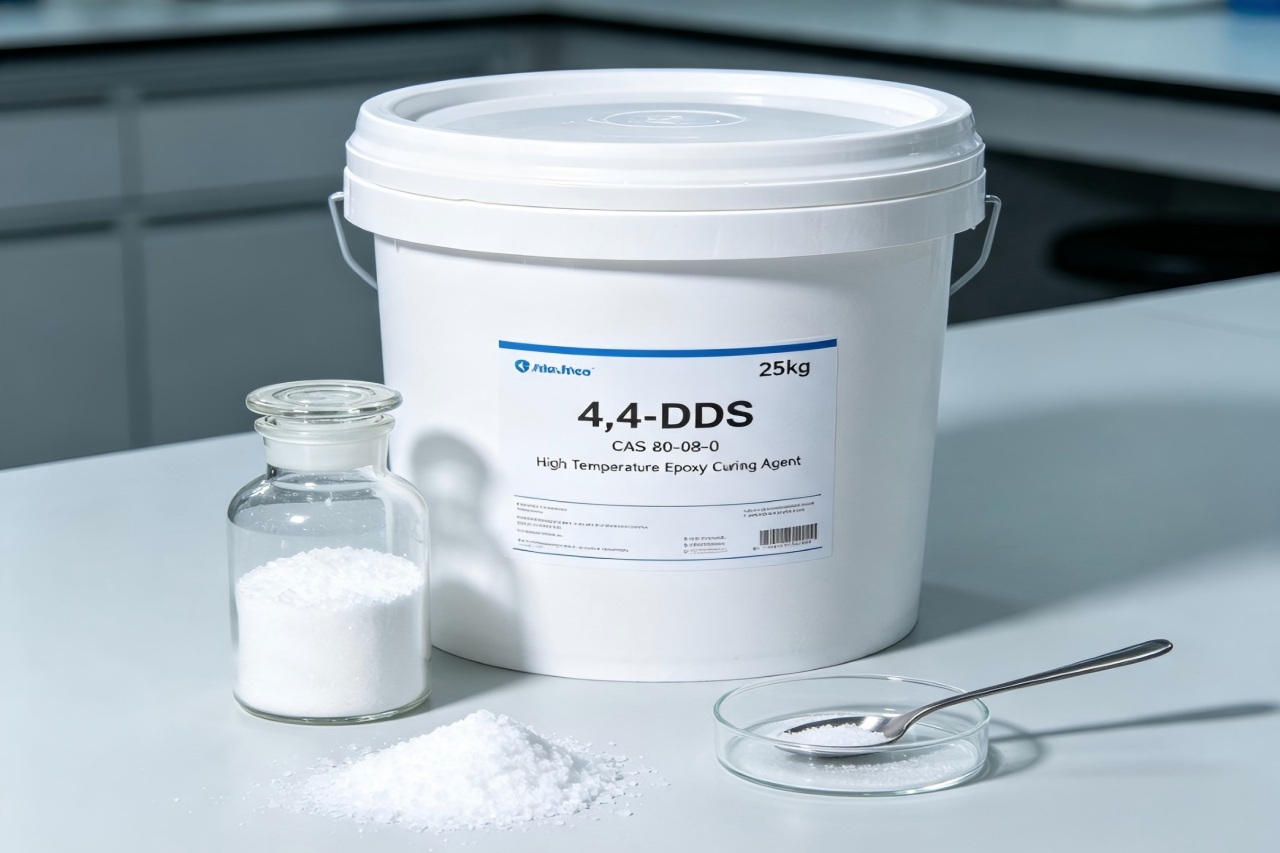
    Two decisions settle most of the outcome in a DDS-cured epoxy: how much hardener goes into the mix, and how the part is heated. Both are calculable before the first trial. In practice, both are often set by habit — a ratio copied from an old formulation sheet, or an oven profile carried over from a different hardener.   DDS dosage is not a number to copy. It is a number to calculate from equivalents, and then adjust on purpose.   4,4'-Diaminodiphenyl sulfone carries four active amine hydrogens on a molar mass of 248.30 g/mol. That gives an amine hydrogen equivalent weight (AHEW) of approximately 62.1 g/eq. Combined with the epoxy equivalent weight (EEW) of your resin, that single constant fixes the stoichiometric dosage. Everything after it — running above or below stoichiometry, adding an accelerator, extending the post-cure — is a deliberate adjustment with a measurable consequence.   From equivalents to grams The calculation is the same one used for every amine hardener: phr = (AHEW ÷ EEW) × 100 phr = parts of hardener per 100 parts of resin, by weight   For a standard liquid DGEBA at 185–190 g/eq — the workhorse laminating resin — this lands at about 33 phr. Published application data for 4,4'-DDS in DGEBA reports 33.4 phr, which is the same figure reached from the other direction.   Resin system Typical EEW (g/eq) Stoichiometric 4,4'-DDS Note Standard liquid DGEBA 185–190 ≈33 phr Matches the 33.4 phr reported in DGEBA/DDS application literature DGEBA / DGEBF blend 170–180 35–37 phr Lower EEW raises the hardener demand Novolac-modified laminate resin 175–200 31–35 phr Calculate on the blend, not on the base resin TGMDA-based aerospace matrix 165–175 effective 35–38 phr TGMDA alone is 111–125 g/eq; the blend is what counts Aminophenol-type multifunctional epoxy 95–110 56–65 phr High functionality means a high hardener demand Stoichiometric values calculated from AHEW 62.1 g/eq. Always confirm against the EEW on the current resin lot certificate.   Figure 1. Stoichiometric 4,4'-DDS dosage as a function of epoxy equivalent weight, calculated from AHEW 62.1 g/eq. Original chart.   The case that trips people up: TGMDA TGMDA — tetraglycidyl methylenedianiline, also written TGDDM and sold as MY-720 or MY-721 — has an EEW of roughly 111–125 g/eq. Read on its own, that suggests a DDS requirement near 50 phr. Aerospace prepreg matrices are not built that way, and the reason is worth understanding.   A widely cited high-performance matrix composition contains four epoxy components and two cure components. The epoxy blend totals 74.0 parts against 25.0 parts of 4,4'-DDS — about 34 phr. Worked back through equivalents, that is roughly 93% of stoichiometry for the blend.   Component wt% Role TGMDA (TGDDM) 56.5 Tetrafunctional base resin; supplies the high crosslink density Alicyclic diepoxy carboxylate 9.0 Viscosity and toughness modifier Epoxy cresol novolac 8.5 Reactivity and heat resistance 4,4'-DDS 25.0 Hardener; ≈34 phr on 74.0 parts of epoxy Boron trifluoride amine complex 1.1 Accelerator Composition as reported for a standard high-performance epoxy matrix system. Percentages are literature values, not a YolaTech formulation.   The lesson is not the number 34. It is that DDS is dosed against the whole epoxy blend, not against the headline resin on the front of the drum.   Running off stoichiometry, on purpose Most production formulations do not sit at a stoichiometric index of 100. A typical working band is 90–105. Moving within that band is a way of trading properties, and it is worth being explicit about the trade.   Running epoxy-rich — index below 100 — generally raises Tg and lowers moisture uptake, because the excess epoxy is consumed in secondary reactions rather than left as unreacted amine. The cost is toughness. Running amine-rich can improve toughness and adhesion, but any amine that stays unreacted acts as a plasticiser inside the network and pulls Tg down. Neither direction is universally correct; both are measurable.   The companion article on this blog looks at a published TGPAP/BPF study where eleven design runs varied blend composition and the amine-to-epoxy ratio. A longer processing window did not automatically produce a higher Tg, and the optimised case settled at 181.2 ± 0.8 °C with a stoichiometric ratio of 0.60. That is a useful reminder that DDS performance belongs to the complete formulation, not to the hardener name.   The cure schedule is a ramp, not a temperature DDS is a latent hardener rather than a fast one. The sulfone bridge withdraws electron density from both amine nitrogens, so reaction onset sits well above room temperature. The practical consequence is useful: the hardener stays effectively inert while the resin is mixed, impregnated or cast, and heat is what starts the cure.   That latency is also why the cure schedule cannot be reduced to one number. Published schedules for DDS systems look like this.   System DDS level Cure schedule DGEBA 30 phr Isothermal at 180 °C DGEBF stoichiometric Ramp from 35 °C to 180 °C at varied rates; hold 3 h at 180 °C TGDDM with mixed DDS isomers 33 phr total 150 °C 2 h → 180 °C 1 h → 210 °C 2 h TMBPBT epoxy 41 phr Varied cure temperatures and times Two-stage industrial practice calculated 130 °C 2 h → 200 °C 2 h Schedules as reported in DDS application literature and supplier application guidance.   Two patterns are worth noting. First, every schedule finishes high — between 180 and 210 °C — because that is where conversion and Tg are won. Second, the staged ramp exists for a physical reason rather than a traditional one. A thick section driven straight to the final temperature can concentrate the exotherm, which shows up as voids and internal stress. Staging lets the gel point arrive before the exotherm peak.   If the final temperature is a hard process limit, an accelerator is the standard route rather than a longer dwell at a lower temperature. BF3-monoethylamine appears at 1.1 phr in the matrix formulation above. Supplier guidance for DDS also describes adding roughly 0.5–1.2% of an acidic accelerator to bring the cure down to about 100 °C for one hour — but the DDS level has to be recalculated when a catalyst is carrying part of the reaction.   What Tg to expect DSC data for DDS-cured epoxy is commonly reported in the 180–210 °C band, against roughly 150–170 °C for an aromatic amine such as m-phenylenediamine in a comparable system. Decomposition onset (Td5%) sits near 363 °C. Optimised matrices in the formulation literature report DDS systems above 250 °C.   Those are system-level values, not constants of the molecule. Resin choice, stoichiometric index, cure schedule and post-cure all move the result. A Tg quoted without the resin and the cure schedule behind it is not a specification; it is a claim.   Where the powder goes matters as much as how much Dosage is only half the job. DDS melts at 175–181 °C, which is above the temperature at which most formulations are mixed. The hardener therefore enters the resin as a solid, and how that solid is distributed decides whether the cured part is uniform.   Three routes are in common use. Powder dispersion. Fine DDS is dispersed in the liquid resin at 80–100 °C and dissolves progressively as the mix heats. The simplest route, and the most dependent on particle size distribution and mixing energy. Solution. DDS is dissolved in hot solvent, or introduced as part of a solvent-borne varnish. The best uniformity, at the cost of a drying step and the solvent question that comes with it. Melt blending. Short residence at 150–170 °C. Fast and uniform, but it consumes the processing time that DDS latency would otherwise give you.   The failure mode to watch for is agglomeration. Clusters of undissolved DDS create hardener-rich and hardener-poor zones at the same time. The hardener-poor zones stay under-cured, and the symptom is deceptive: the part passes a room-temperature test, then shows a low Tg, or a soft core in a thick section, or a scatter of results that cannot be reproduced. Optical microscopy on a cured cross-section is the cheapest way to catch it before it reaches a customer.   Reading an unexpected result When a DDS formulation does not behave, the symptom usually points at one of six causes.   What you observe Most likely cause What to check first Tg below the design target Incomplete conversion Residual exotherm by DSC; extend or raise the post-cure Soft or tacky core in a thick section Agglomerated hardener Cross-section under optical microscopy; particle size distribution Voids or cracking during cure Exotherm concentrated by a direct ramp Ramp rate, section thickness, filler level Powder has turned pink or red Surface oxidation in storage Melting point and assay. A slight tint is cosmetic; deep red or caking is not Same formula, different result between lots Dosage copied instead of calculated EEW on the current resin lot certificate; the phr actually weighed One-part mix gels in storage Accelerator level or storage temperature Storage temperature; accelerator loading; dispersion method   Keep a process log, not just a result What makes a DDS trial reusable is the record behind it. A minimum log for one trial: • Resin identity, current-lot EEW, and the phr actually weighed out • Mixing route, mixing temperature, and how long the DDS was in the resin before use • Processing window observed, and the method used to judge it • Cure and post-cure as actually run, not as planned • Tg by DSC or DMA, with the heating rate stated • The ageing test that matters for the application — heat, moisture, chemical or thermal cycling   A trial without that log produces a result nobody can repeat, including the person who ran it.   YolaTech 4,4'-DDS at a glance   Property TDS value Appearance White crystal powder Purity ≥99.0% Melting point 175–181 °C Loss on drying ≤0.30% CAS number 80-08-0 Theoretical AHEW ≈62.1 g/eq, calculated Primary industrial use High-temperature epoxy curing agent Additional TDS use Material for polysulfone amide and other polymers Storage Cool, dry place; avoid direct sunlight Storage life 12 months in the original sealed container at ambient temperature Packaging 25 kg fiber drum   The formulation is the answer, not the molecule 4,4'-DDS sets a high ceiling. The molecule supplies the rigid aromatic network that makes 180–210 °C service possible. How much of that ceiling a part actually reaches is decided by four things that are all under the formulator's control: the dosage calculated from equivalents, the uniformity of the dispersion, the shape of the cure ramp, and whether a post-cure was run to completion.   If the question is what the molecule does, the companion article on this blog covers the mechanism and the application map. If the question is what to weigh and how to heat it, this is the part that decides the outcome.   Send us the resin type, the EEW on the current lot, the process temperature limit and the section thickness. We will work the dosage and the cure schedule through with you — and tell you when DDS is not the right hardener for the job.
    Read More
  • Built for Heat: What 4,4'-DDS Brings to Epoxy Systems
    Built for Heat: What 4,4'-DDS Brings to Epoxy Systems
    Aug 12, 2026
    A curing agent does not simply harden the resin. It helps decide whether the finished network can keep working when temperature becomes the real test.   When an epoxy component must retain shape, insulation and mechanical integrity at elevated temperature, changing the resin alone may not be enough. The curing agent becomes part of the final structure. That is where 4,4'-DDS earns its place.   4,4'-Diaminodiphenyl sulfone is a crystalline aromatic diamine used in high-temperature epoxy systems. Its rigid sulfone-bridged structure can support a high-Tg, thermally stable network after an appropriate cure. Just as important, its relatively slow reaction at low temperature can leave useful time for mixing, impregnation or casting before heat drives the cure forward.   DDS is not a shortcut to one fixed Tg. It is a route to a high-temperature epoxy network.   Why This Molecule Behaves Differently The molecule contains two primary aromatic amines linked through two phenyl rings and a central sulfone group. The sulfone group withdraws electron density from the amines, reducing their low-temperature reactivity. Once the system is heated and properly cured, the same rigid aromatic framework becomes part of a tightly crosslinked network.     Figure . Structure of 4,4'-DDS Product fact Value Chemical name 4,4'-Diaminodiphenyl sulfone CAS number 80-08-0 Molecular formula C12H12N2O2S Molar mass 248.30 g/mol Theoretical AHEW Approx. 62.1 g/eq; calculated value   The Advantage Comes with a Trade-Off DDS is attractive because it can combine processing time before cure with strong high-temperature potential after cure. The trade-off is clear: it is a solid powder and normally needs controlled dispersion or dissolution, followed by a suitable heat-cure and post-cure program. Incomplete dispersion or insufficient conversion can prevent the formulation from reaching its intended Tg and aged performance.   What Published Test Data Shows A published TGPAP/BPF epoxy study varied blend composition and the amine-to-epoxy ratio while using DDS as the hardener. Across 11 experimental runs, a longer processing window did not automatically produce a higher Tg. The optimized verification result balanced a Tg of 181.2 ± 0.8°C with a processing window of about 140 minutes. This is a literature example, not a YolaTech product test, but it makes the central point visible: DDS performance belongs to the complete formulation.   Original chart based on Junid et al., Polymers 2021, 13, 3304. Design runs n=3. Literature case only . Optimized literature case Predicted Verified Glass-transition temperature 180°C 181.2 ± 0.8°C Processing window 136.1 min ≈140 min   Optimized formulation reported in the study: 55.6 wt.% BPF in the BPF/TGPAP blend and an amine-to-epoxy stoichiometric ratio of 0.60.   Where DDS Makes the Most Sense Composite prepregs and high-temperature laminates In multifunctional epoxy matrices, DDS can provide the controlled processing stage needed for impregnation and layup, followed by a heat-cured network suited to demanding composite service. The finished result still depends on resin flow, fiber wet-out, void control, cure pressure and post-cure - not on the hardener name alone. Electrical insulation and encapsulation Transformers, coils, power modules and related electrical components may need an epoxy system that keeps both insulation and mechanical integrity during heat exposure. DDS is relevant to these formulations when the production process can accommodate an elevated-temperature cure and the finished part is validated for dielectric behavior, thermal cycling and moisture aging. Adhesives, coatings and specialty polymers DDS can also be evaluated in high-temperature structural adhesives, protective coatings and sulfone-containing polymer synthesis. These uses benefit from the same rigid aromatic chemistry, but toughness, adhesion, color and chemical resistance must be balanced in the complete formulation.   What Must Be Clear Before a Trial Resin and ratio. Start with the epoxy type and EEW, then calculate the DDS level from equivalents. Equal-weight substitution for another hardener is not reliable. Processing. Confirm how the powder will be dispersed or dissolved and record the temperature, viscosity and usable processing time. Cure. Use DSC or another suitable method to check reaction onset, conversion and residual cure before fixing the production schedule. Proof. Measure Tg and the properties that matter after heat, moisture, chemicals or thermal cycling. Initial room-temperature strength is only the beginning.   YolaTech 4,4'-DDS at a Glance Property TDS value Appearance White crystal powder Purity ≥99.0% Melting point 175-181°C Loss on drying ≤0.30% Primary industrial use High-temperature epoxy curing agent Additional TDS use Material for polysulfone amide and other polymers Storage Cool, dry place; avoid direct sunlight Storage life 12 months in the original sealed container at ambient temperature Packaging 25 kg fiber drum   The Right Message for DDS DDS is not the first answer for every epoxy. If a process demands very fast ambient cure, another hardener may fit better. When the application can use a controlled heat cure and the finished part must perform at elevated temperature, 4,4'-DDS becomes a strong formulation option.   The most useful customer discussion therefore starts with the target service temperature, resin and EEW, available cure conditions, component geometry and required aging tests. Those details turn the promise of 'high temperature' into a result that can be measured and qualified.
    Read More
  • High-Temperature Epoxy Hardener for Pipeline Coatings: 200°C Thermal Aging Test
    High-Temperature Epoxy Hardener for Pipeline Coatings: 200°C Thermal Aging Test
    Aug 06, 2026
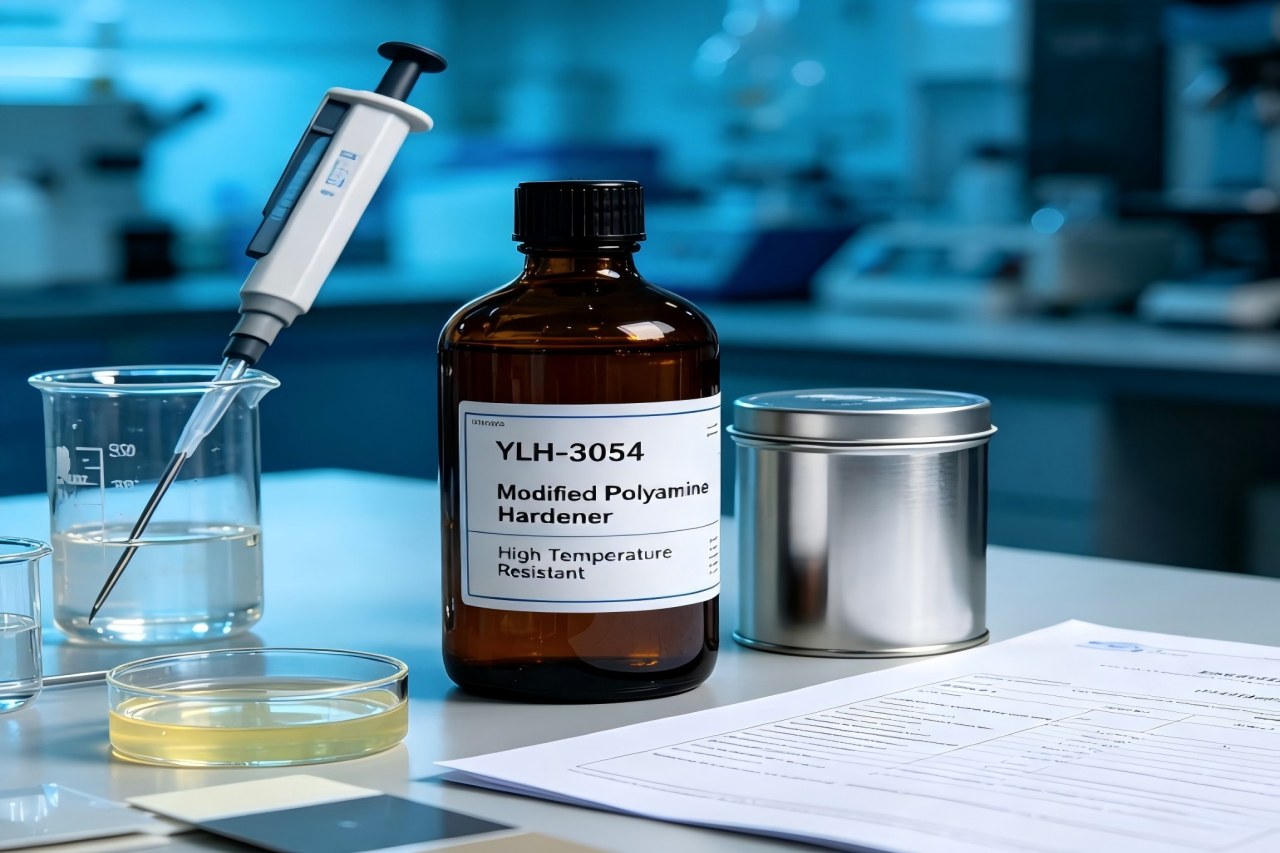
      YLH-3054 is a chemical-resistant epoxy hardener developed for heavy-duty epoxy corrosion protection. This modified polyamine epoxy hardener offers outstanding chemical resistance against most organic acids, alcohols, edible oils, fats, and solvents. Its chemical resistance is further improved when combined with phenolic novolac epoxy resin, supporting epoxy novolac pipeline coating formulations where greater chemical resistance is required.     As a high-temperature epoxy hardener for pipeline coatings and internal linings, YLH-3054 combines chemical resistance, early water resistance, thick-film crack resistance, and high-temperature performance in one epoxy curing system. The evaluation below covers thermal aging at 200°C for 168 h and thermal cycling from 230°C to -60°C. The data are relevant to petroleum pipeline coating development and to the use of this epoxy hardener for steel pipe coating and other high-temperature anticorrosive coating systems.   Advantages for Pipeline Corrosion Protection Chemical-Resistant Epoxy Hardener for Pipeline Corrosion Protection Chemical tank lining; Pipeline internal lining; Heavy-duty steel anti-corrosion primers.   Early Water Resistance and Thick-Film Performance Excellent early water resistance, good flexibility, providing good crack resistance in thick film applications. Cathodic Protection Compatible Coating Systems Excellent compatibility with cathodic protection systems. Suitable for the design of related pipeline corrosion-protection systems. High-Temperature Pipeline Coating Performance After 200°C/168 h exposure and thermal cycling from 230°C to -60°C, the tested system showed no chalking, cracking, or peeling.   Typical Properties Appearance Light yellow liquid Viscosity, mPa.s@25°C 0-100 Amine value, mg KOH/g 280-320 AHEW, g/eq 160 Added Weight, PHR 75-85   To evaluate YLH-3054 as an epoxy curing agent for pipeline coating applications, Formulation A was compared with the control formulation for curing, adhesion, and high-temperature performance. YLH-3054 was added separately as the curing component (Part B) at 20.8 g. The formulation and test results are shown below.     Formulation A (YLH-3054 Curing System) No. Raw Material Amount 1 Xylene 13.5 2 n-Butanol 3.4 3 YLEP-638 23.5 4 Talc 19.8 5 Yellow Iron Oxide 1 6 Barium Sulfate 31.9 7 Titanium Dioxide 6 8 Carbon Black 0.1 9 Ultra 0.8 Hardener YLH-3054 (Part B) 20.8 g   1. BK Drying Item Surface Dry (25°C) Hard Dry (25°C) Formulation A 2h 3h Control Formulation B 1.5 ≥6h At 25°C, Formulation A reached surface dry in 2 h and hard dry in 3 h. The control reached surface dry in 1.5 h but required ≥6 h for hard dry. Although Formulation A was slightly slower to reach surface dry, it completed effective crosslinking much faster.   Figure 1  BK Drying Test   2. Pull-off Adhesion for Pipeline Coatings Item Pull-off Adhesion (Before) / MPa Pull-off Adhesion (After) / MPa Formulation A 23.32  23.03 21.63    18.36 Control Formulation B 7.62   8.22 21.14    21.08 Before heat exposure, pull-off adhesion of Formulation A was 23.32/23.03 MPa, compared with 7.62/8.22 MPa for the control. This shows that Formulation A developed higher initial adhesion under ambient curing conditions. Note: "Before" and "After" refer to before and after baking at 200°C for 168 h. Figure 2  Adhesion Test   3. Thermal Aging Performance at 200°C Item Film Surface Condition After Baking at 200°C for 168 h Formulation A Discoloration observed; no chalking, cracking, or peeling. Control Formulation B Discoloration observed; no chalking, cracking, or peeling. After baking at 200°C for 168 h, both coatings showed discoloration but no chalking, cracking, or peeling, and the coating films remained intact. Figure 3  Thermal Aging Test   4. Thermal Cycling Performance Item Film Surface Condition After 3 Thermal Cycles of 230°C (16 h) and -60°C (8 h) Formulation A Discoloration observed; no chalking, cracking, or peeling. Control Formulation B Discoloration observed; no chalking, cracking, or peeling. After 3 thermal cycles between 230°C (16 h) and -60°C (8 h), both coatings showed discoloration but no chalking, cracking, or peeling, demonstrating stable resistance to thermal cycling. Figure 4  Thermal Cycling Test   5. Conclusion   Comparative results show that the main strengths of Formulation A are faster hard-dry development and earlier adhesion build. Its surface-dry time was 2 h, slightly longer than the control at 1.5 h, but Formulation A reached hard dry in 3 h while the control required ≥6 h. In addition, pull-off adhesion after ambient cure reached 23.32/23.03 MPa for Formulation A, compared with 7.62/8.22 MPa for the control.     After baking at 200°C for 168 h and thermal cycling between 230°C and -60°C, neither coating showed chalking, cracking, or peeling. These results indicate that Formulation A achieved a good balance among curing efficiency, initial adhesion, and coating film integrity under high-temperature conditions.  
    Read More
  • DPTA in Epoxy-Based Ceramic Gelcasting: More Than Simply “Setting the Slurry”
    DPTA in Epoxy-Based Ceramic Gelcasting: More Than Simply “Setting the Slurry”
    Jul 28, 2026
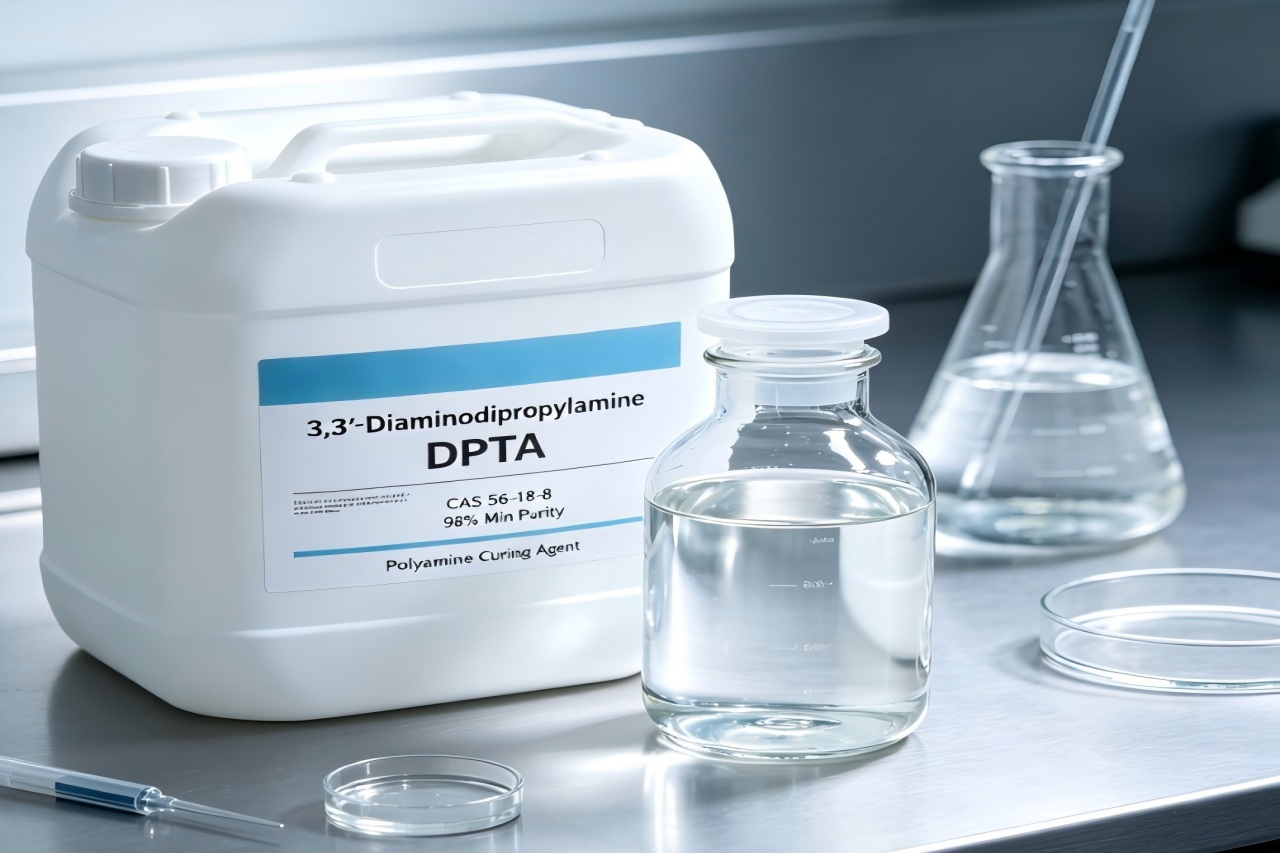
    How 3,3'-Diaminodipropylamine Affects Slurry Rheology, Degassing, Gelation and Green-Body Formation Ceramic gelcasting presents a practical contradiction. Before entering the mold, the slurry must remain low in viscosity, easy to degas, and capable of filling fine details. After filling, it should quickly develop an organic network strong enough to hold the powder particles in place. DPTA is not merely a generic “gelling promoter” in this process; it is a polyamine curing component that directly participates in epoxy ring opening. The real design question is when the viscosity begins to rise significantly and whether the wet green body can pass through demolding and drying without damage. Figure 1. Epoxy-based ceramic gelcasting application schematic   Start with a High-Solids Ceramic Slurry Gelcasting begins with a flowable ceramic suspension. After degassing and mold filling, an in-situ reaction creates an organic network that fixes the powder particles in place. DPTA has been investigated as a hardener in epoxy-based gel systems, including aqueous sorbitol polyglycidyl ether systems and non-aqueous aluminum nitride gelcasting based on hydantoin epoxy resin.   These studies confirm that DPTA can harden an epoxy gelling phase, but their dosage, temperature, and gel time should not be transferred directly to another ceramic powder or resin. Changes in powder surface, solids loading, solvent, dispersant, and epoxy functionality can all alter the induction period and the rate of viscosity build-up. Item Information Chinese Name 3,3'-二氨基二丙胺 English Name 3,3'-Diaminodipropylamine Common Synonyms Bis(3-aminopropyl)amine; Dipropylenetriamine Abbreviation DPTA CAS No. 56-18-8 EC No. 200-261-2 Molecular Formula C₆H₁₇N₃ Molecular Weight 131.22 g/mol Amine Structure Two primary amines and one secondary amine; five N-H active hydrogens in the ideal structure Theoretical AHEW Approx. 26.24 g/eq (calculated for the ideal pure compound; not a guaranteed specification)   Figure 2. Chemical structure of DPTA   How DPTA Turns the Slurry into a Green Body The primary and secondary amine N-H groups in DPTA can attack epoxy groups and open the oxirane ring. As the reaction proceeds, small molecules dispersed in the continuous phase become connected into an organic network, which then fixes the ceramic particles at their existing positions. The aim in gelcasting is not the fastest possible reaction. The induction period must first cover mixing, degassing, and filling, after which sufficient green-body strength should develop inside the mold.   Figure 3. Role of DPTA in epoxy-based ceramic gelcasting The theoretical AHEW is useful only for establishing an initial stoichiometric reference. The effective level in gelcasting is also influenced by epoxy functionality, resin content, solvent, and adsorption at the powder surface. A production-ready formulation cannot be derived from 26.24 g/eq alone.   The Hard Part Is Placing Gelation after Mold Filling Stabilize Rheology before Optimizing Gel Speed A high-solids ceramic slurry may already show shear thinning, settling, or agglomeration. If DPTA is added before dispersion is stable, the subsequent viscosity increase can mask the original problem and may lock agglomerates into the green body. Trials should first establish a repeatable initial viscosity for the powder, resin, and dispersant system before introducing cure as another variable. DPTA Is Normally Added Late in the Sequence Once DPTA is introduced, the processing clock has started. Inadequate mixing can produce localized gelation, while unnecessarily long mixing consumes the mold-filling window. A practical method is to fix the addition order, mixing energy, material temperature, and interval from addition to casting, and then compare whether the viscosity-time curves overlap from batch to batch. Degassing and Filling Must Fit within the Same Window Bubbles can escape only while the material remains sufficiently mobile. Filling corners and fine mold features also requires time. A slurry that has not yet gelled in a cup may already be unable to fill a complex cavity. Evaluation of the DPTA level should therefore include vacuum degassing, transfer, mold filling, and leveling, rather than recording only a static gel point.   Figure 4. Process windows in DPTA-based gelcasting   A Demoldable Green Body Can Still Crack Later A newly demolded green body contains ceramic powder, solvent, and an organic network. If the network is too weak, edges may break during demolding. If local cure is too fast or the drying gradient is too steep, differential shrinkage and cracking may appear later. DPTA evaluation should therefore continue beyond the observation that the slurry has gelled, and include dimensions, appearance, and internal defects after drying. Demolding strength. At the same holding time, compare whether the green body can be removed intact, whether edges shed powder, and whether complex mold features remain complete. Drying uniformity. Record mass change, linear shrinkage, and crack location to distinguish nonuniform gelation, trapped bubbles, and overly rapid drying. Subsequent binder removal. If the part will be sintered, the debinding schedule should reflect the thermal decomposition of the resin and cured network. High green strength does not justify rapid heating during binder removal.   A Practical Small-Scale Evaluation A useful first series keeps the ceramic powder, solids loading, epoxy resin, and dispersant constant, varies only internal incremental levels of DPTA, and includes a blank without DPTA. All samples should use the same mixing, material temperature, degassing, and mold conditions so that changes can be attributed to DPTA rather than slurry-preparation variation. Stage Recommended Records Question to Be Answered Slurry preparation Solids loading, initial viscosity, settling, and agglomeration Is the baseline dispersion stable and the filling behavior repeatable? After DPTA addition Viscosity-time profile and gel time at the selected temperature Does the induction period cover degassing and filling, or does gelation start too early? Inside the mold Leveling, corner filling, bubbles, and gel uniformity Are complex features completely filled without localized early gelation? Wet/dried green body Demolding strength, mass change, shrinkage, cracks, and internal defects Can the network support demolding and remain uniform through drying? Before binder removal TGA or suitable mass-loss/residue assessment when sintering is required Can the organic network be removed smoothly under the proposed schedule?   The most suitable level is usually not the formulation that gels first. It is the one that completes degassing and filling, develops uniform green-body strength within a practical time, and remains low in defects after drying.   When a Different Approach Is Needed If the epoxy resin is incompatible with water or the selected solvent, adding DPTA alone will not prevent phase separation. For large parts, complex cavities, or processes with material-temperature variation, excessive reactivity can also amplify local differences in gelation. In these cases, the resin/solvent system, dispersion process, or a modified curing component should be reconsidered before simply increasing the DPTA level.   DPTA is corrosive and presents significant inhalation and dermal-contact hazards. Laboratory and production handling should follow the latest SDS and use closed handling, ventilation, and appropriate personal protective equipment. Open manual charging should not be treated as routine practice.   DPTA Becomes Useful Only after the Gel Window Is Measured In epoxy-based ceramic gelcasting, DPTA controls the key transition from a flowable slurry to a demoldable wet green body. Its suitability can be judged only when initial rheology, viscosity build-up after addition, gel time, green-body strength, and drying defects are evaluated together, rather than relying on a single gel-time result.   Product specifications, packaging, storage, and safe handling should follow the company’s latest TDS, COA, and SDS. Formulations and performance values reported in research literature are provided only to explain the method and are not guaranteed product values.  
    Read More
  • In PCB Epoxy Potting, the Real Challenge Is Not Simply “Faster Cure”
    In PCB Epoxy Potting, the Real Challenge Is Not Simply “Faster Cure”
    Jul 27, 2026
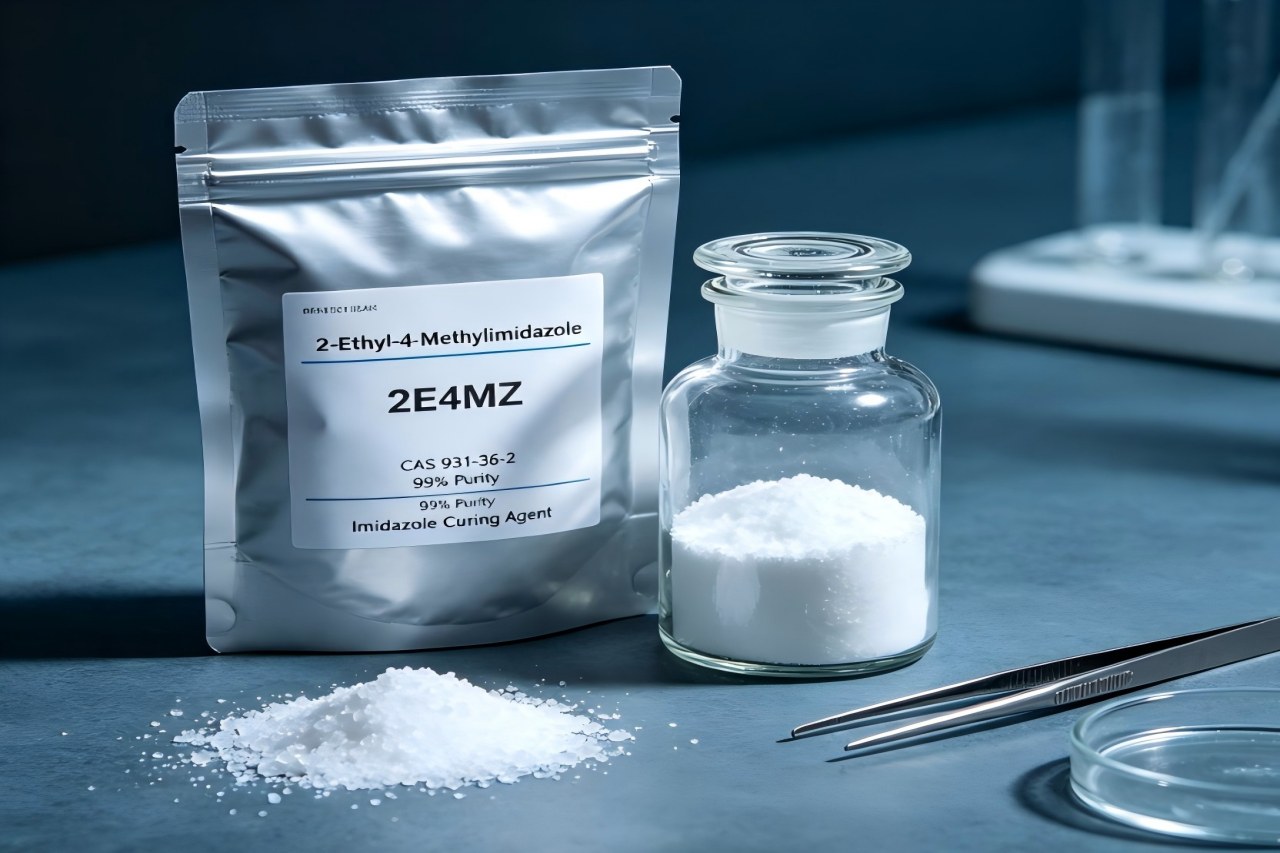
    How 2-Ethyl-4-Methylimidazole Affects the Process Window from Mixing and Degassing to Dispensing and Thermal Cure   Consider a batch of PCB potting assemblies. After mixing, the resin must first undergo vacuum degassing, then flow into narrow gaps around components and circuitry, and finally enter an oven. If the formulation thickens noticeably during degassing, bubbles cannot escape. If it still reacts too slowly after entering the oven, production throughput suffers. In this type of formulation, the role of 2E4MZ is not to make every stage indiscriminately faster. It is to keep the material processable before dispensing and then help the crosslinked network form at the required stage of cure. Figure 1. PCB epoxy potting application Start with the PCB Potting Assembly PCB potting is not simply a matter of pouring resin into a cavity. The material must be mixed and degassed before it can flow around components, solder joints, and narrow gaps. During heating, it should cure as uniformly as possible while avoiding trapped bubbles, localized overheating, and under-cure. In practical terms, the formulation must first remain fluid enough to fill the assembly and then develop a reliable network at the required time.   Public technical literature lists epoxy casting and PCB encapsulation among the relevant applications of 2E4MZ. As a substituted imidazole, it may participate directly in epoxy curing or serve as an accelerator component alongside another curing agent. In PCB potting, this relatively high reactivity can improve curing efficiency, but it is also the variable that requires the closest control. Item Information Chinese Name 2-乙基-4-甲基咪唑 English Name 2-Ethyl-4-Methylimidazole Abbreviation 2E4MZ CAS No. 931-36-2 EC No. 213-234-5 Molecular Formula C₆H₁₀N₂ Molecular Weight 110.16 g/mol Role Discussed in This Article Curing agent or curing accelerator component in PCB epoxy potting systems   Figure 2. Chemical structure of 2-Ethyl-4-Methylimidazole (2E4MZ)   What Does 2E4MZ Actually Do in This System? In a typical epoxy-imidazole system, the cure can be understood as two connected stages. Initially, 2E4MZ contacts the epoxy groups and forms a reactive epoxy-imidazole adduct. The resulting active centers then continue to promote epoxy ring-opening polymerization, allowing a crosslinked network to develop progressively. DSC studies in the literature likewise describe the process in terms of an initial addition reaction followed by catalytic polymerization. Figure 3. Two-stage role of 2E4MZ in an epoxy system A commonly overlooked point is that 2E4MZ does not begin to matter only after the formulation enters the oven. Once it is in effective contact with the epoxy system, temperature, concentration, and mixing time can all affect the subsequent viscosity increase. The point of addition and the hold time after addition are therefore part of the process conditions.、   The Real Challenge Is to Place the Reaction at the Right Time Before Degassing: Establish Uniform Distribution If 2E4MZ reaches a locally high concentration, the formulation may begin to thicken in that area first. Further mixing may not fully restore uniformity once the reaction has advanced. In practice, the resin and filler should first be made homogeneous. 2E4MZ and the other curing components can then be introduced in the established order. After addition, the system must be mixed sufficiently, but unnecessary holding time should be avoided. Vacuum Degassing: More Than Simply Applying Vacuum Successful degassing depends on giving bubbles enough time to rise through the material and collapse. If 2E4MZ causes viscosity to increase rapidly during this stage, bubbles can remain trapped even when the same vacuum level is used. Small-scale trials should therefore record viscosity and residual bubbles before and after degassing, rather than only the vacuum time. Dispensing and Leveling: the Window Must Cover the Entire Operation A PCB contains components of different heights and numerous fine gaps. The material needs time to dispense and spread throughout the assembly. The pot life (usable working time) must cover mixing, transfer, degassing, dispensing, and leveling, rather than being judged only by the point at which a sample gels in a cup. A cup sample that still appears fluid may already be too viscous to penetrate the narrow clearances in an actual assembly. Figure 4. Process windows during PCB potting During Thermal Cure, Hardness Alone Is Not Enough Once heating begins, the relatively high reactivity of 2E4MZ can help the formulation develop a crosslinked network. Surface hardness, however, does not prove that the interior has cured completely. Changes in section thickness and filler loading, together with differences in heat transfer through the mold and PCB, may expose different parts of the same assembly to different temperature histories.   First, examine the exotherm. In a large potting volume, reaction heat may not dissipate quickly, so the internal temperature can exceed the oven setpoint. Increasing the 2E4MZ level or using an overly aggressive heating ramp can narrow the safe process window further. Thin samples and specimens approaching the actual potting thickness should therefore be evaluated separately.   Next, examine the degree of cure. DSC residual exotherm, glass transition temperature (Tg), and application-relevant properties should be considered together. If a cured sample still shows a pronounced residual exotherm, the current cure schedule may not have completed the intended reaction.   Finally, examine service requirements. PCB encapsulants may also be expected to withstand thermal cycling, moisture, and electrical insulation demands. 2E4MZ addresses only one part of the cure chemistry. The final result also depends on resin structure, filler, toughening components, interfacial treatment, and the complete cure schedule.   A Practical Small-Scale Evaluation Method When comparing 2E4MZ levels, it is better not to begin by searching for a supposedly universal optimum dosage. A more reliable approach is to include a blank control and select low, medium, and high incremental levels internally, while keeping the resin, filler, and mixing conditions unchanged. These increments should be established from the company’s TDS, the existing formulation, and the target process; a single value taken from the internet should not be applied directly. Stage Recommended Records Question to Be Answered Mixing Initial appearance, dispersion, initial viscosity at 25°C, and viscosity-time profile Can 2E4MZ be distributed uniformly, and does the formulation thicken prematurely? Degassing and dispensing Degassing time, residual bubbles, leveling, and gap-filling behavior Is the process window long enough, and can bubbles escape before gelation? Thermal cure Gel time, DSC onset/peak temperatures, exotherm, and residual cure reaction Is the reaction excessively concentrated, and can the current heating schedule complete the cure? After cure Tg, hardness or adhesion, electrical properties, water absorption, and cross-sectional defects Is the part fully cured rather than merely hard at the surface?   The preferred result is not necessarily the formulation that becomes hard first. It is the formulation that retains sufficient margin during degassing and dispensing, completes the cure under the established heating schedule, and meets the final electrical and reliability requirements. For PCB potting, this balance is generally more valuable than simply pursuing the shortest gel time.   When Free 2E4MZ May Not Be the Right Choice If a product must be supplied as a one-component formulation with long room-temperature storage, free, non-latent 2E4MZ requires careful evaluation. Direct contact with the epoxy resin can shorten storage life and cause viscosity build-up. Depending on the system, latency may be introduced through adduct formation, salt formation, complexation, or microencapsulation. Each approach can also change activation temperature, dissolution or dispersion behavior, and final cure response, so the process data must be established again.   Likewise, directly increasing the 2E4MZ level is not a robust way to accelerate cure when the potting volume is large, filler loading is high, or the equipment cannot control the heating profile accurately. It is usually more effective to confirm the actual material temperature, viscosity change, and exotherm first, and then decide whether to adjust the dosage or the heating schedule.   Using 2E4MZ Well Starts with Measuring the Process Window In PCB epoxy potting, the value of 2E4MZ goes beyond “fast cure.” It affects the timing of the whole process: when viscosity begins to rise, whether the material can be degassed and fill the assembly, how heat is released during cure, and whether the final network is complete. When these stages are recorded in the same sequence as actual production, 2E4MZ can be managed not simply as a highly reactive raw material, but as a controllable formulation tool.   Product specifications, packaging, storage, and safe handling should follow the company’s latest TDS, COA, and SDS. The formulation and cure schedule must be verified for the specific epoxy resin, filler, potting thickness, and processing equipment.  
    Read More
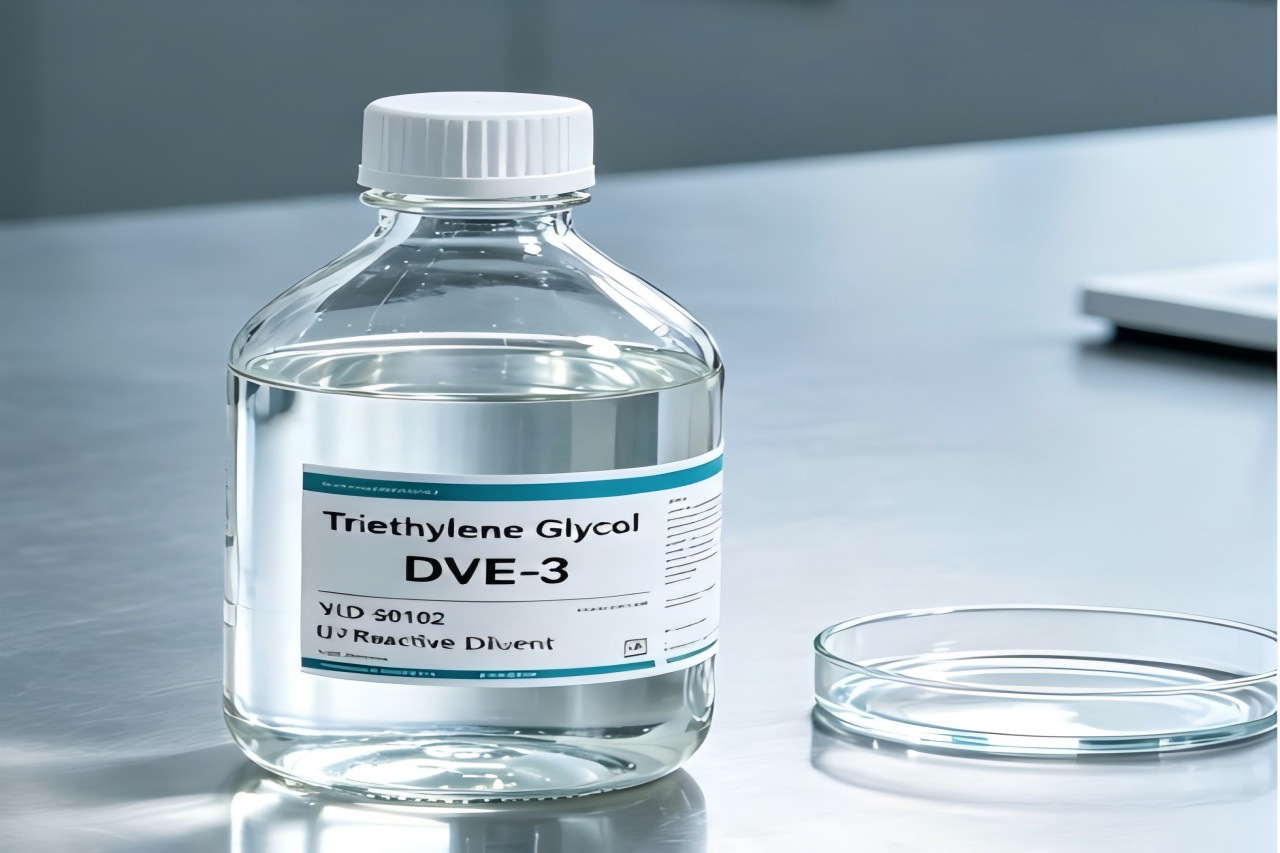
  • YLD-S0102 DVE-3: Low Volatility Vinyl Ether for UV Curing Formulas
    YLD-S0102 DVE-3: Low Volatility Vinyl Ether for UV Curing Formulas
    Jul 23, 2026
    Product Name: Triethylene Glycol Divinyl Ether Product Code: YLD-S0102 CAS No.: 765-12-8 Product Category: Active Diluent / Di-functional Vinyl Ether Monomer   1. Product Information Item Information Product Name Triethylene Glycol Divinyl Ether Other Names DVE-3;tri(ethylene glycol) divinyl ether;DIVINYL TRIETHYLENE GLYCOL DIETHER Product Code YLD-S0102 CAS No. 765-12-8 Molecular Formula C10H18O4 Molecular Weight 202.25 g/mol Category Low-volatility, low-viscosity di-functional vinyl ether monomer   2. Product Description YLD-S0102, Triethylene glycol divinyl ether, is a colorless to pale yellow liquid with low volatility. It is soluble in water and common organic solvents. With vinyl ether reactivity and flexible triethylene glycol ether chains, it can be used in light-curing, UV-curing adhesives, sealants, resins, coatings, spray paints and adhesive systems. As a reactive diluent or crosslinking monomer, it helps adjust formulation viscosity and participate in curing or crosslinking reactions.   3. Structure Features and Key Advantages 1. Di-functional vinyl ether structure YLD-S0102 contains two vinyl ether reactive groups and can participate in crosslinking reactions in relevant curing systems. 2. Low volatility and low viscosity The product has low volatility and is suitable for formulation systems requiring processing stability. It can also help reduce system viscosity and improve mixing, flow and processing operation. 3. Good system compatibility The flexible triethylene glycol ether chains support flexibility and compatibility in material systems. The product is soluble in water and common organic solvents, which makes it suitable for formulation development in resin, coating, sealant and adhesive systems.   4. Typical Properties Item Typical Value Appearance Colorless or light yellow liquid DVE-3 Content, % ≥98.0 Boiling Point, °C 120-126 Density, g/mL @25 °C 0.99 Moisture Content, % ≤0.20   Note: The above data are from Typical Properties in the company TDS. Final delivery specifications shall be subject to the company TDS / COA.   5. Features Feature Description Low volatility Helps reduce volatilization loss during use and is suitable for systems requiring processing stability. Reactive dilution Can reduce system viscosity while participating in the curing process, helping reduce the performance impact of inert diluents. Crosslinking ability The di-functional vinyl ether structure can participate in crosslinked network formation and is suitable for crosslinking agent and reactive monomer applications. System compatibility Soluble in water and common organic solvents, supporting formulation adjustment in coatings, adhesives, sealants and resin systems.   6. Applications 1. Light-curing and UV-curing systems YLD-S0102 can be used as a reactive diluent monomer in light-curing or UV-curing adhesives, sealants and coating systems to adjust formulation viscosity and participate in curing or crosslinking reactions. 2. Cross-linking agent With its di-functional vinyl ether structure, the product can be used as a crosslinking monomer in relevant polymer systems. The TDS mentions its use as a crosslinker in the production of polyacrylate ion exchange resins. 3. Sulfur based sealant YLD-S0102 can be used as a component in sulfur-based sealant compounds. Dosage and final performance should be confirmed by formulation testing. 4. Industrial systems such as coatings, resins and adhesives Due to its low volatility and solubility in water and common organic solvents, it can also be used in fibers, resins, coatings, spray paints and adhesives, mainly as a solvent, reactive diluent or modifier.   7. Storage, Packaging & Safety Item Information Packaging Drums;IBC tanks Storage temperature 5-30°C Storage & Handling Avoid direct sunlight and place in a cool and dry place. Avoid strong oxidants and acids. Storage Life 12 months from the date of manufacture in the original packing in ambient temperatures. Safety All safety information is provided in the Material Safety Data Sheet.  
    Read More
  • YLD-S0101: Low Viscosity Vinyl Ether Active Diluent for UV Curing Formulas
    YLD-S0101: Low Viscosity Vinyl Ether Active Diluent for UV Curing Formulas
    Jul 23, 2026
    Product Name: Diethylene Glycol Divinyl Ether Product Code: YLD-S0101 CAS No.: 764-99-8 Product Category: Active Diluent / Di-functional Vinyl Ether Monomer Chemical Structure   1. Product Information Item Information Product Name Diethylene Glycol Divinyl Ether Product Code YLD-S0101 Chemical Name 1-(2-[2-(Vinyloxy)ethoxy]ethoxy)ethylene, 1,1-[oxybis(2,1-ethanediyloxy)bis]ethene CAS No. 764-99-8 Molecular Formula C8H14O3 Molecular Weight 158.20 g/mol Category Low-viscosity, highly reactive di-functional vinyl ether monomer     2. Product Description YLD-S0101 is a low-viscosity, highly reactive di-functional vinyl ether monomer. The double bonds in its molecular structure give it rapid curing properties, while the flexible ether chains significantly improve the flexibility and hydrophilicity of the material. It can be used as an active diluent, cross-linking monomer or modifier and is widely applied in light-curing, UV-curing systems, coatings and adhesives to regulate the viscosity of the system and enhance the comprehensive performance of the cured product.   3. Structure Features and Key Advantages 1. Di-functional vinyl ether structure YLD-S0101 contains vinyl ether reactive groups and can be used in light-curing and UV-curing systems to support rapid curing. 2. Low viscosity and good diluting effect The company TDS lists Low viscosity and good diluting effect as key features, which support viscosity adjustment and processing performance in formulation systems. 3. Flexible ether chains The flexible ether chains help improve flexibility and hydrophilicity of the cured material, making it suitable for formulations requiring reactivity, flexibility and processability.   4. Typical Properties Item Typical Value Appearance Colorless transparent liquid Color, APHA ≤50 Purity, % ≥99.0 Water, % ≤0.5   Note: The above data are from Typical Properties in the company TDS. Final delivery specifications shall be subject to the company TDS / COA.   5. Features Feature Description Low viscosity Helps reduce system viscosity and improve flow, mixing and processing performance. Excellent reactivity The di-functional vinyl ether structure can participate in light-curing / UV-curing reactions and supports rapid curing. Good flexibility The flexible ether chains help improve the flexibility and overall performance of the cured product. Good diluting effect Can be used as an active diluent to adjust viscosity while participating in the curing reaction.   6. Applications 1. UV-curable coatings YLD-S0101 can be used in UV-curable coatings as an active diluent or cross-linking monomer for formulation development. 2. Electronic encapsulation materials YLD-S0101 can be used in Electronic encapsulation materials. Final suitability should be confirmed by end-use formulation testing. 3. Adhesives YLD-S0101 can be used in Adhesives to regulate system viscosity and enhance the comprehensive performance of the cured product. 4. Active diluent / cross-linking monomer / modifier YLD-S0101 can be used in light-curing and UV-curing systems to regulate viscosity, participate in cross-linking and improve cured material performance.   7. Storage, Packaging & Safety Item Information Packaging Drums Storage & Handling Storage in a cool and dry place. Avoid direct sunlight. Storage Life 12 months from the date of manufacture in the original sealed container at ambient temperature. Safety All safety information is provided in the Material Safety Data Sheet.   Note: This document is prepared for product information database use. Product parameters, features, applications and storage information are mainly based on the company TDS. For external use, the official TDS, MSDS, COA and contract terms shall prevail.
    Read More
  • Moisture Absorbent 2-MI for Industrial Epoxy Resin Systems
    Moisture Absorbent 2-MI for Industrial Epoxy Resin Systems
    Jul 22, 2026
    Product Name: 2-METHYLIMIDAZOLE Product Code: 2-MI CAS No.: 693-98-1 Product Category: Methyl-substituted imidazole compound     1. Product Information Item Information Product Name 2-METHYLIMIDAZOLE Chemical Name 2-Methyl-1H-imidazole;2-MI Product Code 2-MI CAS No. 693-98-1 Molecular Formula C4H6N2 Molecular Weight 82.10 g/mol Category Methyl-substituted imidazole compound   2. Product Description 2-MI is a methyl-substituted imidazole compound. According to the company TDS, it is white to off-white crystalline powder, soluble in water, alcohol, and acetone. The product is moisture absorbent. 2-MI can be used as Epoxy curing agent and Pharm intermediate. In epoxy resin systems, imidazole compounds are commonly used for curing or curing promotion. Final suitability should be confirmed by testing in the target formulation.   3. Structure Features and Performance Notes 1. Methylimidazole structure 2-MI contains an imidazole ring and a methyl substituent. This structure supports its application in epoxy curing-related systems. 2. Crystalline powder form The TDS describes the product as white to off-white crystalline powder and states that it is soluble in water, alcohol, and acetone. 3. Moisture absorbent The TDS states that the product is moisture absorbent. Therefore, storage and handling should avoid prolonged exposure to humid conditions.   4. Typical Properties Item Typical Value Appearance White to off-white crystalline powder Purity, % ≥99.0 Water, % ≤0.5   Note: The above data are from Typical Properties in the company TDS. Final delivery specifications shall be subject to the company TDS / COA.   5. Applications 1. Epoxy curing agent The company TDS lists Epoxy curing agent under Applications. Dosage and curing performance should be confirmed by testing in the final formulation. 2. Pharm intermediate The company TDS lists Pharm intermediate under Applications. Final use should be confirmed based on the specific synthesis route and customer application requirements. 3. Epoxy system applications 2-MI can be used as a related component in epoxy systems where imidazole compounds are required for curing reaction adjustment.   6. Storage, Packaging & Safety Item Information Packaging Drums Storage & Handling Store in a cool, ventilated warehouse, preferably in a well-sealed original container. Storage Life At least 12 months from the date of manufacture in the original packing in ambient temperatures. Handling Protection Contact of eyes and skin with this resin should be avoided, and it is recommended to wear a gas mask and gloves. Wear goggles or face shield when any splashes or droplets are possible. Safety All safety information is provided in the Material Safety Data Sheet.     7. Notice This document is prepared for product information database use. Product name, CAS No., typical properties, applications, storage and packaging information are mainly based on the company TDS. Molecular formula and molecular weight are cross-checked with public chemical databases. For external use, the official TDS, MSDS, COA and contract terms shall prevail.
    Read More
  • MPMD: Ideal Aliphatic Diamine for Polyurea & Hot Melt Adhesive Formulations
    MPMD: Ideal Aliphatic Diamine for Polyurea & Hot Melt Adhesive Formulations
    Jul 21, 2026
    Product Name: 2-METHYL-1,5-PENTANEDIAMINE Product Code: MPMD CAS No.: 15520-10-2 Product Category: Aliphatic Diamine / Amine Intermediate 1. Product Information Item Information Chemical Name 2-METHYL-1,5-PENTANEDIAMINE Product Code MPMD Other Names 1,5-DIAMINO-2-METHYLPENTANE;2-Methylpentamethylenediamine;1,5-Pentanediamine, 2-Methyl CAS No. 15520-10-2 Molecular Formula C6H16N2 Molecular Weight 116.20 g/mol Category Aliphatic diamine compound     2. Product Description MPMD is an aliphatic diamine compound containing two primary amine functional groups. According to the company TDS, MPMD has unique properties such as low viscosity, high elasticity and good compatibility. It can be used in coatings, polyurethane, polyurea, hot melt adhesives, high performance polyamides, neutralizing or buffering agents and metalworking fluids. Using dibasic acids, high molecular weight polyamine polymers and copolymers are generated. Compared with polymers and copolymers prepared using hexamethylenediamine compounds, these compounds have low melting points and low crystallinity.   3. Structure Features and Key Advantages 1. Two primary amine functional groups MPMD contains two primary amine functional groups. According to the TDS, the two primary amine functional groups have different reactivity, which supports formulation design and reaction rate adjustment. 2. Low viscosity and good compatibility MPMD provides low viscosity and good compatibility, which helps improve mixing, flow and processing operation in resin systems. Application performance should be confirmed by testing in the final formulation. 3. Elasticity improvement According to the TDS, MPMD can improve the elasticity of polyamine hot melt adhesives and extend their air exposure time. The epoxy resin curing agent produced with 2-methylpentanediamine has a low adduct viscosity and can promote the improvement of resin formulation through its elasticity.   4. Typical Properties Item Typical Value Appearance Colorless liquid Color (APHA) ≤2 Purity, wt% ≥99.0 Other diamines content, wt% ≤1.0 Specific Gravity, 25 °C 0.86 Moisture Content, wt% ≤0.50   Note: The above data are from Typical Properties in the company TDS. Final delivery specifications shall be subject to the company TDS / COA.   5. Applications 1. Industrial and Marine coatings MPMD can be used in Industrial and Marine coatings. The dosage, curing behavior and coating performance should be confirmed by formulation testing. 2. Decorative coatings MPMD can be used in Decorative coatings as an amine component for formulation development. 3. Low-temperature curative, Accelerator MPMD can be used as a Low-temperature curative or Accelerator in systems requiring low-temperature curing or improved curing efficiency. 4. Polyurethane and Polyurea MPMD can be applied in Polyurethane and Polyurea systems. Final suitability should be confirmed by formulation and process testing. 5. Hot melt adhesives and High performance polyamides MPMD can be used in Hot melt adhesives and High performance polyamides. The TDS states that it can improve the elasticity of polyamine hot melt adhesives and extend their air exposure time. 6. Neutralizing or buffering agent; Metalworking fluids MPMD can also be used as a Neutralizing or buffering agent and in Metalworking fluids. Final suitability should be confirmed by application testing.   6. Storage, Packaging & Safety Item Information Packaging Drums;IBC tanks Storage temperature 5-30°C Storage & Handling Avoid direct sunlight and place in a cool and dry place, Avoid strong oxidants, acids. Storage Life 12 months from the date of manufacture in the original packing in ambient temperatures. Safety All safety information is provided in the Material Safety Data Sheet.   7. Notice This document is prepared for product information database use. Product parameters and application information are mainly based on the company TDS. Molecular formula and molecular weight are cross-checked with public chemical databases. For external use, the official TDS, MSDS, COA and contract terms shall prevail.
    Read More
1 2 3 4 5 6 7 8 9
A total of9pages

leave a message

leave a message
If you are interested in our products and want to know more details,please leave a message here,we will reply you as soon as we can.
submit

home

products

WhatsApp

Contact Us